Economy · Chart
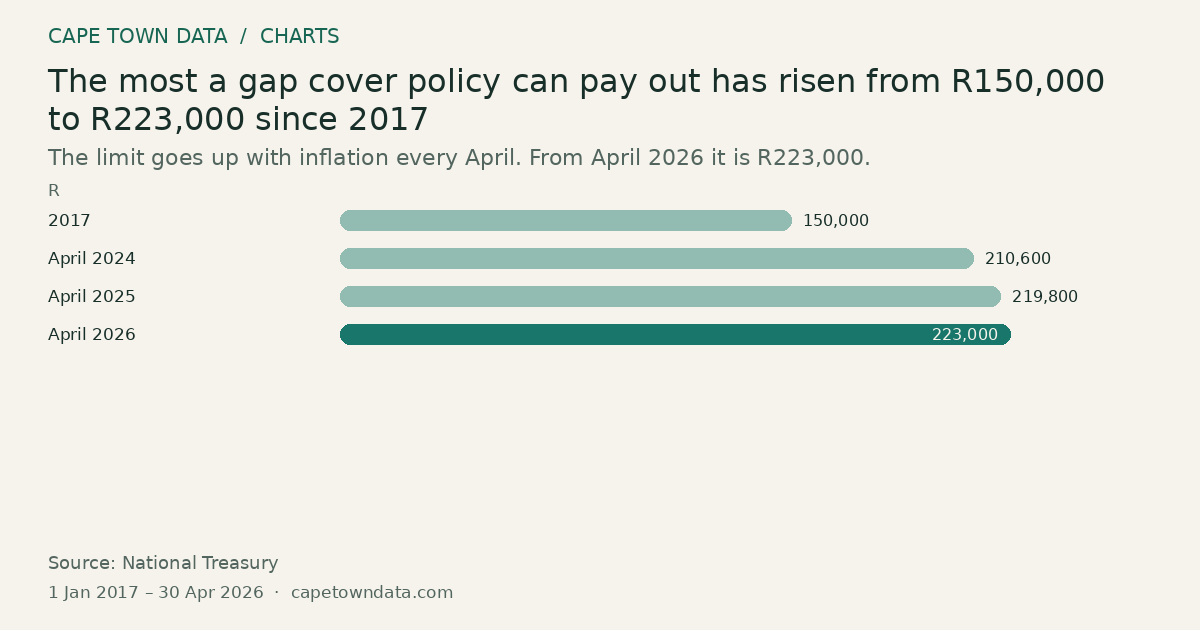
The most a gap cover policy can pay out has risen from R150,000 to R223,000 since 2017
223,000R April 2026 · Highest
The limit goes up with inflation every April. From April 2026 it is R223,000.
 From our storiesWhich health cover should you choose in Cape Town? A data-driven 2026 guideRead the full story →
Method and sources
Each bar is the regulated maximum a gap cover policy may pay per person per year, in rand, as reported in the article.
2017: R150,000, shown in the article as R150k and described as the original demarcation cap. April 2024: R210,600, shown as R210.6k. April 2025: R219,800, shown as R219.8k. April 2026: R223,000, shown as R223k.
The article gives 2017 as a year without a month, so the period runs from 1 January 2017 to 30 April 2026, the month the latest limit takes effect.
Sources: National Treasury Demarcation Regulations annual limits (https://www.treasury.gov.za/)
Figures as published in our article on choosing health cover in Cape Town (chart last checked 14 September 2026): National Treasury Demarcation Regulations annual gap cover limits. The link is to the publisher, not the exact table.
Chart updated · 14 Sep 2026. The observation dates above describe the data, not today’s conditions.
Related charts
The Western Cape took 360,347 of South Africa's 404,712 net new jobs in five years
360,347net new jobs Western Cape · Highest
Select a bar to inspect its value.
Nine in every ten of the country’s extra jobs were in one province, which has about an eighth of the population.
Source: Statistics South Africa · All bars start at zero
Hospitals and specialists take almost two thirds of medical scheme benefits
36% Hospitals · Highest
Select a bar to inspect its value.
Hospitals took 36% and specialists 28%. Together that is almost two thirds of all the money paid out.
Source: Council for Medical Schemes · All bars start at zero
South Africa pays film makers back 20% to 30% of what they spend here
30% Production plus R15m post-production · Highest
Select a bar to inspect its value.
Doing R15 million of editing and effects work locally raises the rebate from 25% to 30%. On a big production that can decide where the work is done.
Source: Department of Trade, Industry and Competition · All bars start at zero