What Is South Africa's New Traveller Declaration?
July 1, 2026
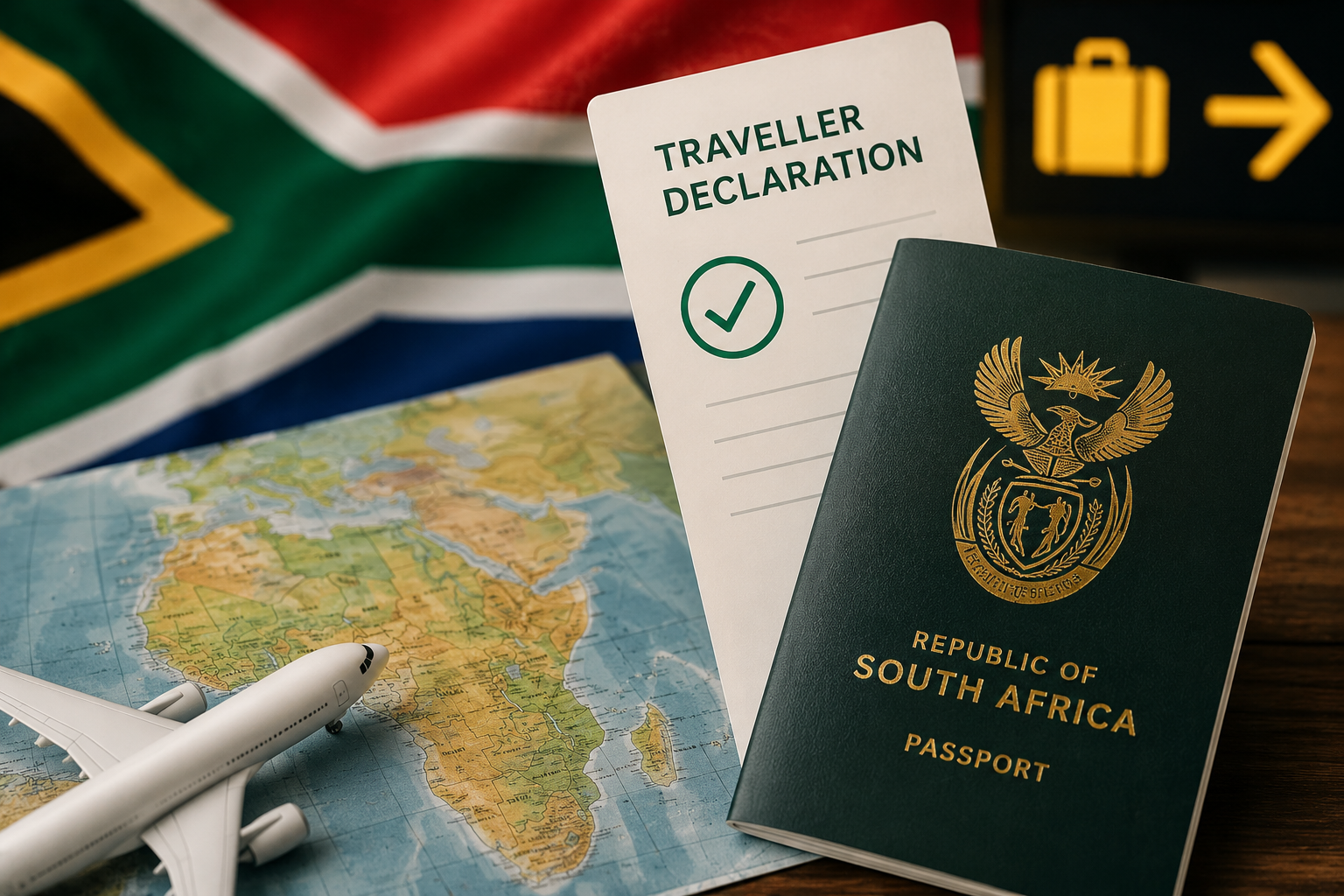
What Is South Africa's New Traveller Declaration?
From today, 1 July 2026, everyone who enters or leaves South Africa has to fill in a short customs form online before they travel. It is free and takes a few minutes. This guide explains, in plain terms, what the form is, who needs it, what you can bring in, and how to do it.
If you read nothing else, read these six points.
- New ruleFill in the form online before you travel. From 1 July 2026 it is required for everyone crossing the border. It used to be optional.
- Do it up to 24 hours before you leave. Use the SARS website, the SATMS app, the SARS MobiApp, a QR code, or a kiosk at the airport or border. It is free.
- One form per person. An adult fills one in for each child.
- Keep the email you get back. It has a reference number. Save it on your phone or print it.
- Only declare extra things. You do not list normal clothes and personal items. You do declare goods worth more than the limits, and cash over R100,000.
- Just passing through? You skip it. If you stay in the transit area and do not enter the country, you do not need one.
What changed on 1 July
The form is not new. SARS, the country's tax and customs service, started testing it in 2022 at three airports: Cape Town, Johannesburg and Durban. Over time it reached every airport, land border and harbour. What changed on 1 July 2026 is simple: filling it in is now the rule, not a choice.
There is a law behind it. SARS changed the customs rules so the online form is now the main way to declare. The old paper forms are gone, replaced by two new ones: a traveller form and, if you have something to declare, a goods form. You can still use paper, but only if the system is down or there is no internet.
The form also feeds a shared government system that checks for risks, such as money laundering. For most people, though, it is just one more quick step before a trip, a bit like an online visa.
Who needs to do it
Almost everyone who crosses the border. That means South Africans, people who live here, and visitors. It covers both arriving and leaving, by plane, car, boat or train. An adult fills in a form for each child, or for anyone who cannot do their own. So a family of four sends four forms.
The main exception is people just passing through. If you change planes and stay in the transit area without entering the country, you do not need one.
Cape Town airport alone had a record 11.1 million passengers in 2025. Of those, 3.3 million crossed an international border, so they are the ones this form is for. Add Johannesburg, Durban and every road crossing, and the form will be filled in tens of millions of times a year.
How to do it
The steps are quick. Use whichever way suits you: the SARS website, the SATMS app from the Google, Huawei or Apple stores, the SARS MobiApp, a scan-to-declare QR code, or a self-service kiosk at the port.
Start your form
Open the system and say you are entering or leaving South Africa. Do it no more than 24 hours before you go.
Fill in your details
Add your information and say whether you are carrying anything you need to declare. One form per traveller, each with an email address.
Add goods, if any
If you have goods over the limit, or cash to declare, list them with their values. For cash, say where it came from and why.
Save the email
You get an email with a reference number. Keep it on your phone or print it.
Pick the right channel
Nothing to declare: take the green channel. Something to declare: take the red one.
What you need on hand
- Your passport
- Your travel dates and flights or crossing
- An email address for each person
- Details of anyone you fill in for
- Company details if you travel for work
It is free
SARS says the form is free, and so is the permit that foreign cars now need. If a website or agent asks you to pay to file a South African traveller form, do not trust it.
What you can bring in
Filling in the form does not mean paying. Most people pay nothing, because normal belongings and small buys are under the limits. The amounts below are per person. You cannot share them, and you get them once every 30 days if you were away for at least 48 hours.
Read it from the left. The first R5,000 of new or used goods is free, with no duty and no VAT. From R5,000 to R25,000 you can pay a flat 20 percent, with no VAT, on up to R20,000 more. Above R25,000, normal duty plus 15 percent VAT applies to the whole value. If you drive in from Botswana, Lesotho, Namibia or Eswatini, your free limit is higher, at R25,000.
Drinks, tobacco and perfume
These are separate from the goods limit, and only for travellers over 18. Go over, and you pay tax on the extra.
Alcohol
Up to 2 litres of wine plus 1 litre of spirits, per person over 18.
Tobacco
Plus up to 250g of tobacco. Not for under-18s.
Perfume
Up to 50ml of perfume and 250ml of eau de toilette.
Medicine
Your own medicine is fine. Bring the prescription for larger amounts.
One catch: the free limit still counts even if you buy at a duty-free shop when you land. And when you leave, you can register things like a laptop or camera, so no one questions them when you come back.
MoneyCash rules
Money is where people slip up, because it has its own limits. You must declare cash, and things like traveller's cheques, if you carry more than R100,000, or the same value in another currency. This is shared with the financial-crime unit, and the form asks where the money came from and why.
A second, separate limit
Do not mix this up with the rand limit. You may carry at most R25,000 in South African banknotes across the border. Foreign cash should be declared if it takes you over the limit. When unsure, just declare it. It is free, and it keeps you safe.
Foreign cars
If you drive in, there is a matching rule that started a bit earlier, on 1 June 2026. Every foreign car must be listed on the same system and given a Temporary Import Permit at the border. This is true even for cars from nearby countries in the same customs union, because a car registered abroad still counts as foreign.
The rollout was big. Nearly 39,000 foreign cars were signed up, with more than 38,900 permits given out by the start. Like the traveller form, the permit is free. List your car, get a reference number, and show it at the border.
What if you don't
There is good news and a warning. The good news: SARS says you will not be turned away just for not filling in the form early. Staff and kiosks can help you at the border, and paper is allowed if the system is down.
The warning: declaring honestly is the law, not a favour. If you hide goods or cash, or lie on the form, you can face delays, lose the goods, pay fines, or worse, under customs law. The safe habit is simple: if you are not sure, declare it and let the officer decide.
Common questions
Yes. From 1 July 2026 every traveller must fill it in before crossing the border, unless the system is down and you use paper. The test period that started in 2022 is over.
No. It is only for crossing the border. A flight from Cape Town to Johannesburg does not need one.
Yes, one per child. An adult fills it in for them.
Yes, but you do not list normal items. You just say you have nothing over the limit, save the email, and take the green channel.
You should do it before you travel, but you will not be turned away. Kiosks and staff can help, and paper is a backup. Doing it early is faster.
The bottom line
For most travellers, this is a small extra step, not a hurdle. It is free, it takes a few minutes on your phone, and if you carry only your own things you pay nothing and walk through the green channel. It only bites if you carry a lot of new goods over R25,000, or cash over R100,000, and choose not to say so. Do it before you fly, keep the email, and know your limits, and you will hardly notice the change.
Official sources
- South African Revenue Service (SARS): Customs Online Traveller Declaration page and the FAQs for the required online traveller declarations from 1 July 2026
- SARS: Arrival in SA, Departure from SA, and Duties and Taxes for Travellers pages, and the Duty-Free Allowances for Travellers external guide
- SARS media releases on the Traveller Management System and on foreign-vehicle declarations from 1 June 2026
- SAnews, on the near-39,000 foreign vehicles registered by launch
News and analysis
- BusinessTech and Accounting Weekly, on the 1 July 2026 rules, the gazetted changes and the R100,000 cash threshold
- Airports Company South Africa, Wesgro and Cape Town Air Access, on Cape Town International passenger figures for 2025
Imagery
- This guide uses original data charts rather than a photograph, so no image credit is carried. No suitable verified Wikimedia Commons image was used.
This article is for general information and reflects the rules as published by SARS and reported on 1 July 2026, the day the online declaration became required. Customs rules, allowances and thresholds change, and individual circumstances vary. Nothing here is legal, tax or customs advice. Always confirm current requirements on the official SARS website before you travel, and complete your declaration through official SARS channels only. Cape Town Data accepts no liability for decisions made on the basis of this content.
You May Also Like
Cape Town and the June 30 Anti-Immigration Marches: What Is Happening
Situation Briefing · Cape Town The June 30 Anti-Immigration Marches: What Is Happening, and What Visitors Should Know Anti-immigration groups have set 30 June 2026…
Read Article