Cape Town and the June 30 Anti-Immigration Marches: What Is Happening
June 29, 2026
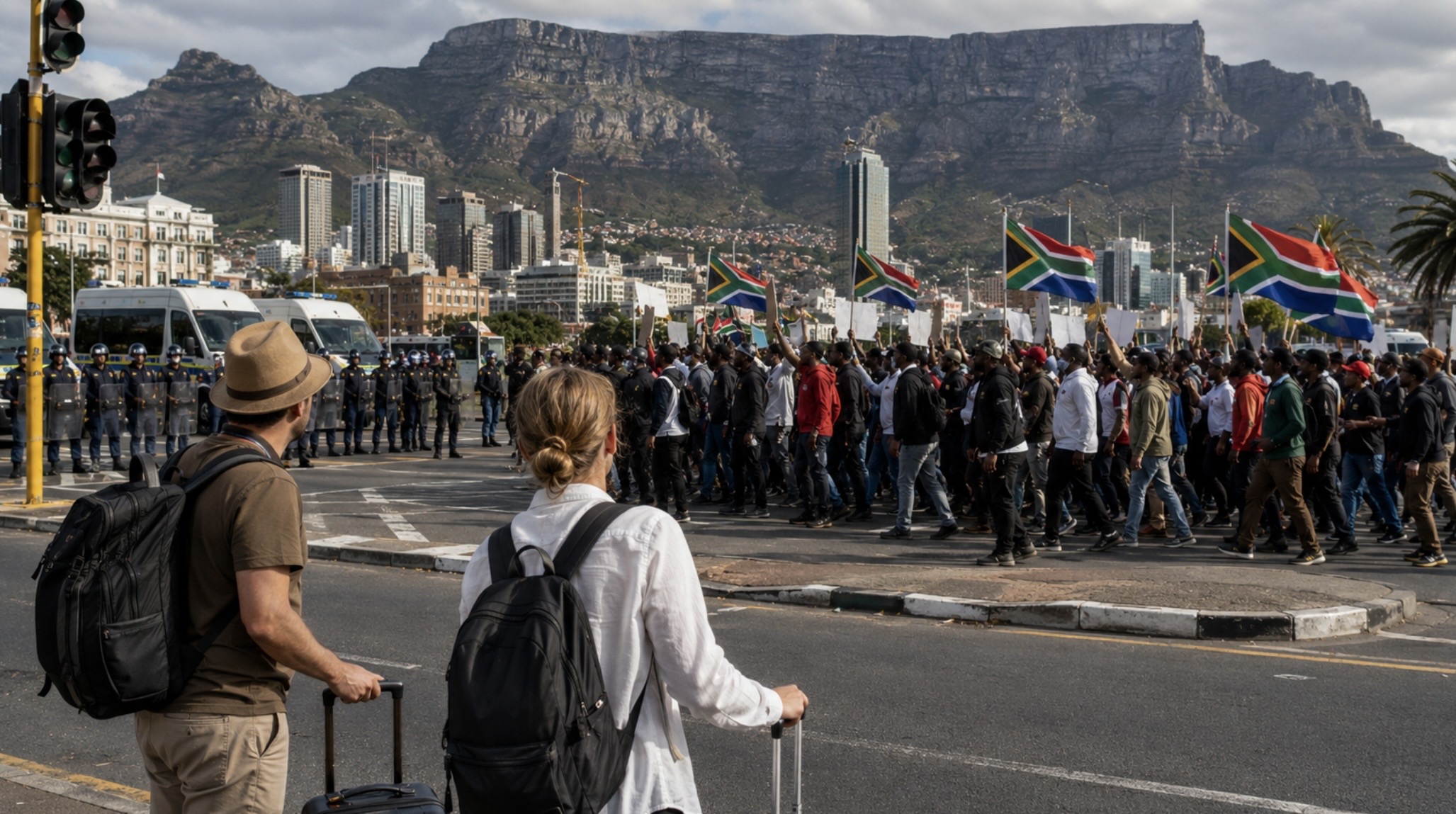
The June 30 Anti-Immigration Marches: What Is Happening, and What Visitors Should Know
Anti-immigration groups have set 30 June 2026 as a self-styled deadline for undocumented migrants to leave South Africa, with marches planned in Cape Town and nationwide. The deadline has no legal force, and the violence so far has targeted African and Asian migrants in specific areas, not tourists. But it is a tense, fast-moving moment. Here is who is involved, who is actually at risk, whether the danger is rising or easing, the history behind it, and how to stay informed.
This is a fast-moving story
This briefing was last updated on 29 June 2026, the day before the planned marches. Situations like this change hour by hour. Treat it as background and orientation, not a live security feed, and check current local news and your government's official travel advice before and during 30 June.
If you read nothing else, read these.
- What it is. Anti-immigration groups, led by one called March and March, set 30 June as a deadline for undocumented migrants to leave. It is a protest campaign and a symbolic ultimatum, not a law. The government has rejected it as unlawful and unenforceable.
- Who is targetedThe threat falls on African and Asian migrants, not tourists. In practice it reaches anyone perceived to be a Black African or Asian migrant, documented or not. The violence is racialised and class-based; wealthier foreigners, White residents and most international visitors are very rarely targeted.
- Where the risk sits. Concentrated in townships, informal settlements and migrant-dense suburbs, not in the tourist core of the City Bowl, Atlantic Seaboard, Table Mountain or the Winelands.
- Cape Town so far. Local marches have drawn small crowds, in the dozens, far smaller than in some other provinces. The Western Cape is still flagged as a potential hotspot.
- The state response. A nationwide police operation costing over R600 million (about 32 million euros or 36 million US dollars) is deployed, with the army on standby. Government says 30 June is not a national shutdown and normal business should continue.
- For visitors. Direct risk to most travellers is low, but expect possible marches, road closures and disruption. Avoid protests and flagged areas, keep your documents on you, and follow local news and your embassy.
Where the flashpoints are, and where they are not
The documented march sites in metropolitan Cape Town cluster in the northern suburbs and a few mixed corridors, not in the tourist core. The map shows every confirmed site together with the displacement focal points. Tap or click any marker for detail.
Wine markers: anti-immigration march sites. Slate markers: displacement or repatriation points. The most serious Western Cape violence happened outside this frame, in Mossel Bay and the Overberg.
Two things stand out. First, the marches have concentrated in the northern suburbs, around Bellville, Parow and the Voortrekker Road corridor, and out toward Parklands, Table View and Blouberg, with smaller appearances in Sea Point and a Main Road march through Wynberg. Second, the consulate and the Epping site are points of displacement, not protest: places where frightened people gathered to leave. None of the documented sites is in the City Bowl tourist core, on the Atlantic Seaboard south of Sea Point, on Table Mountain, or in the Winelands.
The deadliest Western Cape incidents happened outside the metro. In Mossel Bay, about 380 kilometres east, violence in KwaNonqaba left several people dead and more than fifty shacks burned. In Hermanus and Kleinmond, a drive of ninety minutes, mobs went door to door and around a hundred migrants sheltered in the town hall. Migrant-dense city townships, including Dunoon, Khayelitsha, Gugulethu and Mfuleni, have seen the same pattern.
What is actually happening
For months, a loose coalition of anti-immigration groups has been marching through South African cities demanding that undocumented foreign nationals leave the country. The most prominent, a movement called March and March, set 30 June 2026 as a deadline for migrants to "self-deport," and called for a national shutdown on the day. More than twenty civic organisations have aligned with the campaign.
The deadline is a symbolic ultimatum, not a legal instrument. Immigration enforcement in South Africa is the job of the state, and the government has been blunt that no private group can set a date by which anyone must leave. President Cyril Ramaphosa called the so-called deadline unnecessary and warned he "will not tolerate any attempts to destabilise the country by anyone, whether marching or otherwise." Officials have stressed repeatedly that 30 June is not a national shutdown and that normal business should continue.
That risk is not hypothetical. The campaign has already coincided with real harm: foreign-owned businesses attacked and looted across several provinces, migrants chased from their homes, and several people killed. The mobilisation has also driven a remarkable exodus. Across the country, tens of thousands of migrants have queued at consulates and repatriation sites to leave before the date. In Cape Town, more than a thousand Zimbabweans camped on the pavements outside their consulate in District Six before the City and Home Affairs moved them to a repatriation centre in Epping on 28 June.
Several African governments, including Malawi, Zimbabwe, Mozambique, Nigeria and Ghana, have organised emergency repatriations of their citizens, and some issued travel advice. Aid groups such as Gift of the Givers and faith-based volunteers have been feeding and sheltering displaced families through Cape Town's cold, wet winter nights.
Who is behind the marches
Two names recur. Operation Dudula, whose name means "force out" or "push back" in isiZulu, began in Soweto in 2021 and has since become a registered political party. March and March, led by Jacinta Ngobese-Zuma, is newer, emerging around 2024, and is the group most associated with the 30 June deadline. A separate, highly visible figure, Nkosikhona Ndabandaba, who mobilises supporters in traditional Zulu regalia, has claimed authorship of the deadline online to a following of well over a million.
Both movements describe themselves as campaigns against illegal immigration rather than against foreigners as such, and their formal representatives insist the protests are peaceful. Organisers have publicly distanced themselves from violence, with some arguing that keeping order is the government's job, not theirs. Human rights bodies and the courts see them more harshly: Operation Dudula is widely described as a xenophobic vigilante movement, and in late 2025 a court barred its supporters from blocking migrants' access to healthcare. Some prominent figures have also said they "cannot control" how supporters behave once mobilised, which is precisely what worries analysts.
The grievance, and the evidence
The movements draw on genuine pain: official unemployment sits above 30%, youth unemployment above 60%, and public services are strained. They blame migrants for joblessness, crime and pressure on schools and clinics. The research does not support that blame. Foreign nationals are estimated at roughly 6 to 7% of the population yet are credited with contributing around 9% of GDP, and studies repeatedly find no basis for the claim that migrants are the main drivers of crime. The grievances are real; the scapegoating is not borne out by the data.
Who is being targeted
This is the part that matters most, both morally and for anyone assessing their own risk. Although the campaign is framed around "illegal" immigration, in practice the people targeted are anyone perceived to be a Black African or Asian migrant, whether they hold papers or not. Refugees, asylum seekers and fully documented residents have all been swept up in the threats and the displacement.
The hostility is, as one Nigerian businessman put it to CNN, "heavily racialised and classed." It is directed at suspected migrants living and working in and around low-income Black South African communities. Historically the sharpest hostility has fallen on Zimbabweans, Mozambicans and Malawians, with Somalis, Ethiopians, Nigerians, Congolese, Pakistanis and Bangladeshis also frequently targeted. Wealthier foreigners and White residents are rarely touched.
That pattern is why the direct risk to most international tourists is genuinely low: a visitor on the Atlantic Seaboard or in the Winelands does not fit the profile that vigilante groups are stopping in the street. But it would be wrong to read that as reassurance about the situation as a whole. For the families sleeping outside consulates, for the pregnant woman turned away from a clinic, for the gardener told to "leave or leave in a coffin," this is a humanitarian and human rights crisis. Treating it only as a question of tourist convenience would miss the point entirely.
The AssessmentIs the risk escalating or easing?
Honestly, both pressures are in play, and serious analysts are divided. It is worth holding the escalating and the steadying forces side by side rather than reaching for a single label.
Pointing toward escalation
Months of mobilisation, real deaths and displacement, marchers sometimes carrying sticks and spears, online incitement, a symbolic deadline acting as a flashpoint, and organisers who say they cannot control supporters. The Institute for Security Studies warns of moderate to high risk of localised violence, including in parts of the Western Cape.
Pointing toward restraint
A large, pre-positioned police operation across all nine provinces with the army on standby, arrests for incitement, courts ruling against vigilante groups, firm government rejection of the deadline, strong civil-society pushback, and Cape Town turnouts so far measured in dozens rather than thousands.
Cape Town's own numbers are part of why the city is not, at the time of writing, the sharpest flashpoint. The marches here have been small: about 40 people in Sea Point in mid-June, around 60 in Wynberg, roughly 80 in Parklands. The trend is upward, which is why the Western Cape remains on the hotspot list, but these are not mass mobilisations.
The grim counterpoint is that turnout and danger are not the same thing. Most of the harm in this wave has come not from large set-piece marches but from small armed groups going door to door, and from intimidation that empties neighbourhoods through fear rather than force. A march of eighty can still produce a breakaway group, and the worst incidents nationally, the burning of shacks in Mossel Bay, a killing in Pietermaritzburg, have happened away from the big-city cameras.
A short history of xenophobia in South Africa
None of this is new, and understanding why matters. South Africa's economy was built on migrant labour: under apartheid, workers from Mozambique, Lesotho, Malawi and Zimbabwe were recruited into the mines and farms under tight controls. The state wanted African labour but never African belonging, and the slur "makwerekwere" for Black foreigners long predates the current movements. After 1994, against many people's hopes, hostility toward foreign nationals rose rather than fell.
The watershed came in May 2008, when attacks that began in the Johannesburg township of Alexandra spread nationwide, reaching Durban and Cape Town. At least 62 people were killed, more than 1,700 injured, and over 100,000 displaced. The photograph of Ernesto Nhamuave, a Mozambican man burned alive, became one of the defining images of post-apartheid South Africa. Major waves followed in 2015, after remarks widely read as telling foreigners to leave, and in 2019, with attacks focused on Nigerian-owned businesses. From 2021, vigilante formations like Operation Dudula carried the pattern into a new, more organised phase.
The nationwide explosion
Attacks spread from Alexandra across the country. At least 62 killed, over 100,000 displaced. The deadliest episode to date.
Recurring flare-ups
Zimbabweans displaced in De Doorns in the Western Cape in 2009; a nationwide wave in 2015 prompted foreign governments to repatriate citizens.
Attacks on Nigerian businesses
A fresh wave, centred on Gauteng, drew sharp diplomatic reactions across the continent.
The vigilante turn
Operation Dudula emerges in Soweto and spreads, formalising door-to-door "inspections." The killing of Elvis Nyathi in Diepsloot becomes a symbol of the era.
The current wave
March and March and allied groups mobilise around the 30 June deadline. Deadly incidents in Mossel Bay and Pietermaritzburg; mass displacement and repatriation.
One thread runs through every wave: the violence tracks economic distress and is repeatedly inflamed by influential voices and, now, by social media. Researchers and rights groups stress that the cycles are driven by inequality and unemployment, with migrants serving as the most visible and vulnerable scapegoat. That is why each spike combines a local trigger with the same deep, unresolved frustrations.
What visitors should know
If you are a tourist or business traveller, the practical picture is reassuring on the personal-safety front and cautious on the logistics. You are very unlikely to be a target. What you should plan around is disruption and the small but real chance of broader unrest.
Generally unaffected
The City Bowl tourist core, V&A Waterfront, Atlantic Seaboard (Sea Point to Camps Bay), Table Mountain, Constantia and the Cape Winelands. These are not targets of the campaign and daily life continues, though you should still keep an eye on the news.
Avoid around 30 June
Any protest or march, large gatherings, townships and informal settlements, and areas flagged by police. Township tours in particular are best postponed until well after the date. Do not film or insert yourself into a march.
Practical steps
Keep your passport or a clear copy on you, since heightened policing means more roadblocks and document checks. Build flexibility into your plans for 30 June and the days on either side: marches can close roads at short notice and some businesses along routes shut for the day. Monitor reputable local outlets and your own government's travel advisory, several of which were updated ahead of the date. If you use ride-hailing or taxis, confirm routes avoid any flagged areas, and keep emergency numbers to hand: 10111 for police, 112 from a mobile, and 107 for the City of Cape Town's emergency line.
Perspective
Cape Town continues to receive visitors throughout this period, the airport and tourist sites are operating normally, and the heavy security presence is designed to keep public order. The sensible posture is awareness, not alarm: stay informed, avoid flashpoints, and keep your plans flexible for a day or two.
If you are a migrant or could be at risk
If you are a foreign national who could be perceived as a target, your risk is real and your safety comes first. Stay aware of your surroundings, avoid travelling through flagged areas alone, keep your documents secure, and stay connected to community networks that share reliable, real-time information rather than rumour. If you are threatened or attacked, you have the right to protection and to report it.
Support and reporting
- Police emergencies: 10111, or 112 from a mobile phone.
- Scalabrini Centre of Cape Town: long-established support for migrants, refugees and asylum seekers, including advocacy and advice.
- Lawyers for Human Rights and the UNHCR in South Africa: legal protection and refugee assistance.
- Kopanang Africa Against Xenophobia (KAAX): a civil-society coalition organising against xenophobia.
- Gift of the Givers and local faith groups: humanitarian aid for displaced families.
- Your own country's consulate, for documentation and, where offered, voluntary repatriation.
Verify any "deadline" or instruction independently before acting on it. A great deal of false and inflammatory material has circulated online during this period, including fabricated announcements attributed to the government. Official immigration matters come from the Department of Home Affairs, not from social media accounts or self-appointed enforcers.
Questions answered
For most international visitors, the direct personal risk is low, because the campaign targets African and Asian migrants rather than tourists, and the main tourist areas are not flashpoints. The sensible approach is awareness, not cancellation: avoid protests, townships and flagged areas around the date, keep your documents on you, monitor local news and your government's advisory, and allow flexibility in your plans.
No. It is a self-imposed ultimatum by activist groups with no legal authority. The government has rejected it as unlawful and unenforceable, and immigration enforcement remains solely the responsibility of the state. Nothing in law changes on the date.
In practice, anyone perceived to be a Black African or Asian migrant, documented or not, especially those living and working near low-income communities. Zimbabweans, Mozambicans, Malawians, Somalis, Ethiopians, Nigerians and others have borne the brunt. The violence is racialised and class-based, and wealthier foreigners, White residents and most tourists are rarely targeted.
They sit in the same long pattern, but the context differs. 2008 saw two weeks of largely unchecked mob violence that killed at least 62 people. This time the state has pre-positioned a large security operation and made arrests, and many marches have been small. The risk of localised violence is real, but a nationwide repeat on the 2008 scale is not the expected outcome given the response.
Cape Town International was operating normally as this was written, and the government has stressed that essential services and normal business should continue. Even so, allow extra time, keep an eye on any road closures linked to marches, and check directly with your airline if you are travelling on or around 30 June.
Read alongside this
For everyday safety orientation in the city, see our Cape Town crime map and safety analysis and our street-smart safety playbook. Both are general guides and are not specific to the 30 June situation.
The bottom line
The 30 June marches are best understood as a charged, symbolic moment in a long and unresolved story, not a sudden new emergency that materialises and vanishes on a single date. The deadline has no legal weight, the heaviest risk falls on migrant communities rather than visitors, and Cape Town has so far seen smaller mobilisations than some other provinces, all under an unusually large security operation. None of that erases the genuine danger to the people being targeted, nor the human cost already paid in lives lost and families displaced. For a visitor, the right response is informed caution; for everyone, it is worth remembering that the data has never supported the blame at the heart of these marches.
Reporting and analysis
- Daily Maverick, on the marches, the police operation, and the displaced (June 2026)
- CNN, NPR, Reuters and Arab News, on the deadline, displacement and who is targeted (June 2026)
- GroundUp and News24, on the Zimbabwean consulate situation in Cape Town (June 2026)
- Institute for Security Studies (ISS), risk assessment ahead of 30 June
- Moneyweb and Xinhua, on government and security preparations
- IOL, on arrests, repatriation figures and the official position
- EWN and Time Out Cape Town, on Western Cape police hotspot monitoring and the Cape Town march sites (Wynberg, Sea Point, Parklands, Bellville to Parow)
- Map: documented march sites and displacement points compiled from the above reporting; coordinates via Google Places. Tiles by OpenStreetMap and CARTO
History and context
- Human Rights Watch, on the 2026 wave and the cycle of attacks since 2008
- Wikipedia, "Xenophobia in South Africa" and "Operation Dudula", for the historical timeline
- African Commission on Human and Peoples' Rights, statement on xenophobic violence
Support organisations
- Scalabrini Centre of Cape Town; Lawyers for Human Rights; UNHCR South Africa; Kopanang Africa Against Xenophobia; Gift of the Givers
Imagery
- This briefing is illustrated with original data charts rather than a photograph, out of respect for the people affected, so no image credit is carried.
This article is provided for general information and orientation only and reflects the situation as understood on 29 June 2026, the day before the planned marches. It is a fast-moving event and details will change. Nothing here is legal, immigration or security advice. Travellers should consult their own government's official travel advisory and current local news, and anyone facing a threat should contact the police on 10111 or a relevant support organisation. Cape Town Data condemns xenophobia and presents this material to inform readers, not to characterise any nationality or community. We accept no liability for decisions made on the basis of this content.
You May Also Like
What Is South Africa's New Traveller Declaration?
Travel Guide · South Africa What Is South Africa's New Traveller Declaration? From today, 1 July 2026, everyone who enters or leaves South Africa has…
Read Article