AfrikaBurn 2026: Building a Different Kind of Society in the Tankwa Desert
November 19, 2025


Tankwa Karoo • Temporary City • Culture & Community
AfrikaBurn 2026: Building a Different Kind of Society in the Tankwa Desert
Once a year, a city rises out of a semi-desert in the Tankwa Karoo. Thousands of people build “Tankwa Town” from scratch—artworks, camps, mutant vehicles and rituals—and then take it all down again, leaving almost no trace. AfrikaBurn is not a typical music festival; it’s a week-long experiment in a different way of living together.
Quick take: AfrikaBurn is an official Burning Man regional event in South Africa: a non-profit, participant-built gathering on a remote farm called Quaggafontein in the Tankwa Karoo. There are no food stalls, no sponsors and no VIP decks— just a temporary city based on principles like gifting, radical self-expression, communal effort and leave no trace.
2026 dates: 27 Apr – 3 May Location: Quaggafontein, Tankwa Karoo Theme: PRISM Format: week-long temporary city Nearest cities: Cape Town & Ceres Bring: everything you need
Always cross-check dates, themes, ticket releases and survival rules on the official AfrikaBurn channels before you book flights or take leave.
What AfrikaBurn is (and isn’t)
AfrikaBurn is a regional Burning Man event run by a non-profit company, Africa Burns Creative Projects. It’s held on Quaggafontein, a remote farm a long drive from the nearest town, in a semi-desert landscape of dust, stars and wide horizons.
Crucially, it’s not a commercial music festival. There is no headliner poster to plan your weekend around, no official bar to meet at, no brand activations or VIP platforms. Instead, the culture is “no spectators”: if you come, you’re expected to contribute in some way—by building a theme camp, volunteering, performing, offering tea in the midday heat or simply being a kind, engaged neighbour.
Think of it as a temporary town with its own values and norms. For a week, those values get tested in real life: what does gifting look like when there are no shops; how does consent work in a highly expressive space; what does “leave no trace” mean when the wind picks up at 3 a.m. and tries to steal your gazebo?
If Rocking the Daisies feels open and diverse compared with a typical rock festival crowd, AfrikaBurn goes a step further. The whole point is radical self-expression, participation and cultural mix—more like stepping into an alternate society than attending a sponsored show.
AfrikaBurn 2026 at a glance
AfrikaBurn 2026 runs from 27 April to 3 May 2026, with the theme PRISM, at Quaggafontein in the Tankwa Karoo. The site is sometimes called “Tankwa Town” during the event, and returns to being quiet farm land once everyone leaves.
Expect a week of art installations, “burns” (ceremonial burning of selected artworks or structures), mutant vehicles roaming the dust, sound camps, workshops, performances and a lot of unscheduled weirdness.
| Item | Details (2026) |
|---|---|
| Dates | 27 April – 3 May 2026 (one full week, with main burns towards the end of the event). |
| Location | Quaggafontein farm in the Tankwa Karoo, Western Cape—remote semi-desert, gravel roads, no nearby towns. |
| Scale | Attendance in recent years has been around 10–11,000 participants, making it one of South Africa’s biggest destination events—but still tiny compared with a major city. |
| Format | Week-long temporary city with art, mutant vehicles, burns and 24-hour activity. Most people camp for multiple nights. |
| Tickets | Tiers released in phases, with reduced-price options for volunteers and low-income participants. No tickets are sold at the gate. |
| Money on site | No vending, no bar sales, no commercial signage. It’s a gift economy—bring everything you need. |
| Family-friendliness | Kids are welcome in many areas, but there are also adult-focused sound camps and zones. Read the survival guide if you’re bringing children. |
| Accessibility | Desert terrain, heat, dust and limited infrastructure can be challenging—reach out to organisers if you have specific access needs. |
- Sign up to AfrikaBurn’s mailing list and socials for ticket-release phases, volunteer calls and art-grant info.
- Tickets are linked to names and IDs; transfers and resales are tightly controlled to avoid scams.
- Always read the latest survival guide and rules—Tankwa is beautiful, but it is not forgiving.
Principles: how the “other society” works
AfrikaBurn is guided by eleven principles, adapted from Burning Man’s ten principles with a South African addition: “Each One Teach One”. These aren’t laws so much as a cultural backbone—shared expectations that shape how people show up.
Inclusion, gifting & decommodification
- Radical Inclusion: Anyone may be part of AfrikaBurn; you just need a ticket and a willingness to participate.
- Gifting: There’s no buying or selling. People offer food, experiences, massages, art, conversations—no price tags attached.
- Decommodification: No brand logos, product sampling or advertising. It’s a rare break from constant marketing.
Self-reliance, expression & communal effort
- Radical Self-reliance: You bring your own shelter, food, water, shade and meds; there’s no shop to bail you out.
- Radical Self-expression: Costumes, nudity, performance, offbeat identities—within the bounds of consent and safety.
- Communal Effort & Civic Responsibility: Camps, artworks and services are built together; everyone’s responsible for keeping the city safe and workable.
Leave No Trace, participation & Each One Teach One
- Leave No Trace: Everything you bring in must leave with you—down to bottle caps and cigarette butts.
- Participation & Immediacy: No spectators; the magic happens when you step into it, not when you stand back.
- Each One Teach One: The extra AfrikaBurn principle—if you know how things work, you share that knowledge with new burners.
Survival basics: water, weather & gear
The Tankwa Karoo is hot, dry, dusty and remote. There’s little shade, big temperature swings between day and night, and no natural drinking water on tap. AfrikaBurn’s own survival guide recommends at least 5 litres of water per person per day for drinking alone—more if you include cooking and washing.
Non-negotiables to bring
- Enough water for drinking, cooking and a minimal amount of washing (plus a buffer for emergencies).
- Shade (gazebo with good pegs and guy ropes), a solid tent and something soft to sleep on.
- Food for the full duration, including non-perishables that survive heat and dust.
- Sun protection: hat, sunglasses, high-SPF sunscreen, long-sleeved shirts.
- Layers for cold nights: thermal tops, beanie, warm socks.
- A basic first-aid kit and any chronic medication you need.
- Headlamp/torch with spare batteries, power bank for devices, duct tape, multi-tool.
- Sturdy bin bags and containers—everything you generate comes back out with you.
Life in Tankwa Town: art, camps & daily rhythm
Once you crest the last gravel rise and see the city laid out below—a grid of streets, scattered sculptures and shimmering dust—you realise just how much of AfrikaBurn is built by its participants. There is no “main stage” provided by a promoter; the city itself is the artwork.
Theme camps & villages
Theme camps are the backbone of the city: groups of burners who coordinate to offer something specific, from sunrise coffee and talks to late-night dance floors, steam baths, cuddle-puddles, roller discos or quiet tea tents. Many cluster into “villages” that share kitchens, shade structures and sound.
Artworks & burns
Across the playa you’ll see large sculptures, small interactive pieces, performance installations and spontaneous weird experiments. Some will burn in scheduled ceremonies; others are designed to be dismantled and taken home. The point is not permanence but experience and process.
Mutant vehicles & movement
Decorated “mutant vehicles” (art cars) roam the city, from tiny mobile sofas to towering pirate ships. They’re registered and safety-checked, then free to trundle around offering lifts, dance floors and surprise encounters.
A day in the dust (roughly)
- Sunrise: coffee at a neighbour’s camp, quiet wander through early-morning art.
- Midday: hide from the sun in a shaded chill space or workshop; maybe nap through the hottest hours.
- Late afternoon: explore further afield by bike or on foot; follow distant music or laughter.
- Night: bounce between campfires, burns and sound camps until you’re full, then walk home under a sky that feels close enough to touch.
Culture, expression & consent
AfrikaBurn is famous for radical self-expression: costumes, body art, nudity, surreal alter-egos and many different ways of being in public. That expansiveness comes with responsibility. The organisers actively talk about inclusion, racism, microaggressions and power in their culture documents, and they encourage everyone to help build a safer space rather than assuming it will happen on its own.
Basic social rules of thumb
- Ask before you touch or join: Hugs, dances, photos, cuddle piles—get enthusiastic consent.
- Be photo-careful: Many people are happy to be photographed, but some are not; ask, show the shot and offer to share it with them.
- Handle substance use with care: Look after your friends, be honest with medics if you need help, and don’t pressure anyone to partake.
- Respect quiet zones: Not every street wants a 4 a.m. sound system; check the map and face your bass inward.
- Mind cultural context: Be playful without leaning on racial or cultural stereotypes in costumes or camp themes.
How AfrikaBurn compares to other South African festivals
South Africa has a busy festival circuit—from coastal New Year’s events and inland trance weekends to big-brand shows like Rocking the Daisies. AfrikaBurn sits in its own category: it borrows the camping and sound systems, but discards the commercial scaffolding and turns the whole thing into a civic project.
| Feature | AfrikaBurn | Rocking the Daisies & similar |
|---|---|---|
| Core identity | Temporary city & arts gathering; community-built. | Music festival with curated line-up and sponsors. |
| Money on site | No vending; gift economy; bring everything you need. | Bars, food stalls, merch and branded zones. |
| Headliners | No official line-up; focus on participation and art. | Strong focus on who’s on the poster and which stage. |
| Self-expression | Radical self-expression is expected and celebrated. | More relaxed and diverse than many rock events, but still closer to a conventional festival. |
| Effort vs. comfort | High effort: remote drive, full self-reliance, intense environment. | Moderate: on-site services, vendors, shuttles and phone signal. |
Planning your trip from Cape Town
Getting to AfrikaBurn is a pilgrimage in itself. From Cape Town, most routes involve several hours of tar and a long stretch of gravel, with the last bit on farm roads. People drive in convoys, decorate their vehicles and treat the journey as part of the ritual.
Before you leave the city
- Service your vehicle: Check tyres (including the spare), fluids and lights. Gravel roads and heavy loads are tough on cars.
- Fuel up properly: Fill your tank before you leave the last bigger town; there are no surprise fuel stations in the desert.
- Pack smart: Keep water and essentials in easy reach rather than buried under costumes and fairy lights.
- Share the load: Carpooling spreads fuel costs and reduces the number of vehicles on the road.
On the road
- Drive slowly on gravel; dust hides potholes and washboard sections.
- Keep headlights on for visibility in dust clouds.
- Take breaks—fatigue and excitement are a risky combo.
- Respect local farms and wildlife: no off-roading or littering en route.
After the burn
When it’s all over, many burners stop for a night in places like Ceres, Tulbagh or small Karoo towns to shower, eat fresh food and ease back into phone signal. Others make a beeline for Cape Town’s ocean to rinse off the dust. Either way, give yourself time; Tankwa Time doesn’t compress well into Monday-morning meetings.
Quick overview table
| Area | Why it matters | Better approach | Common mistakes |
|---|---|---|---|
| Tickets & volunteering | Entry is limited; volunteering deepens the experience and can affect access. | Join mailing lists early; consider volunteering or contributing art instead of only consuming. | Waiting until the last minute; assuming you can just “rock up”. |
| Water & supplies | There are no shops or taps; running short is dangerous. | Plan for at least 5L drinking water per person per day plus extra; bring more food than you think. | Relying on other camps’ generosity; underestimating heat and thirst. |
| Leave No Trace | Tankwa is fragile; litter and grey water leave scars. | Contain your camp, manage grey water properly, do a final MOOP (“Matter Out Of Place”) sweep before you leave. | Leaving behind broken gazebos, cheap tents or micro-litter. |
| Expression & consent | High expression without boundaries quickly becomes unsafe. | Ask for consent, respect “no”, check in with people who seem uncomfortable. | Assuming outfits or nudity equal blanket permission for touch or photography. |
| Travel logistics | Remote gravel roads + fatigue = real risk. | Drive rested, share driving, consider sleeping over on the way back. | Leaving straight after the burn and trying to push through on no sleep. |
| Re-entry into “default world” | The contrast can be intense. | Plan a soft landing day: laundry, journalling, a quiet dinner with friends. | Going straight from Tankwa to a high-stakes work presentation. |
Use this table as a checklist, not a rulebook. Your best AfrikaBurn will balance preparation with openness to whatever Tankwa Town throws at you.
Map: where AfrikaBurn happens
This simple map marks the approximate location of Quaggafontein in the Tankwa Karoo so you can picture where AfrikaBurn sits in relation to Cape Town and the rest of the Western Cape. Use it for orientation only—always follow the latest official directions and road-safety guidelines from AfrikaBurn when you actually travel.
Marker position is approximate, not a GPS pin for the gate. Check Quaggapedia and the survival guide for turn-by-turn instructions and updated route maps.
Sources & official links
- AfrikaBurn official site — event overview, ticketing, survival guide and Quaggafontein info.
- Quaggapedia — detailed getting-there directions, survival tips and culture documents.
- AfrikaBurn principles pages — full wording of the eleven guiding principles and inclusivity guide.
- Wikipedia: AfrikaBurn — high-level history, dates and themes used as cross-reference.
Key factual details in this guide—dates, themes, attendance ranges, location and water recommendations—should always be verified against AfrikaBurn’s own documentation, Quaggapedia and the latest survival guide.
More in Annual & Seasonal Events
- Western Cape Wildfires: Worst Season in a Decade Update 26 January 2026
- New Developments: Western Cape Wildfires Update 22 January 2026
- Wildfires in Western Cape - What is the situation 19 January 2026?
- Western Cape Wildfires Update: 15 January 2026
- Why Is It Burning in Cape Town?
- Cape Town Cycle Tour 2026 (a.k.a. „Argus“): Visitor Guide to Riding the Cape Peninsula
You May Also Like
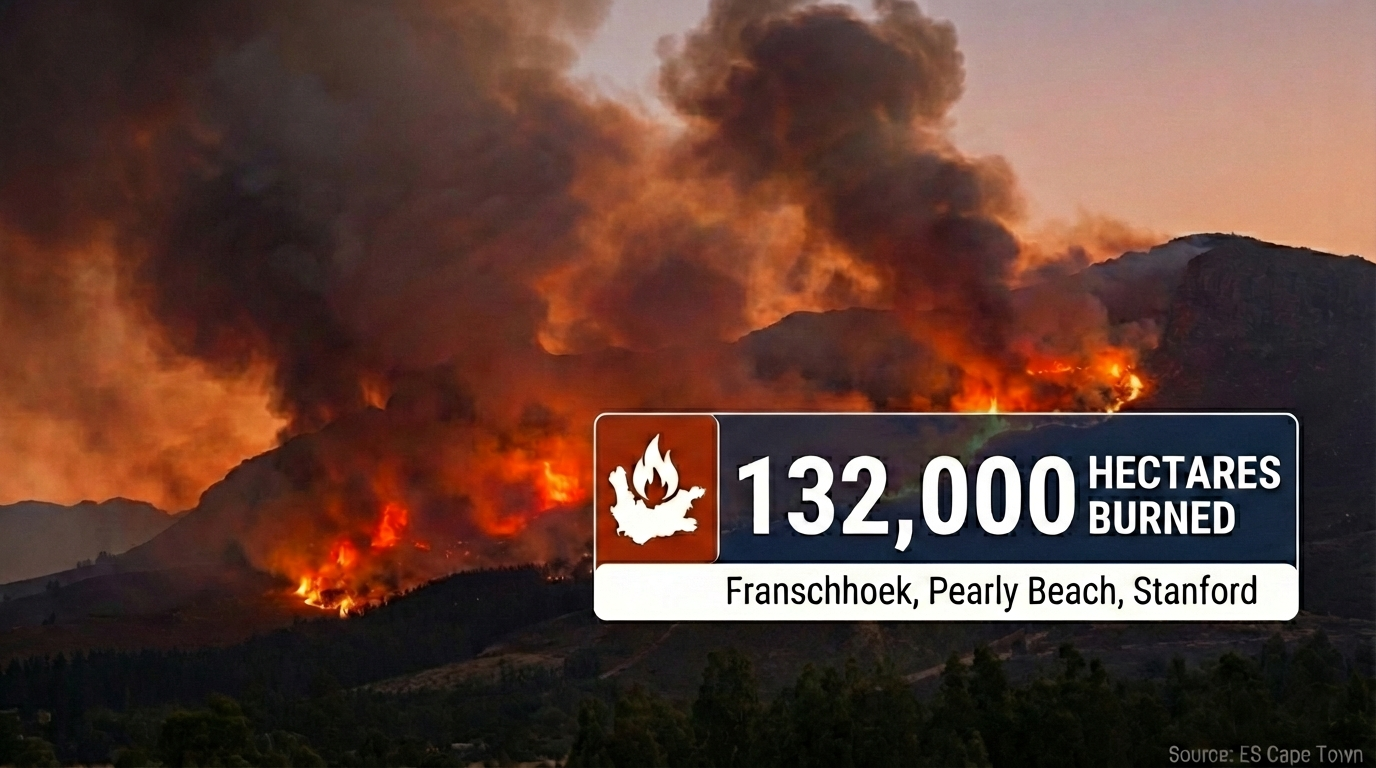
Western Cape Wildfires: Worst Season in a Decade Update 26 January 2026
Live Update • 26 January 2026 Western Cape Wildfires: Worst Season in a Decade 132,000 hectares burned province-wide as Cabinet requests disaster declaration. Franschhoek fire…
Read Article
New Developments: Western Cape Wildfires Update 22 January 2026
Photo courtesy of: SkyPixels, CC BY-SA 4.0, Wikimedia Commons Western Cape • 19–22 January 2026 • Franschhoek CRITICAL • Signal Hill • Strand / Helderberg…
Read Article
Wildfires in Western Cape - What is the situation 19 January 2026?
Photo courtesy of: Jeff Schmaltz, MODIS Land Rapid Response Team, NASA GSFC, Public domain, via Wikimedia Commons NEW UPDATE Newest compiled information is here: Read…
Read Article
Western Cape Wildfires Update: 15 January 2026
Photo courtesy of: SkyPixels, CC BY-SA 4.0, via Wikimedia Commons Cape Town • Western Cape • Summer wildfires • Peninsula + Winelands + Overberg Western…
Read Article
Why Is It Burning in Cape Town?
Photo courtesy of: Warren Rohner, CC BY-SA 2.0, via Wikimedia Commons Cape Town • Summer wildfires • Signal Hill, Table Mountain, the Cederberg Why Is…
Read Article