New driving rules in South Africa from 1 December 2025! Here is what you need to know

South Africa • Road rules & enforcement
New driving rules in South Africa (2025/26)
South Africa is phasing in the AARTO fine process nationwide, clarifying alcohol limits, tightening child-restraint and mobile-phone enforcement, and - in Gauteng - piloting high-security number plates. Here’s what actually changes, when it starts, and what it means for everyday drivers.
Short version: From 1 Dec 2025 the AARTO infringement process starts in major metros (e.g., Joburg, Tshwane, Cape Town, Durban, Mangaung), expanding to remaining municipalities on 1 Apr 2026. The demerit-point system is scheduled to kick in for everyone on 1 Sep 2026. Alcohol limits remain 0.05% BAC (general) and 0.02% BAC (professional) — zero-BAC is not in force. Gauteng’s smart number plates are in pilot.
AARTO phase-in: Dec 2025 → Apr 2026 Demerits planned: 1 Sep 2026 Alcohol limit: 0.05% (0.02% pro) Phones: no handheld use (Reg. 308A) Gauteng: smart plates pilot
What’s new & when it starts
| Change | Effective window | Where | Who it affects | What to do |
|---|---|---|---|---|
| AARTO fine process (administrative notices, discounts, electronic service, enforcement orders) | From 1 Dec 2025 (metros) → 1 Apr 2026 (rest) | National, phased by municipality | All drivers/vehicle owners | Check fines regularly; pay within 32 days to get 50% off; use representation/nomination if needed. |
| Demerit-point system (licence suspensions after threshold) | Planned 1 Sep 2026 (nationwide) | National | All licence holders incl. fleets | Educate drivers; track points; update HR/proxy processes. |
| Alcohol limits (legal maxima unchanged) | Ongoing | National | All drivers | 0.05% BAC (general) / 0.02% (professional). Zero-BAC proposal not commenced. |
| Child restraints & belts (enforcement emphasis) | Ongoing | National | Drivers with children | Approved child seat for under-3s; belts/appropriate restraints for 3–13 (or under 1.5 m). |
| Phones while driving (Reg. 308A) | Ongoing | National | All drivers | No handheld use; only properly mounted/hands-free. |
| High-security number plates (QR, anti-tamper) | Pilot unveiled 5 Jun 2025 | Gauteng (pilot) | Gauteng fleet/public in phases | Follow provincial guidance; general national adoption is not yet in force. |
AARTO: how fines & demerits will work
What changes: Traffic offences are handled through an administrative process (AARTO). You’ll receive an infringement notice (often electronically), with options to pay (50% discount within 32 days), nominate the driver, or submit a representation. If you ignore it, a courtesy letter follows; continued inaction leads to an enforcement order that can block licence/vehicle document renewals until resolved.
Demerits (planned 2026): When the demerit-point system starts, each infringement will add points. Reaching the legal threshold will suspend your driving licence for a set period. Points then reduce over time when you drive offence-free.
Indicative examples (subject to the official schedule)
| Offence (example) | Indicative points* | Penalty (typical)** | Notes |
|---|---|---|---|
| Exceeding speed limit by 21–25 km/h (urban) | 2 | Administrative fine | Higher over-speeds add more points/fines. |
| Driving without a valid driving licence | Up to 6 | Higher penalty | Serious; can fast-track suspensions once demerits apply. |
| Failing to stop at a stop line | 1–2 | Administrative fine | Exact points depend on the final schedule. |
*Point values are examples to illustrate how the system works; consult the official AARTO Schedule when published in your municipality. **Penalties vary by context and may change.
Alcohol limits: myth vs fact
Current legal limits
- Blood: under 0.05 g/100 ml (general drivers); under 0.02 g/100 ml (professional).
- Breath: under 0.24 mg/1000 ml (general); under 0.10 mg/1000 ml (professional).
If you’re unsure, don’t drive. Even a “single drink” can push some drivers over the limit.
Myth-busting
“Zero-BAC is already law.” Not yet. A zero-tolerance provision in an amendment exists on paper but has not commenced nationally. Until officially proclaimed, current limits apply.
Child seats & seatbelts
By regulation, children under 3 must be in an approved child restraint. Older children must be properly belted or in an age/size-appropriate restraint (think boosters) — never loose on laps or in cargo areas. Expect stricter holiday-season checks at roadblocks.
Phones while driving
Regulation 308A prohibits driving while holding a phone or any communication device. Use a secure mount or true hands-free. “One quick glance” is still distraction — and enforceable.
Number plates (Gauteng’s pilot)
Gauteng has unveiled a pilot of tamper-evident licence plates with QR codes and added security features. The pilot runs on provincial fleet vehicles first. Province-wide timelines for public fitment will be communicated by Gauteng authorities; this is not a national requirement yet.
Speed cameras & enforcement tech
Big metros are expanding fixed and average-speed enforcement (ASOD) corridors, plus higher-spec, low-flash cameras. Practical meaning: more consistent detection and faster digital ticketing. Under AARTO, you’ll see notices served electronically more often — so keep your contact details current.
Interactive map: first-wave cities
These metros are among the first to run AARTO from 1 Dec 2025. Click any marker to open Google Maps.
In motion (videos)
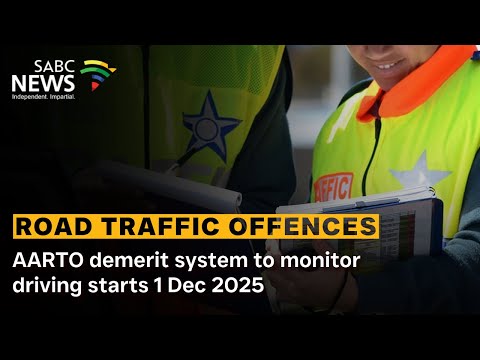
AARTO demerit system — news clip explainer (YouTube).

Gauteng’s high-security number plates — launch coverage (YouTube).
FAQ
Is AARTO already active where I live? From 1 Dec 2025 in major metros listed on the map; other municipalities follow on 1 Apr 2026.
When do demerit points count? The national switch-on is planned for 1 Sep 2026. Until then, the fine process applies without points.
What’s the point threshold? Expect a suspension once you reach the legal limit (e.g., 15 points in the current framework). Exact details will be confirmed alongside the national rollout.
Are speed limits changing? No national change: urban 60 km/h, rural 100 km/h, freeways 120 km/h (unless signed otherwise). Enforcement is what’s changing.
Sources (quick list)
- Government Gazette proclamations on AARTO commencement (2025).
- RTIA guidance on the AARTO process, discounts & options.
- SAPS drinking-and-driving limits (blood/breath).
- Arrive Alive: child restraints & Reg. 308A (phones).
- Gauteng Provincial Government: smart plate pilot (media advisory).
- BusinessTech/EWN: camera upgrades in Cape Town.
Editorial note: Details are subject to official proclamations and municipal notices. Always follow the signage and the latest government communications.
This article was produced with AI assistance and reviewed and verified by humans.
More in Roads & Navigation
Related reading


You May Also Like


N2 Airport routes: September - December 2025 safety update
Photo courtesy of: Jnanaranjan sahu, CC BY-SA 4.0, via Wikimedia Commons South Africa • Cape Town safety • Airport travel N2 & airport routes: September–December…
Read Article
Is the N2 Road to Cape Town Airport Safe?
Hero image credit: Simisa, CC BY-SA 3.0, via Wikimedia Commons South Africa • Cape Town safety • Airport travel Is the route traffic to Cape…
Read Article
Cape Town’s Traffic Woes in 2025, Part 2: Tourist Survival Guide to Driving in Cape Town
Why People Want to Live in the City Bowl Despite the notorious traffic, Cape Town’s City Bowl remains one of the most desirable places to…
Read Article
Cape Town’s Traffic Woes in 2025, Part 1: Geography, Congestion Patterns, and Commuter Coping Strategies
Photo courtesy of Wikimedia Commons, licensed under CC BY-SA 4.0 Table of Contents Cape Town’s Unique Geography: The City Bowl and Beyond Peak-Hour Gridlock: When…
Read Article