The Current Storm Updates in Cape Town, May 2026: How Bad Is It?
May 12, 2026
Eight Days, Six Dead, 83,184 Affected:
The May 2026 Cape Town Storm
Six confirmed deaths. 21,546 dwellings damaged. 83,184 people affected across the Western Cape. 26 informal settlements flooded in the metro. The N1 freight corridor severed at Worcester; Wolseley and Citrusdal cut off. All Western Cape schools closed for a day. This is the worst Cape storm since the September 2023 Heritage Day cut-off low, eight days from first fatality to mop-up. Here is the storm in numbers, charts and interactive maps.
Storm easing, mop-up underway. The SAWS Level 8 rainfall warning lapsed overnight on 12 May; the Wednesday outlook is fine and cool with residual storm-surge along the coast. Western Cape schools reopen today, though some remain closed for damage or access. The N1 stays closed at several points between Worcester and De Doorns; Du Toitskloof Pass, the Huguenot Tunnel and Bainskloof Pass are all shut. Wolseley and Citrusdal remain cut off. Avoid all non-essential travel through the Cape Winelands. Emergencies: City Public Emergency Communication Centre 021 480 7700; Provincial 24-hour Disaster Management 080 911 4357.
In a single sentence: this was the worst Cape Town storm since the September 2023 Heritage Day cut-off low. By Wednesday morning the Western Cape Provincial Health Department had confirmed six storm-related deaths and the City of Cape Town's Disaster Risk Management Centre had logged 21,546 damaged dwellings and 83,184 people affected across the province. About 6,000 were in dire need of immediate humanitarian assistance. All public schools in the province were closed on Tuesday. The N1 corridor between Cape Town and Gauteng remained severed.
This was the second time in a week that the Western Cape carried a SAWS Level 8 rainfall warning, and the second nationally classified disaster of 2026. Two stacked cold fronts and an embedded upper-air cut-off low drove wind gusts of 117 km/h, forecast 24-hour rainfall totals of 200 to 300 mm over the Boland, and rolling flooding across the Cape Flats and Cape Winelands. Khayelitsha alone accounts for about 1,000 of the damaged structures and 4,000 of the affected people in the metro. The Garden Route, hit a week earlier by the same broader system, is still mopping up.
In this analysis
- How bad was it? The dashboard
- A storm in numbers
- Where it hit hardest
- The N1 corridor severed
- Damage map (interactive)
- Timeline of the event
- Dams and water supply
- The Garden Route precursor
- Rainfall map (interactive)
- SAWS warnings explained
- Why these storms keep happening
- Historical context
- Practical information
How bad was it? The dashboard
Snapshot, 13 May 09:00 SASTThe most important framing for this storm is that it was a two-phase event with sharply different victim profiles. The first phase landed on the Garden Route between 6 and 9 May, killing one person and isolating dozens of rural communities. The second phase was a Cape metro and Boland event from 10 to 12 May, whose damage curve was dominated by informal settlements on the Cape Flats and by infrastructure failures in the Cape Winelands. The dashboard below pools the province-wide totals from both phases.
Why these numbers grew so quickly. The Monday afternoon damage tally was 1,655 structures and 5,600 people affected. By Tuesday morning it had grown to 10,703 structures and 41,635 people; by Tuesday evening to 21,546 dwellings and 83,184 people province-wide. Most of that growth reflects overnight assessment teams reaching settlements that had been inaccessible on Monday, not new damage. The Tuesday figures are the closest thing to a final tally, though revisions remain possible as Cape Winelands assessments complete this week.
A storm in numbers
Story in one chartThe cleanest single measure of this event is rainfall. Across the eastern Garden Route on 7 May, the first front delivered single-day totals that exceeded Cape Town's entire average for the month of May, which sits at roughly 136 mm. The Plettenberg Bay Newlands automatic rainfall station logged 162 mm in 24 hours; Knysna's Kleingrysbos station recorded 161 mm. Three George stations registered between 92 and 137 mm in the same window.
Peak 24-hour rainfall, 7 May 2026
Selected SAWS automatic rainfall stations across the eastern Western Cape. Reference line shows Cape Town's long-term May monthly average (136 mm).
Source: South African Weather Service Daily Rainfall Bulletin, 24-hour period ending 08:00 SAST on 7 May 2026. Reference: long-term May monthly mean for Cape Town from climate-data.org (1991–2021).
The second front, which lashed the Cape Peninsula on Monday 11 May, has now produced measured rainfall to match. The chart below shows the SAWS 24-hour totals to 08:00 on 11 May. The Boland mountains absorbed the heaviest load: Ceres logged 69 mm in 24 hours, while Kirstenbosch on the eastern flank of Table Mountain recorded 52 mm. SAWS' impact bulletin had forecast totals of 200 to 300 mm over 48 hours over the mountainous Boland; final accumulations through Tuesday will be higher still once the Wednesday SAWS bulletin is published. Peak wind gust over the metro on Monday reached 117 km/h.
Cape Peninsula and Winelands 24-hour rainfall, 11 May 2026
SAWS measured totals to 08:00 on 11 May, just as the second front made landfall. These are partial figures: the storm continued through Monday and Tuesday, with further accumulation not yet reflected. Compare these to Cape Town's monthly May average of ~136 mm.
Source: SAWS Daily Rainfall Bulletin, 24-hour period ending 08:00 SAST on 11 May 2026.
Where it hit hardest
On-the-ground impactThe City of Cape Town's Disaster Risk Management Centre had logged storm reports across more than two dozen suburbs by Tuesday afternoon. The damage pattern followed a familiar Cape Town fault line: informal settlements on the Cape Flats and Atlantic fringe absorbed most of the flooding, while the strongest wind damage clustered along high-ground neighbourhoods and exposed coastlines. The Cape Winelands phase added a second pattern: rural road and bridge failures across Witzenberg, Breede Valley and the West Coast.
How fast the damage tally grew: Monday → Tuesday morning → Tuesday evening
In roughly 30 hours the City of Cape Town's Disaster Risk Management Centre revised its damage estimates upward by an order of magnitude, as overnight assessment teams reached areas inaccessible on Monday and as the Cape Winelands phase added province-wide figures on Tuesday evening.
Sources: City of Cape Town Disaster Risk Management Centre statements 11–12 May 2026 via spokesperson Charlotte Powell. The Tuesday PM total is province-wide and includes Cape Winelands assessments. The Monday and Tuesday AM totals are metro-focused.
Wind-driven structural damage
Reports concentrated in Westridge, Mitchells Plain (formal and informal), Hanover Park, Lavender Hill (Grindal Avenue), Gugulethu, Crossroads, Marcus Garvie in Philippi, Portlands, Delft and Garden Road in Wynberg. The Spar in Glencairn lost part of its roof; Clicks in Kenilworth lost windows.
Informal settlements waterlogged
Island, Makhaza and Monwabisi in Khayelitsha; Imizamo Yethu (Hout Bay); Nomzamo and Lwandle (Strand); Phola Park, Valhalla Park, Vygieskraal, Tafelsig, Delft and Kampies. Gift of the Givers, Ashraful Aid, Islamic Relief and Mustadaffin all deploying.
Suburban roads underwater
Rosmead Avenue near the Kenilworth BP filling station inundated; a Mitchells Plain day care and the corner of Mercury and Galaxy roads in Rocklands submerged. The Vygieskraal Canal in Belgravia reached and breached capacity.
Towns cut off
Worcester "completely cut off from the outside world" per the WC Disaster Management Centre. Wolseley evacuating residents from Strathbreede and behind the provincial hospital. Citrusdal severed from the N7. Ceres, The Eiland and surrounds under active evacuation by Witzenberg Municipality.
Bridges, hospitals, sinkholes
Oukraal low-water bridge at Goedverwacht (West Coast) completely washed away. Bellville roadway collapse linked to a suspected water-main burst. Sinkhole repaired in Wielie Walie Street, Atlantis. Caledon Hospital reporting electricity faults and roof damage.
Six confirmed deaths
Per the WC Provincial Health Department, the death toll stands at six. Knysna (auxiliary social worker Lauren Fredericks, 37, tree on car, 6 May). Wynberg (Tennant Road, e-hailing passenger killed by falling tree, 11 May). George (Blanco, Montagu Street, 63-year-old woman killed parking at work, 11 May). Worcester (fall from a roof, 11 May). Genadendal (Overberg, tree fall, 11 May). Klaarstroom (Meiringspoort, drowned crossing a river, 11 May).
The N1 corridor severed: Worcester cut off
Road closures · Live, 13 May 09:00 SASTThe most consequential infrastructure casualty of this storm is not in Cape Town but in the Boland. As of Wednesday morning, the entire N1 freight corridor between Cape Town and the interior is severed. Worcester — the North Boland town through which every truck, bus and private vehicle between Gauteng and the Mother City must pass — is, in the words of the Provincial Disaster Management Centre, "completely cut off from the outside world." A Western Cape Provincial Traffic Services officer confirmed to the freight community on Tuesday morning: "All routes in, out and around Worcester are totally closed and remain closed. Please don't send your trucks." Seven trucks have been blown over along the corridor by gale-force winds.
Avoid all non-essential travel into or through the Cape Winelands. Premier Alan Winde has issued an urgent transport advisory: the N1 at Worcester and several escarpment passes remain closed until further notice. Motorists currently on the N1 toward Cape Town should find a safe stopping place and wait for a direct route to reopen. The Western Cape Government does not recommend attempting the back-road detours except in absolute emergency — some rural surfaces are storm-damaged and mobile coverage is patchy.
Closed roads (Wed 13 May, 09:00 SAST)
The freight artery to Gauteng
N1 Huguenot Tunnel — closed.
N1 at Du Kloof Lodge — both lanes blocked by debris.
N1 at Sandhills and De Wet Kelder — both directions closed.
N1 between De Doorns and Worcester — flooded; no alternative route available.
N1 south of the Shell One Stop — both directions closed.
Escarpment routes
Du Toitskloof Pass — closed.
Bainskloof Pass — closed.
Mitchell's Pass (Ceres to Wolseley) — closed to all vehicles following heavy rockfalls.
Provincial roads
R43 (Worcester to Villiersdorp) — closed due to flooding; no alternative route available.
Oukraal low-water bridge (Goedverwacht, West Coast) — completely washed away.
Citrusdal access to the N7 — severed; town isolated.
Reduced capacity
Rawsonville Weighbridge area — traffic controlled, one lane only.
Nuwekloof Pass — passable from the Tulbagh side only; not accessible from Ceres.
Theronsberg Pass — high-risk; limited mobile signal, monitoring ongoing.
Active evacuations underway
Witzenberg Municipality has emergency teams running active evacuations from The Eiland, Ceres, Strathbreede in Wolseley, and areas behind the Worcester provincial hospital. On Farm Seweoliene in the West Coast district, EMS and SAPS are on scene for 25 to 30 people trapped by rising floodwater. About five families have been evacuated from Wolseley and one from Bainskloof. Spokiesdorp informal settlement in Rawsonville is also being evacuated.
Detour routes (extreme emergency only)
If travel is unavoidable, the Western Cape Government has issued the following alternatives. None is a substitute for waiting out the closures: rural surfaces may be storm-damaged with poor visibility, single-lane bridges, missing shoulders and unreliable cell coverage. Drive defensively and carry water, fuel and a paper map.
-
Option 1 · Northern Cape arc
Via Victoria West and the N7
At Victoria West, turn onto the R63, then R67 via Loxton — Williston — Calvinia — Nieuwoudtville — Vanrhynsdorp to rejoin the N7. Longest in distance, most reliable in surface quality.
-
Option 2 · Karoo cut-through
Via Leeu Gamka and the N7
At Leeu Gamka, divert onto the R353 via Loxton — Williston — Calvinia — Nieuwoudtville — Vanrhynsdorp to the N7. Similar profile to Option 1, slightly shorter.
-
Option 3 · Southern bypass
Via Touws Rivier and the N2
After Touws Rivier and Kleinstraat, turn onto the R318 (tarred but narrow, no shoulders) toward Montagu — Ashton, then via Swellendam onto the N2 via Grabouw to Cape Town. The province explicitly does not recommend the alternative Bonnievale — Stormsvlei route via its single-lane bridge.
-
Option 4 · Long way round
Via Colesberg and the N9 / N2
From the N1 at or near Colesberg, take the N9 south to the N2, then continue to Cape Town. Adds the longest distance but bypasses the entire affected zone.
Where to verify before you drive. Conditions are changing hourly. Check the Western Cape Government's live road-closures page at westerncape.gov.za, follow @WesternCapeGov and @TrafficSA on X, and listen to local radio. The Provincial 24-hour Disaster Management line is 080 911 4357.
Damage map: Cape metro and Boland
Interactive mapThe map below pins every confirmed damage location reported by the City of Cape Town's Disaster Risk Management Centre, Gift of the Givers, Western Cape Provincial Disaster Management and emergency responders as of Wednesday morning. The 13 May update adds the Cape Winelands corridor: Worcester, Wolseley, Ceres, Citrusdal and the closed escarpment passes. Click any marker for context.
Confirmed storm damage, fatalities and road closures
13 May 2026, 09:00 SAST. Pan and zoom to explore. Markers cluster five categories: fatalities, structural damage, informal-settlement flooding, infrastructure failures, and transit closures along the N1 corridor.
Sources: City of Cape Town DRMC (C. Powell, 11–12 May); WC Provincial Disaster Management Centre (Dr C. Deiner); WC Provincial Health Department (12 May); Gift of the Givers (A. Sablay); Witzenberg Municipality; WC Government live road-closure page; SA Trucker; GroundUp on-the-ground reporting. Map tiles © OpenStreetMap contributors via CartoDB.
Timeline of the event
Chronology-
Wed–Thu, 6–7 May
Front One arrives over the Garden Route
A deep cold front and embedded cut-off low park over the southern Cape coast. Plett Bay Newlands and Knysna Kleingrysbos log 162 and 161 mm in 24 hours respectively. Meiringspoort, Robinson Pass and 45 other roads close. The Stormdrift and Kammanassie dams begin spilling.
-
Thu, 7 May
First fatality in Knysna
Lauren Fredericks, a 37-year-old auxiliary social worker, dies when a tree falls on her vehicle while she is on duty assisting flooded residents. The Touw River mouth at Wilderness breaches. Sandbagging stations open in Pacaltsdorp and Thembalethu.
-
Fri–Sat, 8–9 May
Brief lull; National Disaster classified
Skies clear over the Garden Route, allowing the first mop-up operations. The Haarlem Dam peaks at 116% before stabilising. Oukloof leaves the storm at 107% and spilling. Buffeljags hits 103%. On Saturday night the National Disaster Management Centre classifies the broader event a National Disaster across six provinces.
-
Sat–Sun, 9–10 May
SAWS issues Level 8 warning for Cape Peninsula
SAWS escalates from Orange Level 6 to Orange Level 8 for disruptive rainfall over the City of Cape Town, Drakenstein, Stellenbosch, Witzenberg, Breede Valley and western Theewaterskloof. The Absa RUN YOUR CITY Cape Town 10K, scheduled for Sunday, is cancelled. Mayor Hill-Lewis warns of significant disruption.
-
Mon, 11 May
Second front lands; five fatalities reported
Gale-force winds across the metro, gusts to 117 km/h. Five storm fatalities reported during the day: Wynberg (Tennant Road, e-hailing passenger), George (Blanco, 63-year-old woman), Worcester (fall from roof), Genadendal (tree fall), Klaarstroom (drowning at Meiringspoort). City emergency line takes 950+ calls between 6:00 and 9:30 alone. 7 trucks overturned on the N1. Chapman's Peak and Ou Kaapse Weg closed by rockfalls. Southern Line train service suspended at Wynberg. Caledon Hospital damaged.
-
Tue, 12 May (morning)
Damage tally explodes overnight
City DRMC's assessment count grows roughly seven-fold overnight as teams reach 26 informal settlements: 10,703 structures, 41,635 people affected. All WC schools closed; about 1 million learners at home. Beaumont Primary School in Somerset West damaged by fallen trees. Borcherd's Quarry road closed; Old Mamre and Darling routes to Atlantis closed.
-
Tue, 12 May (evening)
Storm pivots inland; sixth fatality confirmed
WC Provincial Health Department confirms the sixth death (consolidating the Tuesday count of five plus the 6 May Knysna fatality). Province-wide totals: 21,546 dwellings damaged, 83,184 people affected. N1 closes between Worcester and De Doorns; Du Toitskloof Pass, Huguenot Tunnel, Bainskloof Pass shut. Worcester "completely cut off" per Provincial DMC head Colin Deiner. ~60 residents evacuated in Wolseley; Citrusdal severed from N7. 25–30 people trapped on Farm Seweoliene by rising floodwater. Oukraal low-water bridge at Goedverwacht washed away.
-
Wed, 13 May (today)
Warnings lapse; mop-up begins
SAWS Level 8 rainfall warning ends overnight. Wednesday outlook: fine and cool with residual storm surge along the coast. Schools reopen province-wide, though some remain closed for damage. N1 and Cape Winelands passes remain shut. Humanitarian relief continues via Ashraful Aid, Gift of the Givers, Islamic Relief and Mustadaffin. City asks for donations of non-perishables, hygiene items, nappies, baby formula and blankets at fire stations.
Dams and water supply
Water security contextEvery Cape Town storm raises the same question for residents who lived through 2017–2018: what does it do to the dams? The short answer is that the Boland is where the rain was aimed, and the Boland is where Cape Town's biggest dams sit. The metro's drinking water comes overwhelmingly from the Western Cape Water Supply System's “Big Six” reservoirs, of which Theewaterskloof alone holds 480 188 megalitres when full, more than half of the entire system's capacity.
The catch is that the system entered this storm noticeably below recent norms. As of 4 May 2026, combined storage stood at 48.3%, ticking up to 49.2% by 6 May. That is a full 10.7 percentage points below the same week in 2025, when dams sat at 59.9% after a stronger winter rainy season the year prior. This event is a meaningful, if not transformative, top-up.
Cape Town's “Big Six” dam levels heading into the storm
Storage percentages as of 6 May 2026, with the 2025 same-week combined total for comparison.
Source: Department of Water and Sanitation weekly status reports, 4 and 6 May 2026. Big Six refers to Berg River, Theewaterskloof, Voëlvlei, Wemmershoek, Steenbras Upper and Steenbras Lower. Steenbras values not separately reported in this week's bulletin.
Garden Route dams already overflowing. The picture is sharply different for smaller Garden Route and Central Karoo reservoirs. Haarlem Dam climbed from 104% to 116% capacity, releasing 80 cubic metres per second. Oukloof rose from 30% to 107% within hours of the first front, and Buffeljags hit 103% and was spilling. Authorities are monitoring the Leeugamka and Gamkapoort dams, both above 95%, for downstream consequences between Calitzdorp and Oudtshoorn.
The Garden Route precursor
First front, 4–9 MayUnderstanding this week's Cape Peninsula event requires looking at what came before it. The same broader weather system that hit the Boland began life as a cut-off low parked over the Eastern Cape and Garden Route between Tuesday 5 and Friday 9 May. The Garden Route District Municipality reported more than 300 mm of rain in parts of the region over three days, with George, Bitou and Kannaland the hardest hit. At one point on Wednesday 7 May, 45 roads were closed simultaneously across the eastern Garden Route.
Infrastructure damage from the precursor event is still being tallied. The most serious individual failure is the closure of Meiringspoort, the spectacular Swartberg gorge road on the R407 between De Rust and Klaarstroom, which authorities expect to remain inaccessible for an extended period. Robinson Pass between Mossel Bay and Oudtshoorn is also closed. A sinkhole forced the closure of Seven Passes Road near Saasveld. Across the region, 125 schools shut for the week, and water supply was disrupted in Bitou after pump damage at abstraction points.
Rainfall map: Where the storm dropped its water
Interactive mapThe map below plots the heaviest-hit SAWS rainfall stations across the southern Cape over the two phases of this storm: the Garden Route on 7 May (when the cut-off low was parked there) and the Cape Peninsula plus Boland on 11 May (when the second cold front made landfall). Circle size scales with rainfall depth; click any circle for the station name, exact reading and date.
SAWS 24-hour rainfall: 7 May and 11 May 2026
Two-phase view. Garden Route stations (7 May) in the east logged the highest totals. Cape Town and Boland stations (11 May) show smaller 24h totals because the storm was still in progress at the bulletin cut-off.
Source: SAWS Daily Rainfall Bulletin, 24-hour periods ending 08:00 SAST on 7 and 11 May 2026. Map tiles © OpenStreetMap contributors via CartoDB.
SAWS warnings explained
Reading the systemSAWS uses an Impact-Based Warning system on a 1 to 10 scale, with colour bands of yellow (low), orange (high) and red (severe). A Level 8 sits in the upper-orange band: not yet a red warning, but signalling a high likelihood of significant disruption to settlements, infrastructure and life. For this event the warning peaked at Level 8 for rainfall; despite circulating rumours, no Level 9 was issued. The Level 9 that occasionally gets attributed to this storm is from MEC Anton Bredell's announcement of a Level 6-to-Level 9 upgrade during the September 2023 Heritage Day cut-off low — same MEC, same playbook, same regions, three years ago.
What made this storm unusual is not any single warning level, but the density of overlapping warnings across the southwestern half of the country: simultaneous rainfall warnings inland, wind warnings along the coast, snow warnings in the Eastern Cape Drakensberg, storm-surge warnings at sea, and a national-disaster classification covering six provinces. SAWS forecaster Lelo Kleinbooi described the underlying setup as a textbook cut-off low combined with multiple cold fronts: a configuration that “results in widespread showers and thundershowers across most parts of South Africa.”
Why these storms keep happening
Climate scienceCape Town and its surrounding winter rainfall zone are South Africa's outlier. While the rest of southern Africa receives its rain in summer from convective tropical systems, the western Cape gets most of its precipitation in winter, delivered by two distinct mechanisms: cold fronts (the leading edges of mid-latitude cyclones rolling in from the Atlantic) and cut-off lows (slow-moving, cold-cored upper-air lows that detach from the westerly jet stream).
Cold fronts are seasonal, predictable and roll through every few days in winter. Cut-off lows are not. They can form at any time of year and tend to park over one area for days, dumping enormous rainfall on a localised target. The University of Cape Town's Climate System Analysis Group has noted that cut-off lows are now the most common flood-producing weather system across South Africa, responsible for around 20% of all flooding events nationally. Most of the major Western Cape storms of the past three years have been cut-off lows or cold-front-plus-cut-off-low hybrids. This event is the latter.
Is this climate change?
The honest scientific answer is: not straightforwardly. Climate models project that as the world warms, the cold fronts that bring Cape Town its winter rainfall will weaken and become less frequent, suggesting fewer extreme rain events over time, not more. This is consistent with the broader expectation that the southwestern Cape will become drier, which is itself a partial explanation for the 2015–2017 Day Zero drought.
The complicating factor is cut-off lows. The limited research available suggests they too may become less frequent, but the ones that do happen may carry more moisture, mirroring patterns seen in the Mediterranean (where Storm Daniel devastated coastal Libya in 2023). The result, possibly, is a future of fewer storms but more extreme individual events, with longer dry spells between them. Recent history is consistent with this: a quiet 2016–2020 period in the Western Cape was followed by a sharp spike in major events from 2022 onwards, of which the May 2026 storm is the latest.
How this compares to recent storms
Historical contextThe 2020s have so far been a uniquely stormy decade for the Western Cape. This event sits within a sequence of high-impact storms going back to the June 2017 “Cape Storm”, all of which have triggered significant damage, displacement or fatalities. On a displacement basis, 83,184 people affected is the largest weather-driven figure since the June 2017 Cape Storm.
The original “Cape Storm”
A cold front dropped up to 50 mm of rain in Cape Town and flooded about 800 homes. Crucially, the system did not break the Day Zero drought. High winds also fanned the Knysna fires that followed, which killed seven people, destroyed 600 structures and displaced around 10,000.
Record airport rainfall
An atmospheric river delivered Cape Town International's heaviest recorded single-day rainfall. The same season included intense thunderstorms in December that produced the heaviest local rainfall since at least 1979 in pockets of the Western Cape.
Wettest March since 1893
A series of cut-off lows brought Table Mountain its wettest March in at least 130 years. Followed by widespread, deadly atmospheric-river floods in June and the Heritage Day storm in September.
Heritage Day cut-off low
The benchmark recent storm and the only Western Cape event since 2020 to be issued a SAWS Level 9 warning (upgraded from Level 6 by MEC Bredell). Stellenbosch received 193 mm and Cape Town 143 mm over two days. At least 11 people killed, including four electrocuted children. Estimated agricultural damage: R1.4 billion.
The wind event
Extreme winds gusting at up to 135 km/h, exceeding the famous 2017 Cape Storm. At least 1,500 people left homeless after winds fanned fires through informal settlements, including a major burn-through at Kayamandi in Stellenbosch.
Two fronts and a cut-off low
Eight-day, two-phase event: Garden Route 6–9 May, Cape Peninsula plus Cape Winelands 10–12 May. Six confirmed deaths. 21,546 dwellings damaged, 83,184 people affected across the province. 117 km/h peak wind gust. All Western Cape schools closed for a day. N1 corridor severed at Worcester. SAWS peaked at Level 8.
The cost in rand and foreign currency. Where damage estimates exist, the September 2023 storm caused roughly R1.4 billion (€73 million / $85 million) in agricultural damage alone. The Western Cape Department of Infrastructure has estimated that flood damage over the 2023–2024 cycle ran to R1.8 billion (€94 million / $110 million). Conversions use the mid-market rate of 20 April 2026: R1 ≈ €0.052 ≈ $0.061. A preliminary damage estimate for this event has not yet been published.
Practical information
If you are in Cape Town nowEmergency numbers
City of Cape Town Public Emergency Communication Centre: 021 480 7700
Provincial 24-hour Disaster Management: 080 911 4357
SAPS: 10111 · Ambulance: 10177
For non-emergency service requests, use the City's app or call 0860 103 089.
Driving
Avoid all non-essential travel through the Cape Winelands. Never attempt to cross flooded roads or low bridges, the water's depth and current are routinely underestimated. High-sided vehicles should delay travel where possible.
Verify before driving: live WC road-closures page.
At home
Charge phones and any backup power devices. Clear stormwater drains in your immediate vicinity if it is safe to do so. Move loose outdoor furniture indoors.
If you smell or hear electrical sparking near flooded power lines, call the City Emergency Centre immediately. Do not approach.
Reporting damage
Report flooding, fallen trees, blocked drains and electricity faults using one official channel only. The City has asked the public not to duplicate logs across multiple channels.
Use the City app or call 021 480 7700 for emergencies. Service requests via 0860 103 089.
How to help
The City of Cape Town is collecting non-perishable food, hygiene items, nappies, baby formula and blankets for affected households. Drop-off points include fire stations across the metro. Pick n Pay is running a parallel donation drive at all Western Cape stores.
Established humanitarian operators currently active in affected areas: Gift of the Givers, Ashraful Aid, Islamic Relief and Mustadaffin Foundation. All accept direct financial donations through their own channels.
Frequently asked questions
Was this storm at SAWS Level 9?
No. The peak warning was Orange Level 8 for disruptive rainfall, valid 10–12 May 2026 across the City of Cape Town, Drakenstein, Stellenbosch, Witzenberg, Breede Valley and western Theewaterskloof. No upgrade to Level 9 was issued at any point. The Level 9 in circulation is almost certainly being confused with the September 2023 Heritage Day cut-off low, when MEC Anton Bredell announced a Level 6-to-Level 9 upgrade for the same regions.
Is this the worst storm Cape Town has ever had?
By casualty count, no — the June 2017 Cape Storm and the September 2023 Heritage Day storm both killed more people in the Cape Town metro itself. By peak wind speed, April 2024 was stronger. By displacement, however, 83,184 affected is the largest weather-driven figure since June 2017. It is also unusual for its duration (eight days from first fatality to mop-up), the breadth of regions hit, and the severing of the N1 freight corridor for multiple days.
How long did the storm last?
Eight days, from Wednesday 6 May (first Garden Route fatality) through Wednesday 13 May (mop-up). Two distinct fronts plus one cut-off low. The first phase landed on the Garden Route (6–9 May); the second on the Cape Peninsula plus Cape Winelands (10–12 May). Today, 13 May, is the first day without an active Level 8 rainfall warning.
When will the N1 reopen?
The Western Cape Government has not given a reopening date. As of Wednesday morning 13 May, the N1 remains closed at several points between Worcester and De Doorns, with Du Toitskloof Pass, Huguenot Tunnel and Bainskloof Pass also shut. Premier Alan Winde has asked motorists currently on the N1 toward Cape Town to find safe stopping places and wait. Check westerncape.gov.za for hourly updates.
Will this storm break the current dry spell in Cape Town's dams?
It will help meaningfully, but probably not dramatically transform the picture. The Boland zone, where the highest rainfall is forecast, includes the catchments for Theewaterskloof and Voëlvlei (the two largest Big Six reservoirs), so significant runoff is expected. However, the system entered the storm at 49.2% combined storage, 10.7 percentage points below the same week in 2025. Closing that gap entirely in one event is unlikely.
Is climate change making Cape Town's storms worse?
The science here is genuinely unsettled. Climate models project that the cold fronts which bring most of Cape Town's rainfall will weaken in a warming world, suggesting fewer extreme rain events over time. However, cut-off lows (the other major rain-bringer) may become wetter even if they become less frequent. The frequency cluster of major events since 2022 is striking, but a few years of variability is not the same as a confirmed long-term trend.
South African Weather Service
- SAWS Regional Weather Forecast Bulletin, issued 16:00 SAST 11 May 2026 for the 12 May forecast period.
- SAWS Daily Recorded Rainfall Bulletin, 24-hour periods ending 08:00 SAST on 7 and 11 May 2026.
- SAWS Weather Outlook for 13–14 May 2026 (X/Twitter, 11 May).
- SAWS Impact-Based Warning system documentation.
Provincial & city statements
- Western Cape Premier Alan Winde, urgent transport advisory, 12 May 2026, via SABC News.
- Anton Bredell, WC MEC for Local Government, Environmental Affairs & Development Planning: SABC News interview, 11 May 2026.
- Western Cape Provincial Health Department, six-fatality confirmation, 12 May 2026.
- City of Cape Town Disaster Risk Management Centre, spokesperson Charlotte Powell, statements 11–12 May 2026 (1,655 → 10,703 → 21,546 dwellings; 5,600 → 41,635 → 83,184 people affected).
- City of Cape Town Mayco Member for Safety & Security JP Smith, Disaster Operations Centre activation, 11 May.
- Western Cape Provincial Disaster Management Centre, head Dr Colin Deiner, statements 7–12 May 2026 (including Worcester “completely cut off”).
- National Disaster Management Centre, head Elias Sithole, disaster classification statement, 9 May 2026.
- Garden Route District Municipality, Disaster Management spokesperson Gerhard Otto, statements 7–9 May 2026.
- Western Cape Education Department, MEC David Maynier and spokesperson Bronagh Hammond, school-closure statements 11–12 May.
- Western Cape Government Department of Infrastructure, live road-closures page, last updated 12 May 2026, 13:30 SAST.
- Witzenberg Municipality statement on active evacuations.
- Theewaterskloof Municipality storm bulletin.
- Western Cape Department of Mobility, MEC Isaac Sileku statements on N2 and N1 freight disruption.
Humanitarian
- Gift of the Givers, spokesperson Ali Sablay, statements 11–12 May 2026 (Langrug, Lwandle, Nomzamo, Khayelitsha).
News and on-the-ground reporting
- News24, “Three dead, thousands displaced in Western Cape storm, all schools closed”, 12 May 2026.
- Daily Maverick, “Cold fronts lash Western Cape” and “In photos: Cape storm wreaks havoc”, 11–12 May 2026.
- Cape Town Etc, “Update: Cape storm death toll rises as City calls for urgent donations”, 12 May 2026.
- EWN, “WC storms: Roads closed, water supply cut off, thousands affected”, 13 May 2026.
- EWN, “Five feared dead as storm floods homes, shuts N1 near Worcester”, 12 May 2026.
- IOL, “Six dead as Cape Town floods and storms devastate communities”, 12 May 2026.
- SABC News, “N1 near Worcester closed due to severe weather conditions: Winde”, 12 May 2026.
- SA Trucker, “N1 Closed Indefinitely As Damaging Winds And Floods Batter Western Cape”, 12 May 2026 (provincial traffic officer quote, seven-truck count).
- Jacaranda FM, “Storm death toll rises to five as Western Cape floods leave 6,000 affected”, 12 May 2026.
- GroundUp, “Storm wreaks havoc across the Cape”, 11 May 2026.
- Xinhua, “Severe weather in South Africa officially classified as national disaster”, 11 May 2026.
- U.S. Consulate General Cape Town weather alert, 11–12 May 2026.
Water and infrastructure
- Department of Water and Sanitation, weekly dam storage reports 4 and 6 May 2026.
- Western Cape Government road closure updates.
Climate science
- UCT Climate System Analysis Group: “Cape of Storms” (S. Abba Omar & S. Conradie), 2024.
- ClimaMeter attribution analysis of the September 2023 Cape Town floods.
- Wikipedia: Cape storm (2017); 2023 Western Cape floods.
Maps
- Leaflet 1.9.4 (BSD-2-Clause) via cdnjs with SRI.
- Map tiles © OpenStreetMap contributors via CartoDB (CC BY).
Currency conversion
- Foreign exchange reference rate 20 April 2026: R1 ≈ €0.052 ≈ $0.061 (Xe / Trading Economics mid-market).
Disclaimer. This article is journalism, not real-time emergency advice. Conditions during and after severe weather change quickly. For live operational guidance, follow the South African Weather Service, the City of Cape Town Disaster Risk Management Centre, and the Western Cape Provincial Disaster Management Centre. Specific suburb references, damage tallies and casualty figures reflect publicly reported information at the time of writing and may be revised as authorities complete their assessments. capetowndata.com is independent and not affiliated with any government or emergency agency.
You May Also Like

Where Are South Africans Emigrating? Data-Driven Analysis 2026
Photo courtesy of Nic0, Wikimedia Commons, licensed under CC BY-SA 3.0 Global Diaspora · Migration Data Analysis · South Africa 2026 Where Are South Africans…
Read Article
What Is South Africa's New Traveller Declaration?
Travel Guide · South Africa What Is South Africa's New Traveller Declaration? From today, 1 July 2026, everyone who enters or leaves South Africa has…
Read Article
How Bad Were the June 30 Marches? Cape Town and South Africa 2026
Aftermath · 1 July 2026 How Bad Were the June 30 Marches? For weeks South Africa braced for another 2008. On the day itself, the…
Read Article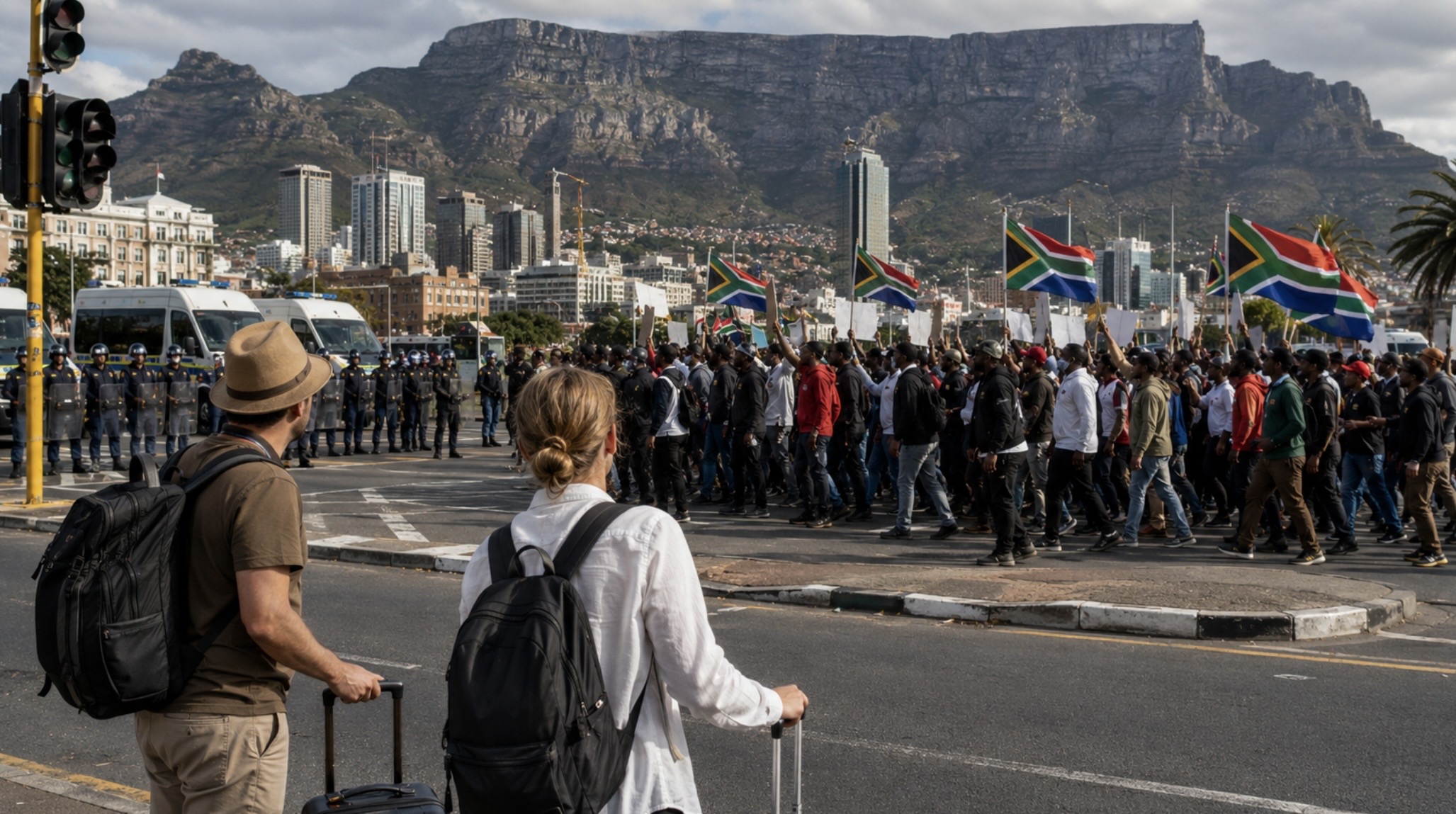
Cape Town and the June 30 Anti-Immigration Marches: What Is Happening
Situation Briefing · Cape Town The June 30 Anti-Immigration Marches: What Is Happening, and What Visitors Should Know Anti-immigration groups have set 30 June 2026…
Read Article
Is Cape Town's container port really bad?
Hero image: the working harbour at the Port of Cape Town · Frans-Banja Mulder, CC BY 3.0 , via Wikimedia Commons Editorial feature · capetowndata.com…
Read Article