How much energy do Cape Town's data centers need?
May 10, 2026

Cape Town's data centre boom: 580 MW, 34% of city power, and the price of becoming Africa's AI gateway
Four planned hyperscale data centres, Cavaleros's 360 MW Cosmas Data City, Equinix's two 80 MW sites at the old King David Golf Club, and Teraco's 60 MW expansion, would together draw 580 MW, equivalent to roughly 34% of Cape Town's current peak electricity demand of 1,676 MW. Construction proceeds without public disclosure of cooling water, diesel back-up volumes, or carbon footprint. This analysis maps who owns what, where the next gigawatt lands, and why a city built by subsea cables is becoming the AI gateway for the continent, and at what cost.
4 new Cape Town data centres
electricity demand of 1,676 MW
at Cape Town: 180+ Tbps
from $2.6B in 2025 (Arizton)
At a glance
Four planned hyperscale data centres would together draw 580 megawatts of electricity from Cape Town's grid. That is roughly 34% of the city's current peak demand of 1,676 MW (Daily Maverick, April 2026). The largest project, Cavaleros's Cosmas Data City, Cape Town, occupies a 100-hectare site and is widely understood, though never confirmed, to anchor Microsoft's South African AI build-out. Equinix's two new sites at the old King David Golf Club add 160 MW; Teraco's CT2 Brackenfell campus, completed at 50 MW in November 2025 with zero-water cooling, plans a further 60 MW. Beyond the headline number, this article maps Cape Town's existing footprint, Teraco's two campuses, Africa Data Centres' CPT1 and CPT2, Vantage CPT1, AWS's captive site near Dunoon, and the Atlantis Special Economic Zone's renewable-manufacturing hub, and the six subsea cables landing at Melkbosstrand and the city that make Cape Town the only realistic AI gateway for the African continent. South Africa accounts for roughly three-quarters of Africa's data centre capacity, yet the continent hosts only 409 MW of operational capacity, less than 1% of the global total. The build-out implied by the Cape Town pipeline alone, approximately 1,000 MW added nationally by 2029, equals one full stage of Eskom load shedding. Whether the grid, the water system, and the political consent to host this infrastructure all hold is the question this analysis tries to answer.
Four data centres = 34% of Cape Town's electricity supply
Combined planned demand of four new Cape Town data centres versus the city's current peak electricity demand of 1,676 MW. Cavaleros's 360 MW Cosmas Data City is the single largest planned facility in South African history. Sources: Daily Maverick (April 2026), City of Cape Town, Cavaleros Group, Equinix, Teraco.
Five facts before the detailed analysis
What's at stake
Cape Town's grid carries roughly 1,676 megawatts at peak demand. By the calculation that anchors this article, four planned hyperscale data centres want, between them, 580 MW. That is not a marginal addition. It is roughly a third of the city's existing peak load, concentrated on a handful of sites, drawn down by a small number of customers, and dedicated to computational work that is overwhelmingly served to clients outside South Africa.
The Cavaleros Group's Cosmas Data City, Cape Town is the largest of the four. Announced in late 2025, the 360 MW campus sits on a 100-hectare parcel and is widely understood, though never confirmed by either party, to be the South African anchor for Microsoft's expanding cloud and AI build-out. Equinix, the Nasdaq-listed colocation operator that opened its first South African facility in Johannesburg in 2024, has acquired land at the old King David Golf Club opposite Cape Town International Airport for two new sites totalling 160 MW. Teraco, the Digital Realty subsidiary that runs the largest existing footprint, plans a further 60 MW expansion on top of the 50 MW CT2 hyperscale campus it completed in Brackenfell in November 2025.
The arithmetic of these four projects produces the headline. The deeper story is what makes them possible, which combinations of geography, fibre, governance, and energy policy explain why hyperscalers are pouring capital into a city of fewer than five million people on the southern tip of Africa, and what infrastructure trade-offs the build-out forces on the city itself. Cape Town is a confluence point: six major subsea cables land at Melkbosstrand and the Cape region, the AWS Africa region has operated locally since April 2020, the Microsoft Azure South Africa region runs from twin sites in Johannesburg and Cape Town, and Google's R5-billion Equiano cable made landfall here in August 2022. None of those advantages is replicable elsewhere on the continent without a decade of capital investment.
The cost structure is also unusual. The City of Cape Town's overall electricity demand has fallen by nearly 20% since 2008, an artefact of behind-the-meter solar adoption among middle and upper-income households and of the load-shedding years that pushed major industrial users off the grid. A senior city official, asked about the implications of an additional 580 MW of data centre demand, told Daily Maverick in April 2026 that the additions "are not that great in scale and might well be seen as a welcome reinvigoration of a grid electricity business that is required to service and connect an increasing number of subsidised customers". The same article noted, however, that the city was "unable to provide information on the maximum demand projections at this time".
That gap, between the headline scale of what is being built and the city's capacity to plan around it, sits at the centre of this analysis. Eskom recorded more than 300 days without load shedding by early 2026 and projects a stable 2026 winter outlook. Energy analyst Chris Yelland, managing director of EE Business Intelligence, has cautioned that approximately 1,000 MW of new data centre demand nationally, combined with EV charging rollout and government subsidies for mothballed metal smelters, could re-tighten supply by 2029 unless substantial new generation is added rapidly. South African Finance Minister Enoch Godongwana designated data centres as critical infrastructure in his February 2026 budget speech, alongside electricity, ports, and transport networks. President Cyril Ramaphosa announced in his 2026 State of the Nation Address that more than 55 data centres had been built in the country with a further R50 billion (roughly $3.05 billion) in committed investment.
The numbers: South African capacity in continental context
To make sense of Cape Town's pipeline it helps to place it inside two larger frames. South Africa is the dominant data centre market in Africa, hosting approximately three-quarters of the continent's operational capacity, but Africa as a whole hosts only 409 MW of operational IT load, less than 1% of the global total. The numbers are small in international terms; the growth rates are not.
Mordor Intelligence values the African data centre market at $1.94 billion in 2025, growing to an estimated $4.36 billion by 2031, a compound annual growth rate of 14.5%. South Africa's share of that market sits at roughly 40-45% by value but considerably higher by IT load capacity. Arizton Advisory & Intelligence projects the South African data centre market alone to grow from $2.6 billion in 2025 to more than $5 billion by 2031. By IT load capacity, Mordor expects the African continent to grow from 1.17 thousand megawatts in 2025 to 3.46 thousand megawatts by 2030, a CAGR of 24.3%. South Africa is projected to deliver the bulk of that increment.
Inside South Africa, the picture is concentrated. Teraco alone holds 189 MW across its four campuses: the Isando complex in Johannesburg (JB1, JB3 and JB5 totalling 70 MW), the Bredell campus in Ekurhuleni (JB2 and JB4 totalling 64 MW), the Cape Town campus (CT1 in Rondebosch and CT2 in Brackenfell totalling 53 MW), and a single 2 MW Durban site. Teraco's published expansion target reaches 500 MW total capacity, including 290 MW of new capacity in Johannesburg and 60 MW in Cape Town. Vantage Data Centers operates approximately 80 MW across two Johannesburg campuses with a 16 MW Cape Town presence (CPT1). Africa Data Centres runs CPT1 (10 MW) and CPT2 (20 MW), the latter currently the largest single Cape Town facility. NTT operates further capacity in Johannesburg.
South Africa is roughly three-quarters of African capacity, but the continent is less than 1% of the world
Operational data centre IT load by region, 2026 (megawatts). Africa hosts approximately 409 MW; South Africa accounts for roughly 75% of that. Sources: BloombergNEF, Equinix Africa filings, Mordor Intelligence (Feb 2026).
Beyond the colocation operators sit the hyperscalers. Microsoft Azure runs cloud regions in Johannesburg and Cape Town, the latter brought online in March 2019. AWS opened the af-south-1 region in April 2020 with three availability zones, including a captive site visible in satellite imagery on Atlantic Drive near Dunoon, Cape Town. Oracle has announced South African plans without committing to specific facilities. Google does not operate a cloud region in South Africa but landed the Equiano subsea cable at Melkbosstrand in August 2022, an investment widely interpreted as the precursor to a future region announcement.
What "IT load" measures, and why it matters. A data centre's IT load (or critical IT load) is the power available to actually run servers, distinct from the larger total electrical capacity which includes cooling, lighting, and overhead. Teraco's 189 MW figure is IT load. The utility power supply required to deliver that load is typically 1.5 to 2 times higher. CT2 alone draws 90 MVA of utility power to deliver its 50 MW IT load. When this article discusses 580 MW of demand from the four planned Cape Town centres, it is the IT load figure. Total grid impact, including cooling and overhead, will be higher.
Who owns what in Cape Town
Cape Town hosts approximately 11 data centres operated by 8 distinct providers as of mid-2026, ranking it the second-largest data centre market in South Africa after Johannesburg, and the 28th-largest in EMEA. The composition is unusual: a handful of well-capitalised colocation operators, a few hyperscaler captive sites, and a small tail of niche providers. The 580 MW pipeline sits entirely in the colocation tier, but the demand pulling it into existence comes from the hyperscalers.
Teraco (Digital Realty)
Teraco runs two Cape Town facilities. CT1 sits in Rondebosch's Great Westerford Building (-33.971200, 18.464900), with 2,500 m² of white space and 5 MW of IT load. CT2 sits in Brackenfell on the city's northern outskirts, 30 km from the city centre. CT2 reached its full 50 MW IT load in November 2025 after the completion of an 8-data-hall expansion across three levels. The campus comprises 73,000 m² of building structure served by 90 MVA of utility power, with 18,000 m² of technical space across 16 data halls. Teraco describes CT2 as designed for liquid-to-liquid cooling, the configuration required by hyperscale AI training clusters and inference nodes. The campus is fibre-connected to CT1 with more than 7,000 cross-connects. Teraco has stated a target of 500 MW total platform capacity, of which 60 MW would be added in Cape Town in coming phases. Teraco's parent, Digital Realty, took a majority stake in Teraco in January 2022, in a deal valuing the company at roughly $3.5 billion.
Africa Data Centres
Africa Data Centres (ADC), part of the Cassava Technologies group, runs CPT1 and CPT2, both in greater Cape Town. CPT1 offers 3,600 m² of white space and 10 MW of IT load, with direct cloud-on-ramp connections to Microsoft Azure, Google Cloud, and AWS. CPT2 is the largest individual data centre in Cape Town today at 20 MW. ADC also operates JHB1 and JHB2 in Johannesburg, making it the largest pan-continental African data centre group; it serves clients across more than ten countries.
Vantage Data Centers
Vantage runs CPT1, a 16 MW base facility, and operates two larger campuses in Johannesburg (JNB1 and JNB2) targeting a combined 100 MW. Vantage's South African strategy has been broadly oriented toward Johannesburg, with Cape Town as the second leg.
Equinix (the new entrant)
Equinix entered South Africa via its $320-million 2022 acquisition of Nigeria's MainOne Cable Company, which gave it West African colocation alongside its eventual Johannesburg launch in October 2024. The Nasdaq-listed firm announced in April 2026 that it had acquired 327,000 m² of land across Johannesburg and Cape Town for a total of R890 million, as part of a R7.5-billion South African investment plan delivering 160 MW of new capacity. The Cape Town component, two new sites at the old King David Golf Club opposite Cape Town International Airport, is the subject of a formal civil-society objection filed in April 2026 by Foxglove and the Housing Assembly. The 160 MW figure is, in Equinix's own description, a "maximum-case scenario rather than committed or immediately deliverable capacity". The company has committed to 100% renewable energy coverage globally by 2030.
Cavaleros Group
Cavaleros is a Johannesburg-based property and development group founded in 1926, originally as a shopfitting business and now active in retail, industrial, hotel, and commercial property across South Africa. In late 2025 Cavaleros launched a data centre development unit and announced two campuses under the Cosmas Data Cities brand: a 200 MW site on 40 hectares in the Kosmosdal/Samrand area north of Johannesburg, and a 360 MW site on 100 hectares in Cape Town. The Cape Town site has not been precisely located in public documents. Both projects are positioned as future "availability zones" for hyperscale cloud and AI deployments. The Johannesburg site is described as having a 450 MW self-built switching station, suggesting Cavaleros is building both grid-grade electrical infrastructure and the data hall capacity that depends on it. Penny Cavaleros, group CEO, has emphasised the family business's five-decade real-estate track record. The Knight Frank EMEA data centre team and Future-tech are advising on site selection and engineering. Neither Cavaleros nor Microsoft has confirmed a relationship between the Cosmas projects and Microsoft's announced South African build-out, but the operational scale and timing strongly imply the connection.
Hyperscaler captive sites
AWS af-south-1 opened in April 2020 with three availability zones, physically distinct data-centre clusters separated for resilience but networked at low latency. AWS does not publish the locations of its data centres, but a satellite-visible facility on Atlantic Drive near Dunoon, Cape Town, has been documented in Daily Maverick reporting. Microsoft Azure operates regions in Johannesburg and Cape Town launched in March 2019, and announced in March 2025 a further R5.4 billion investment on top of the R20.4 billion already spent over the prior three years, to establish South Africa's first "enterprise-grade" data centres in Johannesburg and Cape Town.
The smaller tail
Open Access Data Centres operates two Cape Town facilities (Brackenfell and Belmont Office Park, Rondebosch). RSAWeb runs a smaller dual-power data centre. Several telecommunications operators run their own private data infrastructure for routing and customer-premises equipment, but these are not commercially available colocation capacity and do not appear in market sizing.
Teraco CT1 + CT2
53 MW today, +60 MW plannedCT1 Rondebosch: 5 MW, 2,500 m² white space, in Great Westerford Building. CT2 Brackenfell: 50 MW IT load (Nov 2025), 73,000 m² building, 18,000 m² technical space across 16 data halls. Zero-water closed-loop cooling. Liquid-to-liquid cooling capable. Connected to all six subsea cables at the Cape.
Africa Data Centres
CPT1 10 MW + CPT2 20 MWCPT2, Cassava-owned, currently the largest single Cape Town facility at 20 MW. CPT1 offers direct cloud-on-ramp connections to Azure, Google Cloud, and AWS. Pan-African footprint with sister facilities in JHB and ten other countries. 2N electrical topology and 48-hour generator backup.
Cavaleros Cosmas Data City
360 MW planned (100 ha)Largest single planned data centre campus in South African history. Linked, but not confirmed, to Microsoft's South African build-out. Knight Frank and Future-tech advising. Sister project at Samrand, Johannesburg (200 MW on 40 ha) with 450 MW self-built switching station. Phased construction; no public timeline.
Equinix (King David)
160 MW planned (2 sites)Two new sites at the old King David Golf Club opposite Cape Town International Airport. Land acquired April 2026. R7.5-billion total SA investment plan. Subject to formal civil-society objection (Foxglove + Housing Assembly + Legal Resources Centre, April 2026). 100% renewable energy commitment globally by 2030.
AWS af-south-1
3 availability zones, since 2020Cape Town region active since April 2020. Three physically distinct data-centre clusters. Captive Atlantic Drive site visible on satellite near Dunoon. AWS does not publish facility-level capacity. Compliance footprint (POPIA), and serves as launching point for South African public sector workloads.
Microsoft Azure
JHB + CT regions, 2019Cape Town and Johannesburg cloud regions launched March 2019. R5.4-billion further investment announced March 2025 (additional to R20.4 billion over prior three years). First "enterprise-grade" South African data centres announced jointly with President Ramaphosa and Microsoft President Brad Smith.
The full Cape Town site comparison
Every operational and planned facility, with the disclosed and inferred operational parameters, in one place. Status, IT load, cooling configuration, water disclosure, and renewable commitment are the five dimensions that matter most for assessing impact on the city's grid and water systems. Cells marked n.d. are not disclosed by the operator.
Rondebosch
Brackenfell
Elfindale
Cape Town
Cape Town
Stikland
Atlantic Drive (1 of 3 AZs)
CT region + JHB
King David Golf Club
King David Golf Club
Site location undisclosed
Brackenfell, phase 3
Total existing IT load across all operational Cape Town facilities: approximately 111 MW. Total planned IT load across all four announced pipeline projects: 580 MW. Existing + planned = 691 MW. This is the practical scale of what the city is being asked to host, and the share of disclosure that operators are willing to provide varies sharply between Teraco's published commitments and the not-disclosed posture of the largest planned project.
What "n.d." means here. The phrase not disclosed reflects the public information record as of May 2026, not a judgment about operator practices. Operators may share details with the City of Cape Town through confidential planning channels that are not part of the public application file. The Foxglove + Housing Assembly objection of 13 April 2026 turns on this exact distinction: whether confidential disclosure to the City satisfies the statutory disclosure standard for an application of this scale, or whether the public must also have access to the operational parameters before the City can lawfully approve the application.
Where they cluster: six locations carry the load
Cape Town's data centre footprint is geographically concentrated. Six locations carry essentially all of the existing and planned capacity, and the cluster pattern follows the city's twentieth-century industrial geography rather than its post-1994 residential growth. The result is that data centres tend to sit in light-industrial parks adjacent to high-voltage substations and major fibre routes, with proximity to either the airport or the subsea cable landing at Melkbosstrand as a secondary consideration.
Brackenfell (the new heart of the industry)
Brackenfell, on the city's north-eastern edge close to the N1 corridor toward Stellenbosch and Paarl, hosts Teraco's CT2 hyperscale campus and Open Access Data Centres' Chayyim Park facility. The CT2 site benefits from a 90 MVA utility supply, ample expansion land within the existing campus boundary, and the lowest-cost grid connection profile in metropolitan Cape Town. Teraco's planned 60 MW expansion will likely add to this cluster.
Rondebosch (the legacy centre)
Rondebosch hosts Teraco's CT1 in the Great Westerford Building (the first vendor-neutral colocation facility in Cape Town, opened in 2008) and Open Access Data Centres' Belmont Office Park site. Both are smaller-footprint facilities serving local enterprise rather than hyperscale customers. The southern suburbs location provides 10-km proximity to the city centre and 15 km to the airport but offers limited expansion potential.
Atlantic Drive, Dunoon (AWS captive)
AWS's identified captive site sits on Atlantic Drive near Dunoon in the city's northwestern industrial belt. The location places it close to the Melkbosstrand subsea cable landing (Equiano makes landfall 35 km north of Cape Town) and within the same grid feeder area as several major industrial users. The other two AWS availability zones serving af-south-1 are not publicly identified.
King David / King Air Industria (KAI)
The most contested location is the old King David Golf Club, opposite Cape Town International Airport, where Equinix plans two new 80 MW data centres on a 122,545 m² parcel rezoned as the King Air Industria (KAI) industrial development. The land owner is the King David Golf Club itself, which leased the land to KAI developers after merging in 2016 with King David Mowbray Golf Club following the closure of its airport-adjacent course. Equinix's planning application (Case ID: 1500156580) was lodged in early 2026 and drew the Foxglove + Housing Assembly objection on 13 April 2026. The site sits within view of three residential communities, Nooitgedacht, Matroosfontein, and parts of Gugulethu, whose right to information about diesel back-up generators, noise, and air quality forms a central part of the objection.
Atlantis Special Economic Zone
The Atlantis Special Economic Zone, located on the West Coast 40 km north of Cape Town and 105 km south of the Port of Saldanha Bay, is the only Greentech SEZ in Africa. Designated in June 2018 by then-Minister of Trade and Industry Rob Davies, the zone has attracted more than R3 billion in investment and created over 800 jobs. It hosts wind-tower manufacturing (Gestamp Renewable Industries produces components for Siemens turbines on site), solar component fabrication, and is positioned for green hydrogen development. Atlantis SEZ has not yet attracted hyperscale data centre development directly, but its renewable energy infrastructure, industrial-zoned land at scale, and explicit net-zero commitments make it a logical site for future facilities operating under power-purchase agreements with on-zone renewable generation. CEO Matthew Cullinan has attended industry conferences on electricity wheeling, the regulatory mechanism through which a data centre could buy renewable power generated at Atlantis. Board chair Saliem Fakir, executive director of the African Climate Foundation, brings sustainability policy weight.
Saldanha Bay Industrial Development Zone
The Saldanha Bay IDZ, designated in 2013 and roughly two hours' drive north of Cape Town, has not historically hosted data centres. The zone has attracted over R21 billion in investment focused on oil, gas, and marine engineering services. The combination of port access, industrial-zoned land, and (potentially) future renewable energy supply makes it a candidate for data centre development on a multi-year horizon. None of the four named pipeline projects are currently sited there, but Saldanha is on the list of prospective future locations canvassed by industry analysts.
Pulsing markers indicate the largest sites; click any pin to see operator, capacity, and status. The Cape Town pipeline concentrates around Brackenfell (Teraco CT2), Rondebosch (Teraco CT1, Open Access Belmont), Dunoon's Atlantic Drive (AWS captive), and the proposed King David / King Air Industria site (Equinix). The Atlantis Special Economic Zone is shown to the north as the renewable-manufacturing hub.
Why these locations and not others. Three factors determine site choice: grid proximity (within 1-2 km of a substation capable of delivering 50+ MW), fibre access (within reach of a major dark-fibre route), and land economics (industrial-zoned, large-parcel, with rezoning friction manageable). Brackenfell, KAI, and Cosmas's not-yet-public 100-hectare site all match these criteria. The Cape Town CBD, which has the highest fibre density in the city, is excluded by land cost and parcel size: there are no 50-MW-capable substations in walking distance of large industrial parcels.
The subsea cable advantage: six cables make Cape Town Africa's gateway
The single most important reason Cape Town is the African AI gateway, rather than Lagos or Mombasa or Cairo, is that six major subsea cable systems land at or near the city, providing a level of redundancy and aggregate capacity that no other African city can match. The economics of hyperscale data centres are driven less by computing cost than by latency: a millisecond saved on a New York-to-Lagos round trip is worth more than a megawatt of marginal compute. Cape Town's subsea geography is, in operational terms, a moat.
The six cables landing at the Cape are 2Africa (Meta-led, completed November 2025, 180 Tbps design capacity, 16 fibre pairs), Equiano (Google-funded, landed at Melkbosstrand August 2022, 144 Tbps capacity, 12 fibre pairs), WACS (West Africa Cable System, in service since 2012), SAT-3 / SAFE (the joint southern African to South-East Asia route, in service since 2002), and ACE (Africa Coast to Europe, in service since 2012). Of these, 2Africa and Equiano are by far the most consequential for AI workloads because of their capacity and modern architecture. 2Africa connects 33+ countries across three continents over 45,000 km of cable, making it the longest open-access submarine broadband cable system in the world; the Pearls extension into the Persian Gulf is scheduled for 2026.
Six subsea cables, 600+ Tbps of design capacity, all landing at Cape Town
Subsea cables landing at Cape Town or the immediate Cape region, by design capacity (Tbps), year of service entry, and primary owner. 2Africa and Equiano dominate by an order of magnitude over the older systems. Sources: Submarine Networks, TeleGeography, operator filings.
The Equiano cable lands at the Melkbosstrand Cable Landing Station, 35 km north of Cape Town along the West Coast. Openserve, Telkom's wholesale division, operates the South African landing partnership for Google's Equiano. Equiano connects Sesimbra in Portugal directly to South Africa, with branch lines to Lagos (Nigeria), Lomé (Togo), Swakopmund (Namibia), and Saint Helena. With 144 Tbps of design capacity over 12 fibre pairs, Equiano alone offers 20 times the capacity of the previous-generation cable serving the same region. 2Africa, completed in November 2025 by a Meta-led consortium with seven other partners, lands at multiple Cape Town and West Coast locations and adds 180 Tbps of design capacity, with 21 Tbps per fibre pair on the England-South Africa segment.
The strategic implication is that bandwidth, the historic constraint on African digital growth, has been removed for any user willing to pay continental rates. The new constraint is the local hop: from the Melkbosstrand cable landing station to the data centre. Teraco's CT1 and CT2 are linked to the Cape Town landing stations by diverse fibre routes, supporting more than 7,000 cross-connects on the campus. Cape Town in 2026 is the first African city in which an AI training cluster can be deployed with international-grade interconnect, on the same fibre pair as a New York or London hyperscale facility. That is the foundation under the entire 580 MW pipeline.
The AI demand surge: liquid-to-liquid cooling and the new economics of compute
The phrase that recurs in operator filings from 2024 onwards is liquid-to-liquid cooling. It is not jargon. It marks the technical break between traditional data centres and the AI training facilities that have driven the build-out announcements of the last eighteen months. Understanding it explains both why Teraco's CT2 was rebuilt to a different specification than CT1, and why the 580 MW Cape Town pipeline is sized the way it is.
A traditional enterprise data centre of the 2010s ran racks at 5 to 10 kilowatts of IT load each, cooled by air pushed through computer-room air-conditioning (CRAC) units. The architecture was modular and forgiving. Hyperscale cloud workloads, which arrived in earnest after 2018, pushed rack densities to 15 to 20 kW. Air cooling can handle this, just, with hot-aisle and cold-aisle containment. AI training clusters are different. A modern Nvidia H100 or H200 GPU server consumes 6 to 10 kW per unit; a single rack of eight servers can draw 80 kW. Even more aggressive configurations approach 130 kW per rack. At those densities, air cooling becomes physically impossible, the air can no longer carry heat away fast enough, and operators must move to direct-to-chip liquid cooling or full-immersion liquid cooling.
Rack power density jumped 15× in five years; air cooling breaks above 30 kW
Typical rack IT load (kW) by era and workload type, with the air-cooling physical limit annotated. The break-point at ~30 kW is the reason Cape Town's planned hyperscale campuses are being specified with liquid-to-liquid cooling rather than the air-handling architecture of the 2010s. Sources: Uptime Institute, Nvidia H100/H200 specs, AFCOM State of the Data Center 2025, operator filings.
This is what Teraco means when it says CT2 is "designed to support liquid-to-liquid cooling". The phrase signals that the chilled-water loop carrying heat out of the data hall is itself a liquid loop, capable of accepting waste heat from direct-to-chip systems rather than only from air-handlers. CT2's eight new data halls, each rated for 5 MW of critical IT load and grouped on three building levels, are the clearest indication in South African real estate of an operator preparing for the AI deployment cycle. Four of the new halls are designed for 5 MW each; two for 3.1 MW; two for 2.2 MW. The high-density halls are where Nvidia training clusters can plug in.
(enterprise, air-cooled CRAC)
(8 servers, 6-10 kW each)
(immersion / direct-to-chip)
(beyond this, liquid required)
The demand structure is bifurcated. AI training workloads, the multi-week compute jobs that produce the foundation models behind ChatGPT, Claude, Gemini, and the open-source equivalents, are concentrated, intensive, and largely insensitive to where in the world they run, as long as power is cheap and reliable. AI inference workloads, the per-request serving of completed models to end users, are latency-sensitive and want to be close to the user. Cape Town is uniquely positioned to host both: cheap renewable power potential through Atlantis SEZ wheeling for training, and the only African city with international-grade subsea connectivity for inference serving the continent.
What the build-out implies, if delivered, is that the African continent acquires for the first time the capacity to host frontier-model training runs locally rather than depending on US or European hyperscalers. A 360 MW campus is large enough to host a single training run of a frontier-class model, the kind of project that to date has only been possible inside the largest US clusters. Whether such workloads will actually land in Cape Town, or whether the capacity will go to inference and enterprise cloud workloads on a shorter latency budget, is a commercial question Cavaleros and Microsoft have not answered publicly.
The 2026 step change visible in operator behaviour, the planning applications, the land acquisitions, the cooling specifications, is fundamentally about preparing for AI workloads that did not exist when CT1 was designed in 2008. CT2's eight new high-density halls are the South African equivalent of the high-density build-outs that Microsoft, Google, and Meta have been undertaking in their US footprint since 2023.
The Cavaleros mystery: 360 megawatts and a non-confirmation
The single largest planned data centre in South African history has not been precisely located in any public document. The Cavaleros Group's Cosmas Data City, Cape Town sits on a 100-hectare site somewhere in or around the city. Phase one will draw 360 MW of IT load. The development partner is undisclosed. The anchor tenant is undisclosed. The construction timeline is undisclosed. What we know comes from a combination of company filings, an industry briefing reported by Data Center Dynamics in November 2025, and the visible activities of Knight Frank's EMEA data centre investment team and the engineering firm Future-tech, both of whom Cavaleros has named as advisors.
The Cavaleros family-owned property group, founded in 1926 originally as a shopfitting business, today operates a portfolio of retail, industrial, hotel, and commercial property across South Africa. The group has roots that predate apartheid. Its move into data centres is recent: a dedicated data centre development unit launched in late 2025 with the simultaneous announcement of two campuses, the Cape Town site at 360 MW and a sister site at Kosmosdal/Samrand north of Johannesburg at 200 MW on a 40-hectare parcel. The Johannesburg site is described as having a 450 MW self-built switching station, a piece of grid-grade electrical infrastructure that itself implies hundreds of millions of rand in capital, and that suggests Cavaleros is positioning to sell connection capacity to the grid as well as data hall space.
The reason the project draws such intense interest is the pattern of timing. In March 2025, in a joint announcement with President Cyril Ramaphosa, Microsoft President Brad Smith confirmed a further R5.4-billion investment in South African cloud and AI infrastructure, on top of the R20.4 billion the company had spent over the prior three years. The announcement specified Microsoft's first South African "enterprise-grade" data centres in Johannesburg and Cape Town. Eight months later, Cavaleros announced two campuses in those exact two cities, at scales that match the hyperscale specifications Microsoft uses elsewhere in the world. Asked whether the projects are connected, both parties have declined to confirm or deny.
What is known publicly: Penny Cavaleros, the group CEO, has framed the data centre push in terms of family business continuity. "For over five decades, the Cavaleros Group has built a legacy of vision, quality, and long-term partnerships," she said in the November 2025 launch statement. "These data centre developments continue that legacy, combining our real estate expertise with Knight Frank's industry insight and Future-tech's technical excellence to deliver infrastructure that powers Africa's digital transformation." Knight Frank's Oscar Matthews, head of EMEA data centre investment and development, has described Cavaleros as "a clear market leader with unmatched expertise", language unusual for a developer that has not yet broken ground on a data centre. Future-tech's Will Clarke has called the Johannesburg switching station investment "one of the most deployment-ready locations for hyperscale and AI investment in the region".
Cavaleros's responses to media questions have followed a pattern. On power supply: "Any planned additional supply will be regulated, and detailed configurations are not publicly disclosed." On carbon emissions estimates: "Environmental considerations are addressed through standard regulatory approval processes." On water consumption: water systems will be "designed in line with applicable industry standards and regulatory requirements. Further details are subject to strict non-disclosure agreements." The framing is technically defensible but, given the scale, raises questions about how the City of Cape Town will conduct the planning process when essential operational parameters are commercially sealed.
What we don't know. The 360 MW Cape Town site has not been geographically disclosed. Whether the anchor tenant is Microsoft remains unconfirmed. Whether on-site renewable generation, grid wheeling, or direct Eskom supply will provide the power has not been disclosed. Whether the campus will be built in one phase or over five years has not been disclosed. The construction start date has not been disclosed. The City of Cape Town has not, as of May 2026, received a formal rezoning application that the public can inspect for this site, suggesting that the announcement is several planning steps ahead of the public process. This is the largest single industrial project in the city's recent history and almost nothing about it is on the record.
The hyperscaler footprint: AWS, Microsoft, Google, Oracle
Cape Town has hosted hyperscale cloud capacity since March 2019, when Microsoft Azure opened twin regions in Johannesburg and Cape Town. It was Africa's first hyperscaler region. AWS followed in April 2020 with the Africa (Cape Town) region, identifier af-south-1, comprising three availability zones. Google Cloud has not announced a South African region but has established what is, in connectivity terms, the deepest investment of the four: the Equiano subsea cable landing at Melkbosstrand. Oracle has announced South African plans without committing to a specific facility. The combined effect is that all four major Western hyperscalers have made South Africa their continental priority, and three of them have placed their most consequential infrastructure in the Cape Town area specifically.
Microsoft (R25.8 billion committed)
Microsoft's South African investment, by its own published figures, totals approximately R25.8 billion over the period 2022 to 2026: R20.4 billion over the three years to early 2025, plus the further R5.4 billion announced in March 2025 alongside President Ramaphosa. The R5.4-billion tranche is specifically tied to "enterprise-grade" data centres in Johannesburg and Cape Town, language that signals capacity beyond the existing twin-region build. The Cosmas Data City connection, if it exists, would represent the leasing arrangement under which Microsoft secures multi-hundred-megawatt capacity through Cavaleros rather than building it directly. This is the standard hyperscaler model in markets where they want speed and capital efficiency over operational control.
AWS (af-south-1 since 2020)
The AWS Cape Town region launched 22 April 2020 with three availability zones (af-south-1a, af-south-1b, af-south-1c). AWS does not publish facility-level capacity figures or precise locations. The publicly identified captive site on Atlantic Drive near Dunoon represents one availability zone; the other two are not publicly placed. AWS's South African footprint dates back to 2004, when Amazon set up a Cape Town development centre that built core technologies including parts of EC2. A Johannesburg AWS office followed in 2015, AWS Direct Connect in 2017, and CloudFront edge locations in Johannesburg and Cape Town in 2018. The af-south-1 region serves South African government and enterprise workloads with POPIA-compliant data residency, and increasingly serves regional (sub-Saharan African) enterprise workloads.
Google (Equiano + edge, no region)
Google's investment in South African digital infrastructure, by company figures, exceeds R5 billion (approximately $260 million), the dominant component being the Equiano cable system. Google funded Equiano fully; it is the company's third private subsea cable globally after Curie and Dunant. Equiano's 144 Tbps design capacity over 12 fibre pairs, landing at Melkbosstrand in August 2022 and connecting Sesimbra in Portugal, represents an investment that was committed in 2019. It is widely interpreted as the prerequisite step for an eventual Google Cloud South African region, but no such region has been announced as of May 2026. Google operates CloudFront edge locations, content delivery network nodes, and partnership facilities through Openserve at the Melkbosstrand cable landing station, but does not yet operate a hyperscale captive data centre in South Africa.
Oracle (announced, not delivered)
Oracle announced South African data centre plans in 2024, with both Johannesburg and Cape Town locations under consideration. As of May 2026, no facilities are operational. Oracle's overall hyperscale strategy in Africa has been more cautious than the other three, and the company's Cape Town intentions remain at the announcement stage rather than the construction stage.
Hyperscaler disclosed investment in South Africa: Microsoft leads by an order of magnitude
Publicly disclosed cumulative investment in South African digital infrastructure (ZAR billions, with USD/EUR equivalents at April 2026 rates). Microsoft figure combines R20.4 bn (2022-early 2025) plus R5.4 bn (March 2025). Google figure dominated by the Equiano cable. AWS af-south-1 capacity disclosed but capital spend undisclosed; estimated range shown. Sources: Microsoft + Google + AWS official statements, Daily Maverick, ITWeb, company filings.
The collective implication of these four hyperscaler positions is that the demand pulling the 580 MW Cape Town pipeline into existence is real, contractually committed, and largely already underwritten. The colocation operators are building speculatively only at the margin. The bulk of the capacity coming online has tenants identified, even if the contracts are sealed under non-disclosure. Equinix's caveat that its 160 MW Cape Town pipeline represents a "maximum-case scenario rather than committed or immediately deliverable capacity" is the most public acknowledgment that some of the announced pipeline depends on demand materialising. Cavaleros's silence on tenancy is the more typical posture for a project of this scale.
The power question: 1,000 MW added, one stage of load shedding
The single most consequential number in this analysis is also the one that the City of Cape Town has declined to project: how much new electricity demand the data centre pipeline will actually create, and where the supply will come from. The 580 MW figure is the IT load number, the power that goes to running servers. Total grid demand including cooling and overhead is typically 1.4 to 1.6 times higher, putting the practical Cape Town impact in the range of 800 MW to 930 MW when fully operational. Nationally, including the Johannesburg expansions by Teraco and Cavaleros, the total IT load addition is in the order of 1,000 MW.
One thousand megawatts is precisely the increment that Eskom uses to define one stage of load shedding. Adding the data centre pipeline to demand, holding generation fixed, is therefore equivalent to introducing one full stage of load shedding's worth of new draw. This is the framing energy analyst Chris Yelland, managing director of EE Business Intelligence, has used in public statements: that the data centre additions, combined with EV charging rollout and government subsidies for mothballed metal smelters, would probably lead to constrained electricity supplies by 2029 unless substantial new generation is added rapidly.
The context for this warning is the Eskom recovery itself. Through 2023 and 2024, South Africa endured stages of load shedding that, in the worst weeks, took the grid out for 8 to 12 hours per day. Beginning in late 2024 and through 2025, Eskom's Generation Recovery Plan, focused on intensive maintenance of existing stations and improved operational management, drove a sustained improvement. By early 2026 the country had recorded more than 300 consecutive days without load shedding. Eskom published a 2026 Summer Outlook on 5 September 2025 projecting no load shedding through 31 March 2026, and an April 2026 Winter Outlook projecting continued stability through 31 August 2026. Diesel consumption from open-cycle gas turbines fell by more than 96% year-on-year in early 2026. The Energy Availability Factor (EAF), the share of installed capacity actually able to generate, climbed from below 60% in 2023 to above 68% in late 2025 and approaching 71% by mid-2026.
The Cavaleros, Equinix, and Teraco projects are being announced into this stabilised grid environment. The risk Yelland identifies is that the stabilisation has not been accompanied by significant new generation capacity. The Kusile coal-fired station reached full capacity in early 2026 (4,800 MW); the renewable energy IPP procurement programme has produced incremental additions; behind-the-meter rooftop solar has added several gigawatts of nameplate capacity. But the country's installed generation base in 2026 is not materially larger than it was in 2023. The recovery has come from making the existing fleet work, not from adding new fleet. Adding 1,000 MW of new continuous data centre demand to that base, without commensurate new generation, narrows the margin.
Cape Town peak demand has fallen for a decade, the data centre pipeline reverses the trajectory
City of Cape Town peak electricity demand (MW), historic 2008-2024 plus three projection scenarios to 2030. The 20% drop since 2008 was driven by behind-the-meter solar, industrial offtake, and load shedding adaptation, not by deliberate capacity reduction. The data centre pipeline, at its practical grid impact (1.4-1.6× IT load), would reverse approximately a decade of demand decline. Sources: City of Cape Town historic demand series, Daily Maverick (April 2026), analyst projections.
Eskom recovery: the data underneath
The macroeconomic context for the data centre announcements is the Eskom turnaround. Three indicators capture the shift between 2023 and 2026: load shedding hours, Energy Availability Factor (EAF), and open-cycle gas turbine (OCGT) diesel burn. All three moved sharply in the right direction over an 18-month period.
load shedding (early 2026)
by mid-2026 (was <60% in 2023)
early 2026 vs early 2025
achieved early 2026
The City of Cape Town's response to Daily Maverick's questions about the 34% calculation deserves close reading. Asked whether four data centres drawing 580 MW could be accommodated against a peak demand of 1,676 MW, the city said it was "unable to provide information on the maximum demand projections at this time". The same official noted that overall customer demand for electricity in Cape Town had dropped by nearly 20% since 2008. The implication, that historic demand reduction creates headroom for new industrial users, is technically defensible. But it leaves several questions unanswered. The 20% drop is largely an artefact of upper- and middle-income behind-the-meter solar installations and of industrial load that has left the city, not of capacity being deliberately freed for new connections. A senior city official told the same publication that the additional data centre demand "are not that great in scale and might well be seen as a welcome reinvigoration of a grid electricity business that is required to service and connect an increasing number of subsidised customers". The framing is interesting: a data centre customer paying commercial tariffs becomes the cross-subsidy that allows the grid to maintain service to subsidised residential customers.
National government has moved to formally support the build-out. In his February 2026 budget speech, Finance Minister Enoch Godongwana designated data centres as critical infrastructure, alongside electricity, ports, and transport networks. The designation means easier access to streamlined regulatory approvals, fast-tracked grid connection processes, and treatment of data centre investments as priority projects in the national infrastructure plan. President Ramaphosa, in his February 2026 State of the Nation Address, announced that more than 55 data centres had been built in the country with a further R50 billion (roughly $3.05 billion) in committed investment to come.
The water question: zero-water cooling and the Day Zero memory
Cape Town nearly ran out of water in early 2018. Day Zero, the date by which the city's dam levels were projected to fall below the threshold at which household taps would be cut and residents would queue at distribution points, was announced for 22 April 2018. It did not happen, narrowly, because of severe water restrictions, behavioural shifts, augmentation projects, and the start of the rains. But the city in 2026, with a population of roughly five million, remains acutely sensitive to water availability and has internalised the discipline of measuring industrial water use far more rigorously than most cities of comparable size. This is the political and operational backdrop against which the data centre water question must be read.
Hyperscale data centres elsewhere in the world consume substantial volumes of water. A typical large facility using evaporative cooling can use 3 to 5 million litres per day, equivalent to the residential water use of 10,000 to 15,000 households. The water is consumed because evaporative cooling, where heat is transferred from the data centre's chilled-water loop to the atmosphere by evaporating water in cooling towers, is the most energy-efficient way to reject heat at warm-climate sites. Less water-intensive options exist, including air-cooled chillers and closed-loop systems, but they consume more electricity to do the same work.
Teraco's CT2 in Brackenfell is the public benchmark for how a Cape Town data centre should respond to this question. Teraco describes CT2 as built with "a state-of-the-art zero-water closed-loop cooling system". The phrase means that no fresh water is consumed for cooling under normal operations; the chilled-water loop is sealed and rejects heat through air-cooled chillers. The configuration uses more electricity than evaporative cooling would, but in a city where water has been a recent emergency and electricity is being directly addressed by Teraco's own 120 MW solar PV programme, the trade-off is reasonable. The CT2 specification establishes a precedent: any new Cape Town data centre asking for water-cooling permits will be measured against the zero-water benchmark.
The other three projects in the pipeline have not, as of mid-2026, made comparable public commitments. Cavaleros's response to direct questions from Daily Maverick on water consumption was: water systems will be "designed in line with applicable industry standards and regulatory requirements. Further details are subject to strict non-disclosure agreements". Equinix's land-use planning application for the King David sites, in the form publicly available, did not specify cooling technology, water source, or projected consumption. The 24-page motivational letter Equinix submitted to the City of Cape Town as part of the rezoning application said "nothing about water", in the language of the formal objection lodged by Foxglove and the Housing Assembly on 13 April 2026.
Daily water draw: closed-loop vs evaporative cooling, expressed in Cape Town households
Daily fresh-water consumption of the 580 MW Cape Town pipeline under three cooling configurations, expressed both in millions of litres per day and as the residential-equivalent number of Cape Town households (at 350 L/day typical post-Day-Zero use). The choice between Teraco-style zero-water and conventional evaporative cooling is, at scale, the difference between a non-event and a small suburb's worth of water demand. Sources: industry cooling specifications, City of Cape Town residential demand averages.
The objection makes the case in technical terms: "In the absence of any information from the applicant about the cooling technology, water source, or projected consumption of these facilities, the City cannot assess the impact on Cape Town's water infrastructure, a city that narrowly avoided 'Day Zero' in 2018 and remains acutely vulnerable to water scarcity." Without disclosure of how the cooling will be configured, the city is being asked to approve a 160 MW industrial development whose water demand could plausibly range from zero (closed-loop) to several million litres per day (evaporative). The objection asks the City of Cape Town to decline to consider the application in its current form, and instead to compel the developer to provide the missing information.
Cape Town's water position in 2026 is materially better than in 2018. Major dams sit close to historic seasonal averages, the Voëlvlei augmentation project is online, and seawater desalination has moved from emergency to permanent infrastructure. But the city's water demand projections assume continued residential and commercial efficiency improvements; they do not factor in industrial users at the scale of a 160 MW data centre using evaporative cooling. If even one of the three undisclosed projects opts for evaporative cooling, the cumulative water draw on Cape Town's supply could exceed 10 million litres per day, equivalent to the residential consumption of approximately 30,000 households at typical usage rates. Whether that is acceptable is not a technical question. It is a political one, and one for which the city's planning system is supposed to provide a public process, not a sealed approval.
What zero-water cooling looks like in operation. A closed-loop system uses approximately 10-15% more electricity than an evaporative system to do the same work, because air-cooled chillers are less thermally efficient. For CT2 at full 50 MW IT load, the additional electricity is in the range of 4-6 MW continuous. This is real cost. Teraco's response has been to underwrite that additional electricity through its 120 MW solar PV development at Lephalale and a wheeling arrangement that routes solar energy to the data centres. The Cape Town water question and the Cape Town renewable energy question are, in operator terms, two aspects of one decision.
Renewables, wheeling, and the Atlantis advantage
The cleanest answer to both the power question and the water question is renewable generation, ideally located in the Western Cape itself, dedicated to data centre offtake. The legal mechanism that makes this possible is electricity wheeling: a renewable generator at one location sells power directly to a customer at another location, with the national grid providing transmission services for a fee. South Africa enabled wheeling at scale through reforms in 2022 and 2023; the regulatory framework now allows large-scale corporate power purchase agreements (PPAs) outside Eskom's traditional monopoly procurement.
Teraco has moved fastest on this. The company's stated renewable strategy, announced alongside the CT2 expansion in November 2025, is to develop a 120 MW solar PV plant for direct supply to its data centres through wheeling. This is in addition to the company's earlier investment in a Lephalale solar farm. The model is: Teraco owns the renewable generation asset, the power flows through the Eskom transmission network to Teraco data centres in Johannesburg and Cape Town, and the carbon footprint of the IT load is offset by direct attribution to the renewable plant. Teraco's long-term goal is 100% renewable power across its platform. CT2's zero-water cooling, which uses more electricity than evaporative cooling would, is paid for in carbon terms by the renewable generation.
Equinix has made a parallel commitment: 100% renewable energy coverage globally by 2030, already achieved across the company's Europe, Middle East, and Africa operations as of 2026. The South African delivery model will combine power purchase agreements (PPAs), Energy Attribute Certificates (EACs/REGOs), and, where feasible, direct investment in new wind and solar generation. The grid connection itself flows through the City of Cape Town's electricity distribution network, with upstream generation ultimately sourced from Eskom plus the contracted renewable suppliers.
Atlantis SEZ: the structural advantage
The Atlantis Special Economic Zone, 40 km north of Cape Town on the West Coast, is positioned to become the strategic anchor of the renewable generation that supplies Cape Town's data centre fleet. The zone was designated in June 2018 specifically as a Greentech SEZ, the only one in Africa with that focus. CEO Matthew Cullinan and board chair Saliem Fakir, the latter the executive director of the African Climate Foundation, lead an entity that has attracted more than R3 billion in investment, created over 800 jobs, and now hosts wind-tower manufacturing (Gestamp Renewable Industries makes Siemens turbine components on site), solar component fabrication, and adjacent green industries. The zone offers industrial-zoned greenfield and brownfield land at scale, fast-tracked development approvals, fee exemptions, and connection to the renewable energy generation that the Western Cape Province has been actively procuring under the Renewable Energy Independent Power Producer Procurement Programme (REIPPPP).
For a data centre operator, the value proposition is straightforward. Atlantis offers proximity to renewable generation that can be wheeled to data centre sites, port access via Saldanha Bay (105 km), proximity to Cape Town's commercial centres (40 km), and a regulatory environment specifically designed to support green industrial development. None of the four projects in the current pipeline is sited at Atlantis, but the SEZ has been canvassed by analysts as a likely future location for a fifth or sixth wave of data centre development, particularly for hyperscale projects whose operators want the strongest possible renewable energy claim.
The wheeling economics
The reason wheeling matters operationally is that data centres must run continuously. A solar farm produces power for roughly 8 hours a day at full output; a wind farm operates with a capacity factor of 35-45%. To supply a continuous 100 MW data centre load with renewable generation alone requires a combination of overprovisioning, storage, and grid balancing. Teraco's approach has been to overprovision (a 120 MW solar plant for, ultimately, 60-80 MW of continuous data centre demand) and rely on the grid to balance during off-peak generation hours. Equinix's approach mixes PPAs with grid offtake. Cavaleros has not disclosed its renewable strategy.
The political and economic implication is that Cape Town's data centre boom is structurally compatible with South Africa's renewable energy build-out. A 580 MW data centre demand, supplied at 70% renewable factor, requires roughly 1,500 MW of new wind and solar generation dedicated to the offtake. That represents an investment in the order of R30-50 billion in renewable plant, mostly in the Western and Northern Cape. South Africa's REIPPPP programme procures roughly 5,000 MW in each round; the Cape Town data centre demand alone could justify a procurement round of equivalent scale. Whether the political will and the procurement pace exist to deliver this is a separate question, but the technical and economic alignment is favourable.
The political fight: Foxglove, the Housing Assembly, and Maine
On 13 April 2026, the London-based non-profit Foxglove, a legal-and-tech-policy organisation that previously forced the UK government to reverse a hyperscale data centre approval, joined with the Cape-based Housing Assembly and, through the Legal Resources Centre, lodged a formal objection to Equinix's planning application for two new data centres at the old King David Golf Club site (Case ID: 1500156580). The objection is the first of its kind against a South African data centre project and, depending on how the City of Cape Town responds, may set the template for how the rest of the 580 MW pipeline is processed.
The substance of the objection is procedural. "This application asks the City to approve one of the largest and most resource-intensive developments in the northern suburbs on the basis of a 24-page motivational letter that says nothing about water, nothing about emissions, limited on electricity, nothing about diesel generators, nothing about air pollution, nothing about noise, and provides no plans for the buildings themselves." The argument is not that the project should not be built, but that the City of Cape Town cannot lawfully approve the application as filed because Equinix has provided insufficient information for the City to assess the impact under its statutory duties.
The communities adjacent to the King Air Industria site are Nooitgedacht, Matroosfontein, and parts of Gugulethu. These are working-class and historically disadvantaged neighbourhoods sitting under the Cape Town International Airport flight path and within line of sight of the proposed data centre footprint. The objection draws specific attention to the right of these residents to know how many diesel back-up generators will be installed, how much fuel will be stored on site (with attendant fire and pollution risks), what air pollutants might be emitted, what noise the chillers and generators would produce, and what visual impact the buildings themselves would create. None of this information is in the public planning record.
Foxglove and the Housing Assembly note the precedent: in early 2026, Maine became the first US state to pass a statewide data centre ban, in response to growing public pushback against the rapid roll-out of hyperscale infrastructure. Earlier in 2026, a Foxglove-led legal action forced the UK government to reverse plans to push through a hyperscale data centre approval against local opposition. The Cape Town objection is part of a larger global pattern: the AI-driven build-out of hyperscale capacity is moving faster than the planning systems designed to assess it. In South Africa, the question is whether the City of Cape Town's assessment process, and the political space the City makes available for objection, can match the scale and speed of the build-out that the national government's critical-infrastructure designation is actively encouraging.
The Housing Assembly's framing situates the objection in a broader claim about housing and infrastructure equity. The organisation represents residents of informal settlements, backyard dwellings, temporary relocation areas, rental properties, and Reconstruction and Development Programme (RDP) housing. Its case is that public infrastructure, water, electricity, the city's planning capacity, is a contested resource, and that allocating substantial chunks of that resource to commercial data centres without public consultation amounts to a transfer of capacity from the city's most vulnerable residents to its most powerful international investors. The argument may or may not prevail in court; politically, it shapes the terrain on which the rest of the pipeline will be approved or contested.
Equinix and the King Air Industria developers had 30 days to respond to the objection from the date of filing. The City of Cape Town must make a decision on the application within 180 days of receiving the applicant's response. As of mid-May 2026, the process is in its early stages. Equinix's published statements have emphasised the company's renewable energy commitments and operational standards but have not directly addressed the specific information gaps identified in the objection. A successful objection would force Equinix to lodge a more comprehensive application with full disclosure of cooling technology, water source, projected consumption, diesel generator specifications, and noise and air-quality assessments. If the City rules in favour of the objectors, the same disclosure standard would, in practice, apply to Cavaleros's much larger 360 MW project as well.
What the political fight signals. South Africa's planning system is now part of a global pattern in which civil society organisations are using procedural objections to slow down or shape hyperscale data centre approvals. Whether the King David objection succeeds, the precedent of a formal objection backed by international NGO capacity (Foxglove) and Cape-based community organising (Housing Assembly) creates a template that future objections are likely to follow. Operators that want to move quickly will need to lodge applications with full disclosure of operational parameters, accept higher levels of community engagement than has been standard practice, and, at minimum, match Teraco's published commitments on water and renewable energy.
Outlook 2026-2030: three scenarios
The 580 MW Cape Town pipeline announced in 2025 and 2026 will not be delivered uniformly. The plausible range, looking from mid-2026 toward 2030, is between roughly 200 MW and 600 MW of actually-online capacity, with the remainder either delayed, restructured, or cancelled. Three scenarios capture the realistic envelope of outcomes.
Scenario A: Steady build (most likely, ~50% probability)
Teraco delivers the 60 MW Cape Town expansion on its previously announced schedule, bringing the Cape Town campus to roughly 113 MW by 2028. Equinix delivers approximately 80 MW at the King David site by 2029 after a delayed planning process that responds to the Foxglove objection with revised disclosures. Cavaleros delivers an initial 100-150 MW phase of Cosmas Data City Cape Town by 2030, considerably less than the announced 360 MW. Combined Cape Town additions reach roughly 250-300 MW. The Eskom grid recovery holds. Renewable energy procurement keeps pace. Cape Town becomes the African AI gateway by 2030 but at a measured pace that the city's planning system can absorb. Water and political objections are addressed by operator transparency improvements and community benefit programmes that resemble the European playbook.
Scenario B: Hyperscaler land grab (~30% probability)
The Cavaleros-Microsoft connection is confirmed in 2027 and the full 360 MW Cape Town campus moves into accelerated construction, supported by Microsoft's R5.4-billion investment. Equinix's full 160 MW pipeline is delivered by 2029. Teraco accelerates its expansion to keep pace. Combined Cape Town additions reach close to the full 580 MW by 2030. South Africa becomes a globally significant AI infrastructure hub. The Eskom grid is stressed by the addition; new generation capacity must come online faster than currently planned, with significant private capital flowing into renewable wheeling agreements. Water disclosure becomes mandatory for all new applications. Political opposition consolidates into a recognisable national movement. Cape Town's data centre footprint approaches 700 MW total operational capacity by 2031.
Scenario C: Regulatory tightening (~20% probability)
The Foxglove + Housing Assembly objection succeeds; the City of Cape Town imposes much higher disclosure requirements on all data centre applications. Cavaleros's 360 MW project is delayed by 2-3 years through a more extended planning process. Equinix's King David sites are reduced to one facility instead of two, with a comprehensive renewable and water plan. Teraco's expansion proceeds but at a measured pace. Microsoft adjusts its South African strategy by directing more of its R25.8-billion commitment toward Johannesburg sites where political resistance is more diffuse. Cape Town additions reach only 150-200 MW by 2030. The country's AI infrastructure hub status moves north toward Gauteng, with Cape Town retaining its role as the connectivity gateway through subsea cables but losing its position as the primary hyperscale hub. Atlantis SEZ becomes the focus of a slower, more sustainability-focused build-out from 2028 onwards.
Variables that determine which scenario plays out
Watch list 2026-2028Eskom EAF and load shedding status; the Foxglove objection ruling and any subsequent appeal; Cavaleros-Microsoft confirmation or non-confirmation; the timing of any new Microsoft Azure region announcement; renewable energy procurement pace; the City of Cape Town's disclosure standards; Atlantis SEZ first data centre tenant; Google Cloud South African region announcement.
Risks to all scenarios
External shocksA return to load shedding above Stage 2; a water crisis in 2027 or 2028 that recreates Day Zero conditions; a global AI capital expenditure pullback if foundation model returns disappoint; rand depreciation that materially raises the dollar cost of imported equipment; a change in national government posture on data centre critical-infrastructure status; subsea cable damage that disrupts Cape Town's connectivity advantage.
What is not in doubt across all three scenarios is that Cape Town will be a materially different infrastructure city by 2030 than it was in 2025. Whether the additional capacity is 200 MW or 580 MW, the data centre footprint becomes a structural feature of the city's industrial economy. The connectivity advantage from subsea cables is locked in. The hyperscaler presence is committed. The question is the pace, the political consent, and the degree to which the build-out is matched by renewable generation and water-efficient cooling. Cape Town's planning system, the operators' disclosure practices, and Cape Town's political society will all be shaped by this build-out as much as they shape it.
Practical guide: businesses, residents, investors
For different audiences, the data centre build-out raises different practical questions. The following short guide draws together the most relevant considerations for businesses considering colocation, residents who live near or rely on the same grid as the new sites, and investors looking at where the next site goes.
For businesses: where to colocate, and on what terms
If you need full hyperscale cloud (AWS, Azure, soon possibly GCP): AWS af-south-1 has been operational since April 2020 with three availability zones. Microsoft Azure South Africa runs from Johannesburg and Cape Town regions since March 2019. Both are mature offerings with full POPIA compliance and standard pricing. Latency to European endpoints is sub-150 ms via the Equiano route. Latency to North America averages 220-250 ms. For data residency requirements, both options keep data in South Africa.
If you need vendor-neutral colocation: Teraco's CT1 (Rondebosch) is the long-established option for enterprise and small-to-medium hyperscale workloads. Teraco's CT2 (Brackenfell), now operational at 50 MW IT load with liquid-to-liquid cooling support, is the option for AI workloads requiring high-density racks. Africa Data Centres' CPT2 at 20 MW is the largest single facility for non-hyperscale workloads. Vantage CPT1 at 16 MW is a solid mid-tier option. All four operators offer direct cloud on-ramps to AWS Direct Connect and Microsoft Azure ExpressRoute.
If you need AI training capacity: Teraco CT2 in Brackenfell is the only Cape Town facility with publicly committed liquid-to-liquid cooling support across multiple high-density data halls. Other options will likely emerge from the Cavaleros and Equinix pipeline by 2028-2029.
Pricing: South African colocation pricing in 2026 ranges roughly R8,000 to R15,000 per kW per year for premium colocation, depending on facility, redundancy level, and contract length. Pricing in Cape Town carries a slight premium over Johannesburg of roughly 5-10%, justified by subsea cable diversity and the smaller competitive set.
For residents: what to ask the City
If you live near a proposed data centre site (most relevant near Brackenfell, KAI, Atlantis, or any future Cosmas location), the questions worth asking the City of Cape Town and the developers are: (1) cooling technology and projected daily water consumption; (2) number of diesel back-up generators, fuel storage volume, and emissions profile; (3) noise specifications for chillers and generators; (4) air quality monitoring commitments; (5) renewable energy supply commitments; (6) jobs and community benefit commitments. The Foxglove + Housing Assembly objection provides a useful template for the standard of disclosure that should be expected.
If you live elsewhere in Cape Town, the relevant questions concern the cumulative impact on the city's electricity and water systems. The City has not yet published projections of how the 580 MW pipeline interacts with existing residential and commercial demand. Asking for these projections, and for the modelling assumptions behind the senior official's claim that data centre demand is a welcome "reinvigoration of a grid electricity business", is reasonable civic engagement.
For investors: where the next site goes
The colocation operator stack in 2026 is approaching the natural concentration limit for a mid-sized national market. Teraco (Digital Realty), Africa Data Centres (Cassava), Vantage, Equinix, and Cavaleros account for essentially all the announced pipeline. The interesting investment opportunities are in the supporting infrastructure: renewable generation dedicated to data centre offtake (mostly Western and Northern Cape solar, eastern and southern Cape wind); grid-grade electrical infrastructure (Cavaleros's 450 MW Samrand switching station as a model); submarine cable backhaul and metro fibre (the local network between Melkbosstrand and the Brackenfell or Dunoon clusters); and specialist services (data centre engineering, security, power equipment, cooling specialists). The Cape Town pipeline alone implies roughly R30-50 billion of capital flowing into supporting infrastructure over the next five years.
The Atlantis SEZ stands out as the most interesting greenfield investment location. The combination of greentech designation, port access, fast-tracked approvals, available industrial-zoned land, and proximity to renewable generation makes it a natural location for a fifth-wave data centre development that has not yet been announced. The Saldanha Bay IDZ is a longer-horizon prospect (post-2030). The Stellenbosch and Paarl wineland corridors east of Cape Town are unlikely candidates for hyperscale facilities but plausible for smaller specialist data centres given the universities, telecommunications operators, and corporate headquarters in the area.
Your business's compute footprint
Slide the rack count to see what a Cape Town colocation deployment of that scale implies in cost, water, and residential-equivalent power. Useful for sizing a request to a colocation operator, or for understanding the scale of the planned 580 MW pipeline relative to your own footprint.
For 10 racks: a typical mid-sized enterprise deployment, well below hyperscale.
Indicative ranges based on industry averages. Actual costs depend on contract length, redundancy tier, power density, and operator. Cape Town colocation pricing in 2026 ranges roughly R8,000 to R15,000 per kW per year. Water consumption assumes evaporative cooling; closed-loop systems (Teraco CT2 standard) consume effectively zero. Reference FX (20 April 2026): R 1 ≈ €0.052 ≈ $0.061. The 580 MW pipeline = roughly 70,000 racks of equivalent capacity.
Frequently asked questions
Sources and methodology
Government and institutional sources
- City of Cape Town, official statements on electricity demand projections; municipal planning records (Case ID: 1500156580 for the King Air Industria rezoning).
- Eskom, Summer Outlook September 2025; Winter Outlook April 2026; weekly system status updates 2025-2026; Generation Recovery Plan documentation.
- South African National Treasury, Finance Minister Enoch Godongwana's February 2026 budget speech designating data centres as critical infrastructure.
- Office of the Presidency, President Cyril Ramaphosa's 2026 State of the Nation Address; March 2025 joint announcement with Microsoft President Brad Smith.
- Department of Trade, Industry and Competition, Special Economic Zone designations and reports; Atlantis SEZ documentation.
- Western Cape Government, provincial economic indicators; Atlantis SEZ board reporting.
Industry data and operator filings
- Teraco / Digital Realty, CT2 expansion announcements (November 2023, November 2025); company fact sheets for CT1 and CT2; CEO Jan Hnizdo public statements.
- Equinix, South African investment announcement (April 2026); MD Sandile Dube public statements; planning applications.
- Cavaleros Group, Cosmas Data Cities project announcements (November 2025); CEO Penny Cavaleros statements; spokeswoman Mikaela Potgieter responses.
- Africa Data Centres / Cassava Technologies, facility documentation for CPT1, CPT2.
- Vantage Data Centers, facility documentation for CPT1.
- Microsoft, March 2025 R5.4-billion investment announcement; cumulative South African investment figures.
- Amazon Web Services, af-south-1 region launch (April 2020) and operational documentation.
- Google, Equiano cable funding and landing announcements (2019-2022).
- Atlantis Special Economic Zone, investor reporting; CEO Matthew Cullinan public engagements; Board Chair Saliem Fakir public statements.
- Submarine Networks / TeleGeography, subsea cable system specifications, capacities, landing locations.
Market analysis
- Mordor Intelligence, Africa Data Center Market Size & Share Outlook to 2031 (February 2026).
- Arizton Advisory & Intelligence, South Africa Data Center Market 2025-2031 projections.
- BloombergNEF, operational data centre capacity by region (2026); Equinix coverage.
- Knight Frank, EMEA data centre investment commentary; Cavaleros project advisory.
- Future-tech, data centre engineering services commentary on the Cosmas projects.
- EE Business Intelligence, Chris Yelland's grid risk analysis (2026).
Media coverage and analysis
- Daily Maverick, primary investigative coverage of the 34% calculation, the Cavaleros mystery, the Foxglove objection, and the Cape Town power and water questions (February-April 2026).
- TechCentral, Equinix doubles down on South Africa (April 2026); Sandile Dube interviews.
- Data Center Dynamics (DCD), Cavaleros launch coverage (November 2025); Teraco JB4 and CT2 expansion reporting.
- Engineering News / Creamer Media, Equiano cable launch coverage; Teraco CT2 expansion.
- BusinessTech, Bizcommunity, South African industry coverage.
- Bloomberg, Equinix CEO interviews; Eskom stability reporting.
Civil society and policy
- Foxglove, formal objection to King David Golf Club rezoning (13 April 2026); UK and US data centre litigation precedents.
- Housing Assembly, Cape Town community organising and housing rights advocacy.
- Legal Resources Centre, non-profit law clinic representing the objectors.
- African Climate Foundation, Saliem Fakir's policy work on green industrialisation.
Internal links
- Why Cape Town ranks 7th in the world for traffic congestion
- Cape Town's safety map: police precinct crime, Q3 2025/26
- Cape Town's rental market: pressure and spillover
- Cape Town's water: from Day Zero to 2026
- 2026 municipal elections: what the property market is pricing in
- Cape Town's family suburbs: a 2026 guide
- Coastal spillover: Hermanus, Langebaan, the Garden Route
- Helderberg property market 2025: where to buy
- Western Cape's overseas buyers: 2024-2026 trends
- Cape Town's school district guide: 2026 edition
Methodology. All capacity figures are stated as IT load (critical IT power), the standard industry metric. Total grid impact, including cooling and overhead, is typically 1.4 to 1.6 times higher. The 580 MW Cape Town pipeline figure follows the calculation in Daily Maverick (28 April 2026); the 34% comparison divides this by Cape Town's current peak demand of 1,676 MW per the same source. African capacity figures (409 MW) follow BloombergNEF and Equinix filings as of early 2026. Market sizing follows Arizton (South Africa) and Mordor Intelligence (Africa). All ZAR currency figures are reported in nominal rand. Reference exchange rate (20 April 2026): R 1 ≈ €0.052 ≈ $0.061 (1 EUR ≈ R 19.27, 1 USD ≈ R 16.41), per Xe / Trading Economics mid-market rates. All conclusions and interpretations in this article are the responsibility of the author.
Disclaimer. This content is for informational purposes only. It does not constitute investment, legal, planning, or operational advice. Capacity figures, ownership relationships, and project timelines change rapidly in this sector; readers should verify the latest data with operators directly before making decisions. Quoted statements are reproduced as published in the cited sources. The article expresses the views of the author and may be updated as new data becomes available.
You May Also Like
Where Are South Africans Emigrating? Data-Driven Analysis 2026
Photo courtesy of Nic0, Wikimedia Commons, licensed under CC BY-SA 3.0 Global Diaspora · Migration Data Analysis · South Africa 2026 Where Are South Africans…
Read Article
What Is South Africa's New Traveller Declaration?
Travel Guide · South Africa What Is South Africa's New Traveller Declaration? From today, 1 July 2026, everyone who enters or leaves South Africa has…
Read Article
How Bad Were the June 30 Marches? Cape Town and South Africa 2026
Aftermath · 1 July 2026 How Bad Were the June 30 Marches? For weeks South Africa braced for another 2008. On the day itself, the…
Read Article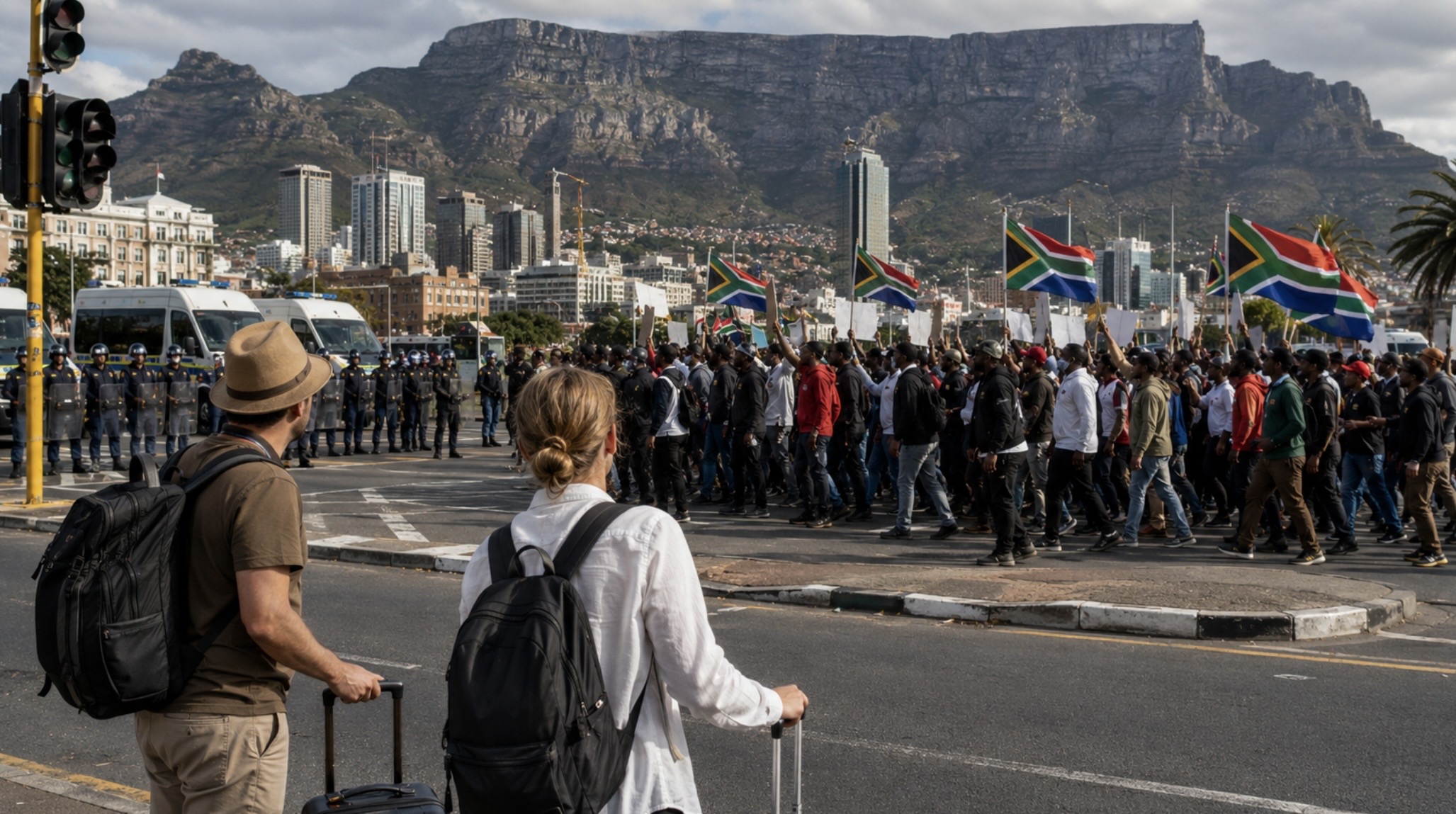
Cape Town and the June 30 Anti-Immigration Marches: What Is Happening
Situation Briefing · Cape Town The June 30 Anti-Immigration Marches: What Is Happening, and What Visitors Should Know Anti-immigration groups have set 30 June 2026…
Read Article
Is Cape Town's container port really bad?
Hero image: the working harbour at the Port of Cape Town · Frans-Banja Mulder, CC BY 3.0 , via Wikimedia Commons Editorial feature · capetowndata.com…
Read Article