What are the best routes to fly from Germany to Cape Town?
June 10, 2026
Flights from Germany to Cape Town: Best Routes, Prices and Times
Two German airports fly nonstop to Cape Town in about eleven hours, and a dozen one-stop routings through the Gulf, Istanbul and Amsterdam fill in the rest. This guide sets out who flies the route in 2026, what the journey actually costs from each German city, how long each option really takes, and the cheapest months to book.
For most German travellers, Cape Town is the longest single flight they will take all year, and one of the few long-haul fares where the routing choice changes both the price and the day you arrive. The good news is that the route is well served: two German airports offer a nonstop flight of about eleven hours, and at least seven airlines connect the rest of Germany through a single hub. The catch is that fares swing by a factor of two across the year, and the cheapest month is not the one most people guess.
This guide works through the route the way a frequent flyer would: the direct options first, then the one-stop alternatives and what each hub adds in time, then the real fare data by airline and departure city, and finally the seasonal pattern that decides whether you pay 530 euros or close to 1,000 for the same seat. Fares are quoted in euros, with US dollar and South African rand equivalents where useful, since a meaningful share of capetowndata.com readers are pricing this trip from outside the eurozone.
The Two Direct Routes
Only two German airports have a scheduled nonstop service to Cape Town, and both are Lufthansa Group operations. Frankfurt is the workhorse: Lufthansa and its leisure sister Condor both fly the route nonstop, between them offering around a dozen departures a week on Boeing 787 Dreamliners. Munich adds a daily Lufthansa Airbus A350 through the South African summer schedule. No other German airport, including Berlin, Hamburg and Dusseldorf, has a direct flight; every other city routes through a hub.
Frankfurt (FRA) 12× weekly
Lufthansa & Condor · Boeing 787 · 11 h 15 m–11 h 55 mThe main gateway. Lufthansa flies a Boeing 787-9 and Condor a Boeing 787, both nonstop from Terminal 1. Departures leave in the evening, roughly 19:30 to 22:15, and land in Cape Town the next morning between 07:25 and 09:30, which lines up neatly with hotel check-in and a first full day. Economy, Premium Economy and Business are all sold on the route.
Munich (MUC) Daily, summer schedule
Lufthansa · Airbus A350-900 · ~11 hLufthansa runs a daily A350 from Terminal 2 through the South African summer (late October to late March), the period when demand from Germany peaks. From the 2026/27 winter schedule the route gains Lufthansa's new Allegris cabin across all classes. Outside the summer schedule, Munich passengers usually connect via Frankfurt or a Gulf hub.
The nonstop flight is the fastest and least tiring option by a wide margin: about eleven hours in the air, an overnight departure, and only a one-hour time difference between Germany and South Africa in the European winter, which means almost no jet lag in the southbound direction. Cape Town keeps South African Standard Time year-round, so the gap widens to two hours during European summer.
One-Stop Routes and Hubs
If you are not flying from Frankfurt or Munich, or you want a lower fare, you connect through a hub. The route is unusually well supplied with one-stop options because Cape Town is a marquee leisure destination for the Gulf and European network carriers. Seven airlines run frequent one-stop service from multiple German cities, and the competition between them is the single biggest reason fares stay reasonable.
Turkish Airlines Widest coverage
via Istanbul (IST) · from most German airportsThe broadest German footprint of any carrier on the route, connecting Berlin, Hamburg, Munich, Stuttgart, Dusseldorf and more through Istanbul. Frequently the cheapest one-stop fare in the market, and Istanbul is a relatively quick connection from northern and eastern Germany.
Qatar Airways Premium product
via Doha (DOH) · ~21 weekly connectionsA consistently strong fare and a well-regarded cabin, connecting Frankfurt, Berlin, Munich and others through Doha. Often the value pick when you want a better onboard experience than the cheapest economy ticket buys, without paying full business class.
Emirates via Dubai
via Dubai (DXB) · from Frankfurt, Munich, Dusseldorf, HamburgA large network and a comfortable widebody product, though typically a little pricier than Turkish or Qatar on this route. Dubai is the longest of the Gulf detours from Germany, so total journey time runs at the higher end.
KLM & SWISS Short European hop
via Amsterdam (AMS) / Zurich (ZRH)The European one-stops shine from northern Germany: KLM via Amsterdam is regularly the cheapest option out of Berlin and Hamburg, and SWISS via Zurich is competitive too. A short first leg keeps the routing sensible even if the headline saving is modest.
Two more carriers round out the picture. Air France connects through Paris and Ethiopian Airlines through Addis Ababa, the latter often turning up among the lowest fares if you are willing to take a less familiar routing. British Airways flies via London, but on this route it is consistently the most expensive of the one-stops from Germany and rarely worth the premium unless London is part of your plan anyway.
Airline quality and safety
On an eleven-hour overnight, who you fly with shapes the trip as much as the routing does. The reassuring part first: every airline on this route is a major IOSA-certified carrier, and the independent safety scores cluster so tightly that the real differences are about comfort, not risk. AirlineRatings, which grades carriers on fleet age, incident rate, pilot training and audit results, gives Qatar, Emirates and the European majors its top seven-star rating. On the product side, the 2025 Skytrax World Airline Awards rank Qatar first in the world, Emirates fourth and Turkish sixth, with Air France, SWISS, British Airways and Lufthansa all inside the global top twenty.
Qatar Airways World's best 2025
Skytrax World's Best Airline for the ninth time, with a seven-star safety rating. The premium benchmark on the route via Doha, and often the best value once you price Business class.
Emirates Top 5 worldwide
Fourth in the 2025 Skytrax ranking and joint third safest on AirlineRatings, with a crash-free jet-era record. Spacious A380 and 777 cabins via Dubai; the priciest of the Gulf options.
Turkish Airlines Best in Europe 2025
Named Best Airline in Europe and praised for its catering. The widest German coverage via Istanbul, and frequently the cheapest one-stop fare in the market.
Lufthansa, SWISS & Air France Top 20
The European network carriers, all top-twenty Skytrax and seven-star safety. Lufthansa flies the two nonstops and rolls out its new Allegris cabin from 2026/27; SWISS and Air France connect via Zurich and Paris.
That leaves Ethiopian Airlines, which routes via Addis Ababa and is regularly the lowest fare on the board. It is no budget unknown: Ethiopian is Africa's largest airline, a Star Alliance member, IOSA-certified, and has been voted Skytrax Best Airline in Africa for seven years running, flying a modern widebody fleet of Airbus A350s and Boeing 787s on its long-haul routes. Its onboard product sits a clear notch below the Gulf giants, the seats are tighter, the lounges and entertainment less lavish, but it is a credible, comfortable way to save money, and the Addis Ababa connection is geographically efficient for a southbound journey.
How Long It Really Takes
The nonstop flight is about eleven hours gate to gate. Every one-stop option adds the second flight plus a connection of one to four hours, so the realistic door-to-door gap between direct and connecting is larger than the raw flight times suggest. The shortest one-stop journeys run around 13.5 hours; the longer Gulf and London routings stretch to 16 hours or more once a comfortable layover is included.
The practical reading: a direct flight saves three to five hours of travel and one set of security and boarding, which on an overnight long-haul is the difference between arriving ready for the day and arriving wrung out. Whether that is worth the fare gap is the central trade-off of the whole route, and the next two sections put numbers on it.
Every route on one map
Here is the whole picture at a glance: the direct lines dropping straight south from Frankfurt and Munich, and the one-stop routes arcing through Istanbul, Amsterdam, Doha and Dubai. Tap any German airport for its airlines, journey time, average return fare and when to book; tap a hub to see who connects there.
What You'll Pay: by Airport and Season
Two forces set your fare: where you leave from and when you fly. Stacking them shows the real spread. The same trip that costs about €530 return from Frankfurt in March can run close to €1,180 from Dusseldorf in the December or July peak, a difference of more than double for the identical destination. The table below the chart gives indicative low, shoulder and peak returns for each German gateway, modelled by applying the monthly fare curve to each airport's verified low-season floor.
Read down the chart and the city pecking order is clear: Frankfurt and Berlin are the cheapest gateways in every season, Hamburg a step behind, and Munich, Stuttgart and Dusseldorf carry a structural premium because they lean on connecting traffic rather than the fare wars that competition at the big hubs produces. The seasonal gap matters more than the city gap, though: shifting your dates from peak to low saves roughly €370 from Frankfurt and over €480 from Dusseldorf, more than you would save by driving to a cheaper airport.
Frankfurt (FRA) Direct
€530 low · €680 shoulder · €900 peakThe cheapest and best-connected gateway, and the only one with two nonstop operators. A Condor return was recently seen from about €670 in May. Best hub alternatives: Doha and Dubai.
Berlin (BER) Best value, one-stop
€530 low · €680 shoulder · €900 peakMatches Frankfurt on price despite having no nonstop, thanks to aggressive KLM, Turkish and Condor pricing. A Qatar return from about €668 and KLM from €616 have appeared. Best hubs: Amsterdam, Istanbul.
Hamburg (HAM) One-stop
€540 low · €690 shoulder · €920 peakA short KLM hop via Amsterdam keeps the north competitive; Turkish via Istanbul is the alternative. KLM has been seen from about €540 return. Shortest one-stop total at roughly 13 h 30 m.
Munich (MUC) Direct, summer
€620 low · €790 shoulder · €1,050 peakThe second nonstop gateway, daily on the A350 through the South African summer, with Allegris cabins from 2026/27. Off-season it reverts to one-stop. Turkish has been seen from about €709 return.
Stuttgart (STR) One-stop, premium
€640 low · €800 shoulder · €1,080 peakTurkish via Istanbul is the mainstay, often from about €658 return in low season. A short feeder to Frankfurt for the nonstop is frequently near-free in the through-fare, so price both.
Dusseldorf (DUS) One-stop, premium
€700 low · €880 shoulder · €1,180 peakThe priciest mainstream gateway. Emirates via Dubai and Turkish via Istanbul both serve it; Istanbul usually undercuts Dubai. Emirates has been seen from about €793 return.
Fares by Airline and City
Return economy fares from Germany to Cape Town cluster in a wide band. In the cheaper months and booked ahead, the floor sits around 530 to 620 euros return on the value carriers; in peak weeks the same seat runs 900 euros and up. The cheapest tickets are almost always one-stop on Condor, KLM, Turkish or Qatar; the nonstop Lufthansa and Condor flights command a modest premium for the time saved, and Emirates and British Airways sit at the top of the range.
Departure city matters almost as much as airline. Frankfurt and Berlin produce the lowest fares, Hamburg close behind, while Munich, Dusseldorf and Stuttgart run a little higher. The pattern reflects competition: Frankfurt has the direct flights and every hub carrier, Berlin draws aggressive pricing from KLM, Turkish and Condor, and the smaller catchments see fewer fare wars.
For orientation in other currencies, a 530-euro return is about 570 US dollars or 10,100 South African rand; a 950-euro peak fare is roughly 1,025 dollars or 18,200 rand. Even the peak German fare is modest against what the same route costs from North America or Australia, which is part of why Cape Town has become such a strong long-haul market out of Germany.
Forward LookingThe Cheapest Months to Fly
This is the section that saves the most money. Fares to Cape Town follow a clear annual curve driven by two calendars at once: the South African summer, which is peak tourist season, and the German school-holiday calendar, which is when Germans want to escape winter. Where the two overlap, prices spike. Where neither applies, they collapse.
The pattern is consistent across the aggregators. March is the cheapest month to fly, with November close behind; both pair low fares with excellent Cape Town weather, since the city's summer runs October to April. The two spikes are July, driven by German summer school holidays, and December, when Christmas travel collides with the start of Cape Town's peak season. February, April, May and September fill the comfortable middle.
So, When Should You Go?
Put the fare curve and the Cape Town weather side by side and the answer falls out cleanly. The city's best weather, hot and dry, runs December to February, but that is also the most expensive and crowded window. The trick is the shoulders: March and November deliver almost the same summer conditions at the lowest fares of the year. The chart below grades every month on both price and weather so you can match the trip to what matters most to you.
The bottom line
- Best overall: March. High-summer weather, the calmest winds of the season, and the cheapest fares of the year. If you can only pick one month, pick this one.
- Best value runner-up: November. Warm, dry spring, low fares and fewer crowds than midsummer.
- Best weather: December to February. Hot, dry and long days, but the priciest fares, the strongest south-easter wind and the busiest beaches.
- Cheapest flights: March, then November. Avoid July (German summer holidays) and December (Christmas plus the start of Cape Town's peak), the two fare spikes.
- Cheapest of all, if you will take winter: June. Low fares and quiet sights, but Cape Town's wet, cool season, so pack for rain and pick indoor-friendly plans.
Booking Tactics That Work
Beyond the month, a few repeatable tactics move the fare. None are secrets, but together they are worth a few hundred euros on a peak booking.
Five things that actually lower the fare
- Book the cheap months, not the cheap days. Shifting your trip from December or July into March or November saves far more than any day-of-week trick.
- Depart midweek. Tuesday and Wednesday departures are consistently cheaper than Friday and Sunday across the aggregators; an evening departure also tends to price below daytime.
- Price at least two hubs. The cheapest one-stop carrier changes by departure city. From Berlin and Hamburg, check Amsterdam and Istanbul; from Frankfurt and the south, check Doha and Dubai.
- Compare the nonstop premium directly. Lufthansa direct often sits within 50 to 100 euros of the cheapest one-stop in low season. Put a price on three to five hours of your time before defaulting to the connection.
- Book six to ten weeks out for off-peak, three to six months for December and July. The peak dates sell their cheap fare buckets first; the cheap months reward patience.
Economy, Premium and Business
On an eleven-hour overnight, cabin choice matters more than on a short hop. The nonstop Frankfurt and Munich flights sell all classes, including Lufthansa's new Allegris Premium Economy, Business and First on the Munich A350 from the 2026/27 season. The Gulf carriers are the value play above economy: Qatar and Emirates often price Business below Lufthansa, and their lie-flat seats and lounges turn the layover into a feature rather than a cost.
Economy
The 530-to-980-euro band the charts above describe. Premium Economy on Lufthansa and Condor typically runs 50 to 100 percent above the economy fare and buys meaningfully more legroom and a second checked bag, which on this route length many travellers consider worth it.
Business
Roughly 2,200 to 4,000 euros return depending on season and carrier, with the Gulf airlines often undercutting Lufthansa for a comparable or better seat. If you intend to land and go straight into meetings or a long drive to the Winelands, the lie-flat sleep is the strongest argument on the whole route.
Arriving at Cape Town
Cape Town International (CPT) sits about 20 kilometres east of the city centre and handled over 11 million passengers in the 2025/26 year, making it South Africa's second-busiest airport. Nonstop arrivals land mid-morning, between roughly 07:25 and 09:30, which is close to ideal: you clear immigration before the day's heat, and most accommodation will hold an early check-in for a flight everyone in the city knows arrives at that hour.
Immigration is straightforward for German passport holders, who do not need a visa for short tourist stays, though you should confirm current entry rules before travelling. From the airport, a metered taxi or e-hailing ride to the City Bowl or Atlantic Seaboard takes 20 to 30 minutes outside peak traffic. For the journey planning that follows touchdown, our Cape Town neighbourhood and safety guides cover where to base yourself, and our wedding-venue and Winelands coverage maps out the estates 40 to 60 minutes from the terminal.
Which Routing for Which Traveller
Match the routing to what you actually value on the day, not to the lowest headline fare:
Time-poor or jet-lag sensitive
Fly nonstop from Frankfurt or Munich. The three-to-five-hour saving and single overnight are worth the small premium, and the one-to-two-hour time difference means you land ready. Book the direct flight as early as you can for December and July.
Budget-led, dates flexible
One-stop on Condor, KLM, Turkish or Qatar, departing in March or November. This is where the 530-to-620-euro fares live, paired with strong Cape Town weather. From Berlin or Hamburg, start with Amsterdam and Istanbul.
Comfort-led above economy
Qatar or Emirates Business through the Gulf often beats Lufthansa on price for a comparable seat, and the hub lounges make the layover restful. If you want Business nonstop, the Munich A350 with Allegris is the premium pick from 2026/27.
Flying from a smaller city
From Dusseldorf, Stuttgart, Hannover or Cologne, the cheapest path is usually a one-stop on Turkish via Istanbul or a short feeder to Frankfurt for the nonstop. Compare the all-in fare, not just the long-haul leg, since the feeder is sometimes nearly free in the through-fare.
Quick-Glance Summary
Frequently Asked Questions
How long is the flight from Germany to Cape Town?
The nonstop flight from Frankfurt or Munich takes about 11 hours, roughly 11 h 15 m from Frankfurt and a little under 11 h from Munich. One-stop routings run longer once the connection is added: about 13.5 hours via Istanbul at the quickest, and 15 to 16 hours or more via Dubai or London.
Which German cities have direct flights to Cape Town?
Only Frankfurt and Munich. Frankfurt is served nonstop by both Lufthansa and Condor on Boeing 787s, around a dozen times a week between them. Munich has a daily Lufthansa A350 through the South African summer schedule. Every other German city, including Berlin, Hamburg and Dusseldorf, connects through a hub.
What is the cheapest month to fly to Cape Town from Germany?
March is consistently the cheapest, with November close behind, and both coincide with very good Cape Town weather. The most expensive months are July, driven by German summer school holidays, and December, when Christmas travel meets the start of Cape Town's peak season. February, April, May and September sit comfortably in the middle.
How much does a return flight cost?
In the cheaper months and booked ahead, return economy starts around €530 to €620 on value carriers such as Condor, KLM, Turkish and Qatar. Nonstop Lufthansa typically runs from about €610. In peak weeks the same routes climb to €900 and above. Business class runs roughly €2,200 to €4,000 return depending on season and carrier.
Is it worth paying more to fly direct?
Often, yes. In low season the nonstop premium over the cheapest one-stop is frequently only 50 to 100 euros, and the direct flight saves three to five hours of travel plus a second security and boarding on an overnight journey. If your dates are flexible and budget is the priority, a one-stop in March or November is the better value; if time and comfort matter, the direct flight costs surprisingly little extra.
What is the time difference and will I have jet lag?
Cape Town is one hour ahead of Germany during the European winter and two hours ahead in summer, because South Africa does not change its clocks. Since the route runs almost due south rather than east-west, jet lag is minimal. An overnight departure and a mid-morning arrival mean most travellers start their first day close to normal.
Which airline should I choose, and is the cheapest one safe?
Every airline on this route, Lufthansa, Condor, Qatar, Emirates, Turkish, KLM, SWISS, Air France, British Airways and Ethiopian, is a major IOSA-certified carrier, and independent safety scores separate them only marginally. On comfort, Qatar ranks first in the world on the 2025 Skytrax awards, with Emirates and Turkish close behind and the European carriers in the global top twenty. Ethiopian, often the cheapest via Addis Ababa, is Africa's best-rated airline and a Star Alliance member flying modern A350s and 787s long-haul; its onboard product is a step below the Gulf giants but it is a safe, credible choice. Pick on comfort, schedule and price rather than on safety worries.
Do German citizens need a visa for South Africa?
German passport holders do not require a visa for short tourist visits, but entry rules, permitted length of stay and passport-validity requirements are set by South African policy and can change. Confirm the current requirements with the South African authorities or your airline before booking, and check that your passport and any onward-ticket evidence meet the rules in force on your travel date. This is a sensitive area where official guidance takes precedence over any summary here.
Sources & References
Routes, schedules & flight times
- Lufthansa, Flights to Cape Town and Frankfurt / Munich to Cape Town route pages (flight duration, weekly frequency)
- Munich Airport, Winter flight schedule: Lufthansa long-haul (daily A350 to Cape Town)
- Aerotime, Lufthansa Allegris cabin destinations, winter 2026/27 (Munich–Cape Town Allegris)
- FlightConnections, FRA to CPT; FlightsFrom, direct Frankfurt–Cape Town and Munich–Cape Town (operators, aircraft, distance, departure times)
Fares & seasonality
- Google Flights, Frankfurt–Cape Town, Berlin–Cape Town and Hamburg–Cape Town (airline and city fare samples)
- Cheapflights, Germany to Cape Town (cheapest and most expensive months)
- momondo, Cape Town–Germany (cheapest day-of-week and time-of-day patterns)
Airline quality & safety
- Skytrax, 2025 World Airline Awards (Qatar world's best, Turkish best in Europe, Ethiopian best in Africa, regional and global rankings)
- AirlineRatings, World's Safest Airlines 2025 (seven-star safety ratings, IOSA certification, incident and fleet-age methodology)
Airport & exchange rates
- Wikipedia, Cape Town International Airport (2025/26 passenger numbers, location)
- Wise, EUR/ZAR; Trading Economics, USD/ZAR, mid-market, 10 June 2026
You May Also Like

How to Buy Property in South Africa?
Property Guide · South Africa What You Need to Buy Property in South Africa South Africa is one of the most open property markets in…
Read Article
What’s up with South African credit rating?
Hero image: “Johannesburg Hillbrow” by NJR ZA, sourced from Wikimedia Commons , licensed under Creative Commons Attribution-ShareAlike 3.0 (CC BY-SA 3.0) . No changes were…
Read Article
Is the Rand weakening? What drives the South African currency?
Hero image: “Johannesburg Hillbrow” by NJR ZA, sourced from Wikimedia Commons , licensed under Creative Commons Attribution-ShareAlike 3.0 (CC BY-SA 3.0) . No changes were…
Read Article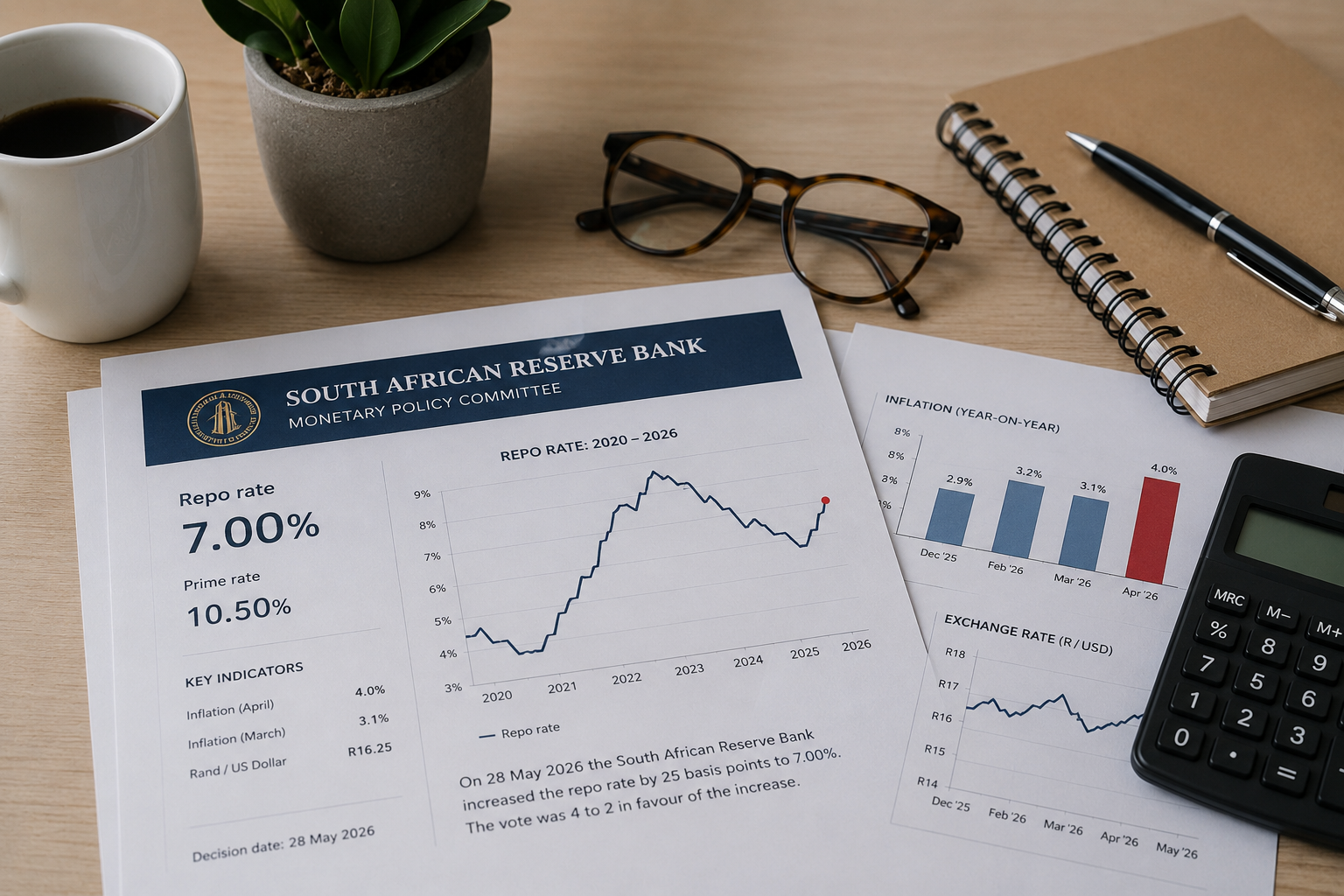
The Reserve Bank just raised rates. Here is why that was a difficult decision
Money & Policy · Explainer The Reserve Bank just raised rates. Here is why that was a difficult decision. On 28 May 2026 the South…
Read Article
What is The Best Time to Visit Cape Town - Decoded by Data
Photo courtesy of Luca Galuzzi, Wikimedia Commons, licensed under CC BY-SA 2.5 Travel Data · Cape Town · 2026 Best Time to Visit Cape Town…
Read Article