How Bad Were the June 30 Marches? Cape Town and South Africa 2026
July 1, 2026
How Bad Were the June 30 Marches?
For weeks South Africa braced for another 2008. On the day itself, the anti-immigration marches were the largest since then, yet far less destructive than feared: mostly peaceful nationwide, calm in Cape Town, with pockets of looting in Gauteng and no deaths reported on the day. Here is an accurate account of what actually happened, where it did turn ugly, and why the real damage had already been done before a single march set off.
The morning after, this is what the evidence shows.
- Bottom lineThe catastrophe most feared did not happen. The day was tense and disruptive, but there was no repeat of the 2008 xenophobic massacre or the 2021 riots. No deaths were reported on 30 June itself.
- Largely peaceful, with exceptions. Marches in Durban, Johannesburg, Pretoria and Cape Town passed off without mass violence, shadowed the whole way by police. The trouble that did occur was scattered looting and clashes, mostly in Gauteng.
- Cape Town stayed calm. Roads were open, businesses traded, and the only anti-immigration action was a small, peaceful picket outside the provincial legislature.
- The real harm came earlier. More than 25,000 foreign nationals had already been bussed out of the country before the deadline, and thousands more were displaced. The human cost was paid in fear and flight, not on the streets on the day.
- It is not over. The March and March movement has vowed to keep marching every week for six months. The grievances, and the danger to migrants, remain.
What actually happened
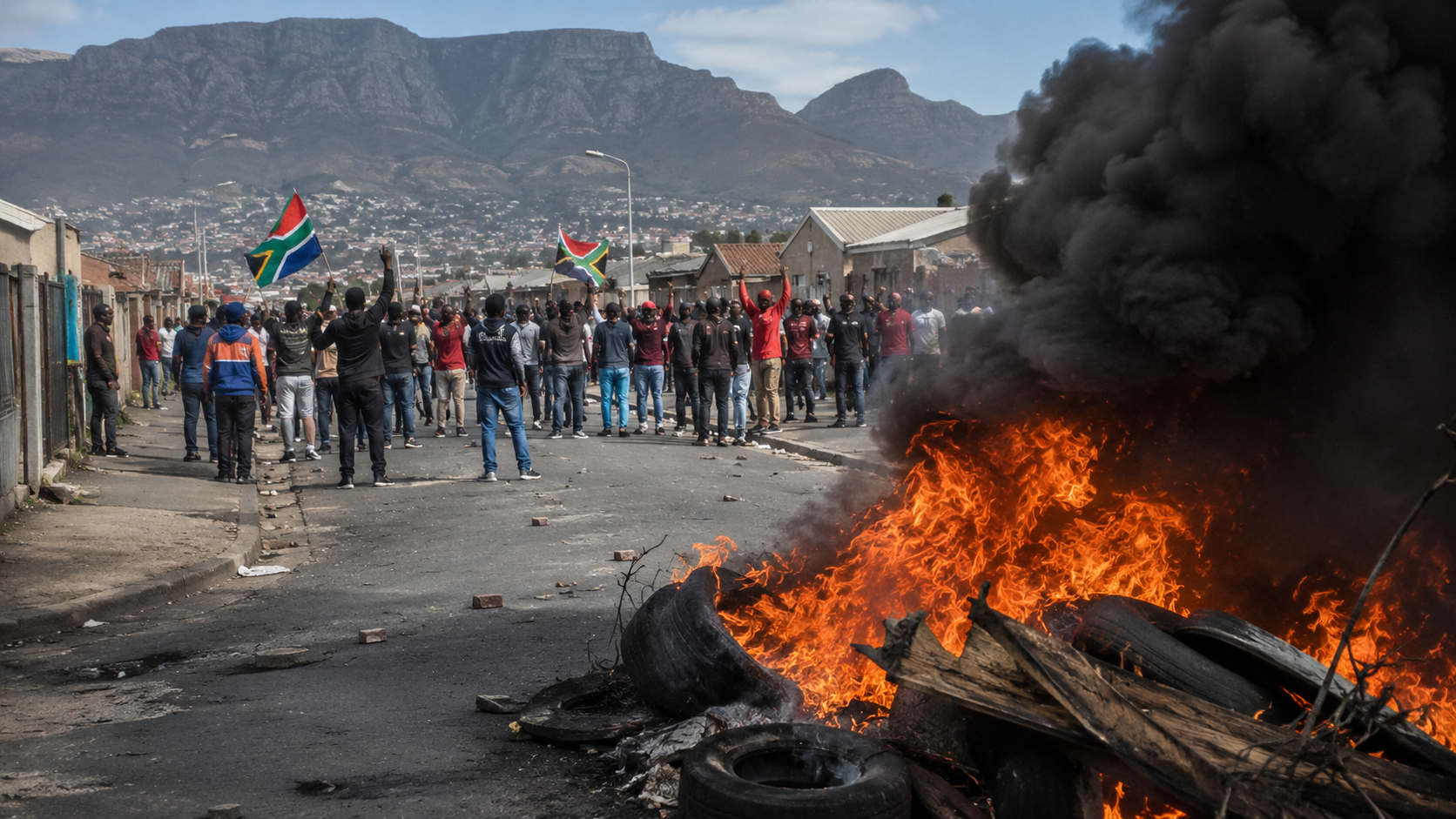
The 30 June deadline, an ultimatum set by anti-immigration groups for undocumented foreigners to leave the country, arrived after weeks of dread. It passed without the disaster many had braced for. By first light, police across the country reported no major incidents. By nightfall, the picture had held: a day of large but mostly orderly marches, tightly shadowed by police, with outbreaks of looting and confrontation in specific spots rather than a nationwide explosion.
In scale, this was significant. News agencies described it as the largest migration-related mobilisation since the 2008 xenophobic violence. Thousands marched in Durban behind the March and March leader Jacinta Ngobese-Zuma. Marchers moved through central Johannesburg to Hillbrow, and through Pretoria's Sunnyside. What made the difference was not a lack of anger but the response: a security operation costing more than R600 million, thousands of police and soldiers on standby, and a deliberate crowd-control approach that kept officers walking alongside the marchers all day.
That is clearest when the day is set against the two events it was constantly compared to. Every police briefing invoked the ghosts of 2008, when xenophobic riots killed 62 people, and of July 2021, when unrest left about 350 dead. Measured against those benchmarks, 30 June was contained.
Cape Town: the calm city
For Cape Town, the day was close to a non-event, and the City went out of its way to show it. Mayor Geordin Hill-Lewis rode a MyCiTi bus from Table View into the CBD on Tuesday morning, calling it business as usual and describing Cape Town as the only working city in the country that day. By 8.30am, the City's safety chief reported all roads open and free flowing, with no incidents of xenophobic violence.
The only anti-immigration action of note was a small, peaceful picket outside the Western Cape provincial legislature, where members of March and March, Operation Dudula and a labour group handed over a memorandum demanding that South Africans be prioritised for jobs. The provincial government returned a bundle of CVs the group had submitted, explaining it cannot hire outside formal recruitment processes. The protesters dispersed peacefully, promising to escalate their campaign.
Watch the disinformation, not just the marches
The most disruptive thing in Cape Town on the day may have been fake news. A video circulated overnight claiming violence had broken out in Khayelitsha; the City traced the footage to an unrelated cash-in-transit robbery in Gugulethu. A single minor flare-up in Kalksteenfontein on the Monday was, in the City's words, quickly contained. Officials repeatedly urged residents to report incidents to authorities rather than amplify unverified clips.
None of this was luck. Cape Town's marches through June had already been strikingly small, in the dozens rather than the thousands, and the metro's flashpoints sit well away from the tourist core. The calm on 30 June was the product of low turnout, heavy policing and a City determined to keep trading. For residents and visitors, the practical takeaway is simple: the day passed, and the city kept working.
The ExceptionsWhere it turned ugly
Peaceful overall does not mean peaceful everywhere. The violence that did occur was concentrated, and almost all of it was in Gauteng, the province around Johannesburg and Pretoria. This is the pattern of South African xenophobia in miniature: trouble erupting in specific poor neighbourhoods rather than sweeping whole cities.
Shacks looted
The national broadcaster reported that protesters looted shacks belonging to foreign nationals. Police moved in to make arrests.
Stones and gunfire
Rioters reportedly threw stones at police and suspected migrants, with witnesses describing sporadic gunfire. Foreign-owned hawker stalls were forced to close.
Police fire shots
Officers deployed tactical vehicles and fired after being confronted by a group of roughly 500 protesters, according to reporting from the ground.
Somali-owned shops targeted
Looters reportedly focused on businesses owned by Somali nationals. In Yeoville, a fire was lit near where homeless people live before soldiers dispersed the crowd.
Migrants stopped and questioned
Protesters reportedly demanded documents from suspected migrants, and in one case carried out so-called citizen's arrests before handing people to police.
Large march, isolated incidents
Thousands marched. At a refugee site, more than 300 gathered and some marchers tried to intimidate individuals; in Briardene there was an attempted break-in and fires; in Sydenham a woman was arrested for assaulting officers protecting a foreign national.
Police said they arrested looters and fired rubber bullets to disperse crowds in several areas. Two provinces, Mpumalanga and Limpopo, reported no protest-linked violence at all, and police there debunked at least one viral looting video as old, recycled footage. The overall shape was a country that mostly held, with a handful of Gauteng townships where it did not.
A caution on the numbers
This account reflects reporting in the first 24 hours, which is inevitably incomplete. Arrest tallies for the day were still being compiled, and some incidents will only surface in the coming days. What is already clear is the absence of the mass-casualty event that dominated the run-up.
The cost was paid before the day
Here is the part that a "how bad was it" scorecard of the day itself can miss. The heaviest damage was done in the weeks before 30 June, through fear rather than through marching. A fake but official-looking notice, complete with a government seal, had circulated declaring the deadline real. It was never issued by the state, but it went viral, and it gave the movement a date to rally around and migrants a reason to run.
By the eve of the deadline, authorities said more than 25,000 foreign nationals had already been repatriated, with thousands more displaced from their homes. Whole communities emptied out. In Cape Town, that human cost is captured in a single building.
More than two thousand Zimbabweans crowded into a home affairs building in Epping meant to hold about three hundred, after camping for days outside their consulate in District Six. Multiply that scene across the country, and the true weight of the June 30 campaign becomes clear. The marches were the visible event; the exodus was the real one.
Was it as bad as feared?
No, and it is worth being precise about why. Several things went right on the day, and they are instructive.
A heavy, visible state response
Thousands of police and soldiers, private-security support, air surveillance and a R600 million operation meant marchers were escorted, not left to their own devices. Officers walking with the crowds all day is the single biggest reason breakaway violence stayed small.
Moderation and division among organisers
Under government pressure, organisers stressed marches must stay peaceful. Cracks also showed: the March and March leader was reportedly left out of a meeting with the president that rival figures attended, blunting the movement's coordination.
The caveats matter too. "Not as bad as 2008" is a very low bar, and clearing it is not the same as safety. People were still robbed of their homes, businesses were still looted, and migrants were still stopped in the street and made to prove they belonged. The fear did its work whether or not the marches did. And the day was calm partly because so many potential targets had already fled.
What comes next
The deadline has passed, but the movement behind it has not. Addressing thousands in Durban, Ngobese-Zuma promised to keep going, giving the government six months and a weekly rhythm of protest.
Whether that momentum holds is uncertain. Turnout on the day was solid in Durban but thin in much of the country, the leadership is visibly divided, and the state has shown it will deploy at scale and make arrests. What has not changed are the conditions underneath: high unemployment, strained services and a widespread belief, unsupported by the evidence, that migrants are to blame. Those pressures will not disappear on a schedule, and neither will the risk to the people this campaign targets.
For now, the immediate emergency has eased. The country did not burn. But 30 June is better understood as a marker in a long story than as an ending, and the tens of thousands who left, many of them legally entitled to stay, are the measure of what it already cost.
Questions answered
No deaths were reported on the day itself in the first 24 hours of coverage. That is a meaningful contrast with the weeks before, when several foreign nationals were killed in xenophobic violence during the build-up. Reporting is still developing, but the day did not produce the mass-casualty event authorities feared.
Barely, in terms of disruption. Roads stayed open, businesses traded, and the mayor made a point of riding public transport to show the city was working. The only anti-immigration action was a small, peaceful picket at the provincial legislature. The most notable problem was disinformation, including a falsely captioned video that officials had to debunk.
Almost all of the looting and clashes were in Gauteng townships, including Soweto, Tembisa, Benoni, Cosmo City and Mamelodi, plus isolated incidents around Durban in KwaZulu-Natal. Police made arrests and used rubber bullets. Mpumalanga and Limpopo reported no protest-linked violence.
Because the campaign had already forced more than 25,000 foreign nationals out of the country and displaced thousands more before 30 June arrived. Many were in South Africa legally. The absence of violence on the day does not undo the fear, flight and family separation the movement had already caused.
The March and March movement has said it will march weekly for the next six months. Whether it sustains that is unclear, given uneven turnout and visible divisions among its leaders, but the underlying grievances remain, so further protests and continued risk to migrants should be expected.
The bottom line
How bad were the June 30 marches? On the day, far less bad than the country feared: the largest anti-migrant mobilisation since 2008, yet held in check by an enormous security operation, with no reported deaths and a calm, working Cape Town. Judged over the month, though, the campaign was already a human catastrophe of a quieter kind, measured in the tens of thousands who packed up and left. The fire everyone watched for did not come. The damage came anyway, in the emptying of homes and the breaking up of lives, and that is the part worth remembering as the marches continue.
Reporting from 30 June and 1 July 2026
- Reuters and AFP wire reports on the national scale of the protests and scattered looting
- Mail and Guardian, on the demonstrations concluding relatively peacefully
- Daily Maverick live coverage, on low turnout and on-the-ground incidents across four provinces
- IOL and Weekend Argus, on the Cape Town picture, the Epping shelter figures and the national repatriation total
- The Citizen, on looting arrests and the March and March pledge of weekly protests
- Time Out Cape Town and EWN, on the City of Cape Town response and the Parklands march
- TimesLIVE, on the Western Cape legislature picket and the returned CVs
- Al Jazeera, on the run-up, the fake deadline notice and the fears among migrant communities
Context and benchmarks
- Institute for Security Studies (ISS), on the 2008 and 2021 comparisons and the security posture
- NatJoints briefings, on arrests, cases opened and repatriation figures
Imagery
- This report uses original data charts rather than a photograph, out of respect for the people affected, so no image credit is carried. No suitable verified Wikimedia Commons image of the events was available at the time of writing.
This article is provided for general information and reflects reporting available on 1 July 2026, the day after the marches. Fast-moving events are inevitably incomplete in their first day, and figures, including arrest and casualty tallies, may be revised as more is confirmed. Nothing here is legal, immigration or security advice. Cape Town Data condemns xenophobia and presents this material to inform readers, not to characterise any nationality or community. Anyone facing a threat should contact the police on 10111.
You May Also Like
Is South Africa Xenophobic? An Honest Look at What Is Going On
Explainer · South Africa Is South Africa, and Cape Town, Xenophobic? It is a fair question, and it deserves an honest answer rather than a…
Read Article