PART II: The South African Miracle: Lessons in Forgiveness, Unity, and Nation-Building
September 12, 2025
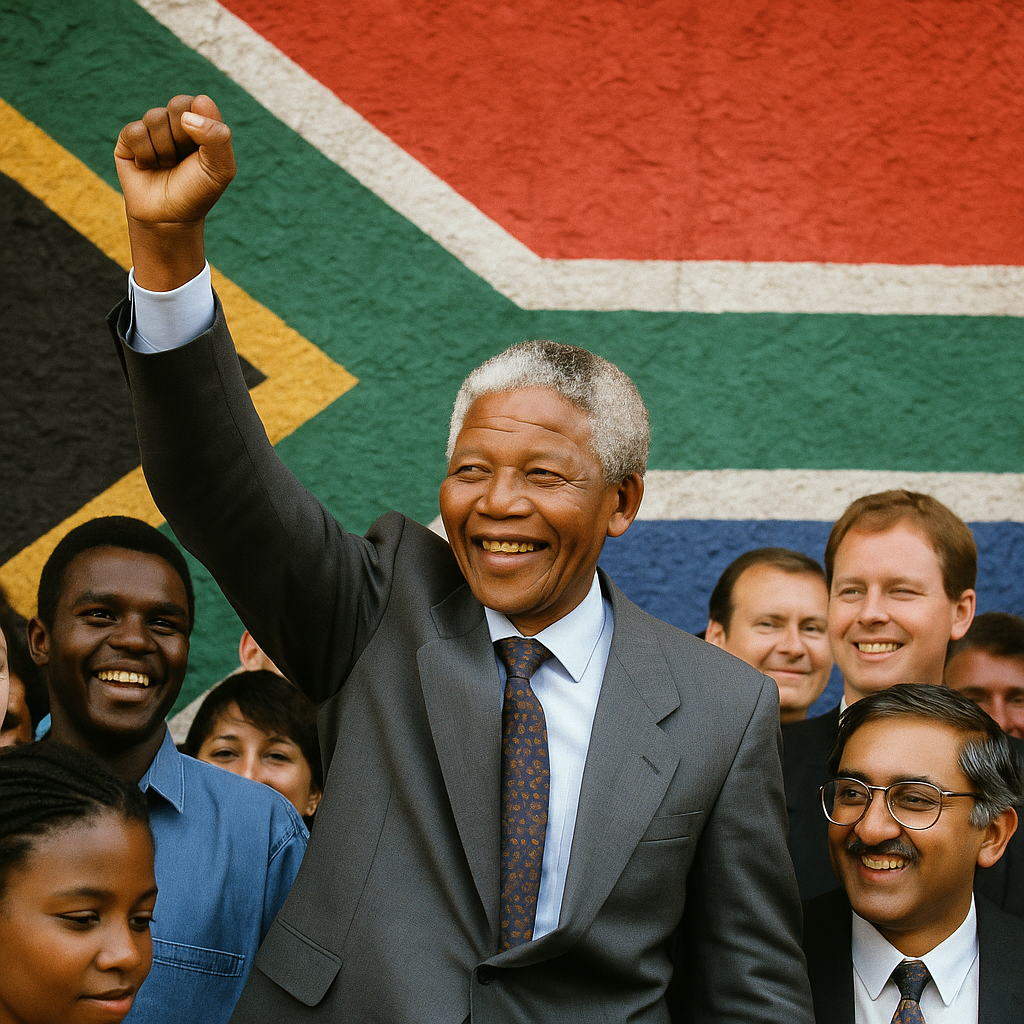
The South African Miracle: Truth, Reconciliation & the Work of Nation-Building
TL;DR: South Africa chose truth before vengeance. The Truth and Reconciliation Commission (TRC), launched in 1995, was a court-like restorative-justice body that offered conditional amnesty only for full and truthful disclosure of apartheid-era crimes (Britannica). By centering victims’ testimony and building a shared public record, it enabled forgiveness without forgetting and helped avert a retaliatory spiral. Meanwhile, Mandela and Tutu modeled reconciliation in gestures and unifying symbols—from a multilingual anthem to a rugby jersey—while the 1996 Constitution enshrined equality and 11 official languages in law. Since then, the country has mixed pride and progress (1994 vote, 2010 World Cup, growing social contact) with real challenges (inequality, unemployment, corruption). Yet surveys still show most South Africans believe unity is both desirable and possible.
Quick Timeline Highlights
- 1994: First all-race election. 19.7 million ballots cast. Government of National Unity formed so everyone had a place (overview).
- 1995: TRC established to “help heal the country … by uncovering the truth” (Britannica).
- 1995: Rugby World Cup final at Ellis Park. Mandela in a Springbok jersey. Crowd chants “Nelson! Nelson! Nelson!”—a moment of national fusion (History.com).
- 1996: Constitution adopted. Strong Bill of Rights. 11 official languages recognized. Discrimination outlawed.
- 2010: FIFA World Cup hosted. Streets and stadiums overflowed with languages, songs, and flags in a euphoric display of unity (The Guardian).
Transformation: From Apartheid to Reconciliation
South Africa’s peaceful transition in the mid-1990s is often called the “Rainbow Nation miracle.”
The first milestone was the 1994 election. People of all races—Black, White, Coloured, Indian—stood shoulder to shoulder in lines that stretched for miles. Fingers dipped in ink; ballots dropped for a free South Africa. 19.7 million votes were cast, symbolizing the rebirth of the nation (overview).
The ANC won decisively; Nelson Mandela became President. A Government of National Unity included even the National Party, signaling that everyone had a place in the new South Africa (details).
April 27 is now Freedom Day, marking apartheid’s end.
The TRC, briefly but clearly
- What it was: A court-like restorative-justice commission, created in 1995, to establish the truth about apartheid-era abuses and promote reconciliation.
- How it worked: Perpetrators could receive amnesty only for full, public, and truthful disclosure of politically motivated crimes. Victims’ televised testimony created recognition and a national record.
- Why it mattered: Naming the truth could heal a racially divided nation and prevent denial, trading blanket punishment for acknowledgement and accountability.
The hearings were raw and cathartic. Thousands of victims spoke of torture, killings, and disappearances. Perpetrators from both state forces and liberation movements confessed in harrowing detail. Archbishop Desmond Tutu opened sessions with prayer and often wept alongside witnesses. Critics worried the process “opened old wounds,” but it also produced extraordinary grace.
Pull-quote
“Let us keep silent, because we were in the presence of something holy.” — Archbishop Desmond Tutu, after survivors applauded an officer who confessed and asked forgiveness (BillMoyers.com)
One oft-retold moment: a frail mother listened as a former police officer admitted murdering her son and husband. When she spoke, she asked him to become her son, to visit so she could pour out the love she still had—and then offered forgiveness. He fainted; the gallery sang Amazing Grace (International Forgiveness Institute).
The TRC did not erase pain, and some felt perpetrators were treated too leniently. Yet it documented abuses, granted amnesty only for full disclosure (ultimately 849 cases), and in 1998 issued a final report that laid a foundational truth for the new nation.
Mandela’s Everyday Reconciliation & the “National Embrace”
Mandela practiced reconciliation as a daily discipline: inviting former jailers to his inauguration, learning languages not his own, and urging South Africans toward ubuntu—“I am because we are.”
He also made sport a lever for unity. Rugby, once a symbol of Afrikaner nationalism, could have been scrapped. Instead, Mandela reclaimed the Springbok.
Early in his presidency, Mandela met Francois Pienaar and turned the 1995 Rugby World Cup into a national healing project. He urged Black communities to “stand by these boys—our boys.” At Ellis Park, he walked out in a green No. 6 Springbok jersey. A hush; then the chant: “Nelson! Nelson! Nelson!” South Africa upset New Zealand.
Black and White South Africans celebrated together—what one account called a “moment of national fusion” (History.com). The image—yesterday’s foes, today’s teammates—became a living metaphor for reconciliation (later dramatized in Invictus).
Law That Locks It In: The 1996 Constitution
Inspiration needed institutions. The 1996 Constitution is widely praised for a muscular Bill of Rights, independent courts, anti-discrimination guarantees, and recognition of 11 official languages—a decisive break from apartheid’s elevation of only English and Afrikaans (overview).
Pride & Progress Amidst Challenges
What clearly improved
- Democratic normality: Regular competitive elections, vibrant civil society, protected speech, and a respected Constitutional Court.
- Shared national moments: The 2010 FIFA World Cup became a euphoric display of unity—a multilingual anthem sung in unison, flags and vuvuzelas, strangers hugging after goals (The Guardian).
- More everyday mixing: Post-1994 Born Frees grew up across old lines. Surveys show rising cross-racial social contact. 85% say “being South African” is central to identity; 77% agree more unites than divides; roughly 72–75% believe a more united country is possible (Reconciliation Barometer).
What still hurts
- Inequality & unemployment: Among the world’s most unequal societies. Stubborn youth unemployment. Apartheid’s spatial and asset legacies persist.
- Governance strains: Corruption scandals, power crises, and uneven services erode trust. Many believe corrupt officials often escape accountability.
- Safety & social stressors: Crime and gender-based violence weaken social trust.
Bottom line: The Mandela/Tutu vision still resonates. Institutions have wobbled but held. Society’s center of gravity remains against racial polarization and in favor of working problems together.
Living Diversity, Every Day
South Africa tries to live its motto: ǃke e꞉ ǀxarra ǁke (Unity in Diversity).
- Languages: 11 official languages—adding nine African languages after 1994 was a revolutionary recognition of equal dignity (Berkley Center).
- Anthem: Nkosi Sikelel’ iAfrika / Die Stem, sung in five languages, turns history into a shared ritual.
- Shared rituals: Heritage Day reframed as Braai Day—a nationwide cookout where difference is celebrated and community is built. As Tutu quipped, it’s a day to “all just be South Africans together.”
- Symbols reborn: The flag braids old and new palettes. Banknotes pair the Big Five with Mandela—nature beside human rights.
Walk through Johannesburg or Durban and you’ll hear conversations slip from English to Zulu to Afrikaans in a few breaths. Slang cross-pollinates. Gqom thumps from car speakers. At a Springboks or Bafana match, cheers rise in many languages—but as one voice.
Lessons for the World
- Truth-telling heals. You can’t heal what you refuse to name. Truth commissions have spread worldwide, often citing South Africa’s example (overview).
- Mercy with conditions. Amnesty for full disclosure can short-circuit revenge while honoring victims’ need to be seen and heard.
- Leadership by example. Reconciliation scales when leaders model it—tea with former opponents, a jersey at the right moment.
- Symbols matter. Flags, anthems, sports, and holidays become social glue when designed for everyone.
- Justice must be material too. Political reconciliation requires economic inclusion. Without it, inequality reopens old wounds.
Five-Point Cheat Sheet (keep this!)
- 1994 vote: Queues across race lines. 19.7M ballots. Unity government.
- TRC (1995): Truth before vengeance. Victims centered. Amnesty only for full disclosure.
- 1995 jersey moment: Mandela + Springboks = national embrace.
- 1996 Constitution: Rights + 11 languages. Law backs the rainbow.
- Since 2010: Big pride, hard problems. Most people still believe unity is possible.
Sources & Further Reading (selection)
- 1994 election & turnout
- TRC: what/why/how
- Mandela, Springboks & 1995
- Tutu on forgiveness
- “Become my son” story
- Constitution lauded; inequality context
- 2010 World Cup unites SA
- Reconciliation Barometer
- 11 official languages & “Unity in Diversity”
Conclusion
South Africa’s transformation is a story of hope under pressure—forged in truth-telling, modeled by leaders, secured in law, and lived through everyday habits of inclusion.
The country is open about its contradictions: inspiring unity one day, frustrating setbacks the next. Yet most people still believe unity is desirable and achievable, and continue to choose cooperation over grievance.
The lesson travels: confront injustice honestly; pair mercy with accountability; build shared symbols; and pursue material justice so hope has roots. As South Africans sing a five-language anthem and say Simunye—we are one—they show that even entrenched walls can fall, and yesterday’s foes can become tomorrow’s partners.
More in Culture & Identity
- Kulturelle Sensibilität als ausländische Person in Kapstadt, Südafrika
- PART I: The South African Miracle: Lessons in Forgiveness, Unity, and Nation-Building
- Wer sind die Afrikaner und was ist die afrikaanse Kultur in Südafrika?
- Werden Weiße in Südafrika systematisch unterdrückt?
- Racism Part 3: A Guide for Foreigners Navigating South Africa’s Racial Dynamics
- Racism Part 2: Recent Incidents and Current Racial Tensions
Das könnte Sie auch interessieren

Abdullah Ibrahim in 2026: A Living Legend Returns to Cape Town International Jazz Festival CTIJF
Editorial feature · capetowndata.com · March 2026 Photo courtesy of Patrick Scales, Wikimedia Commons, licensed under CC BY 3.0 CTIJF 2026 · Cape Jazz ·…
Artikel lesen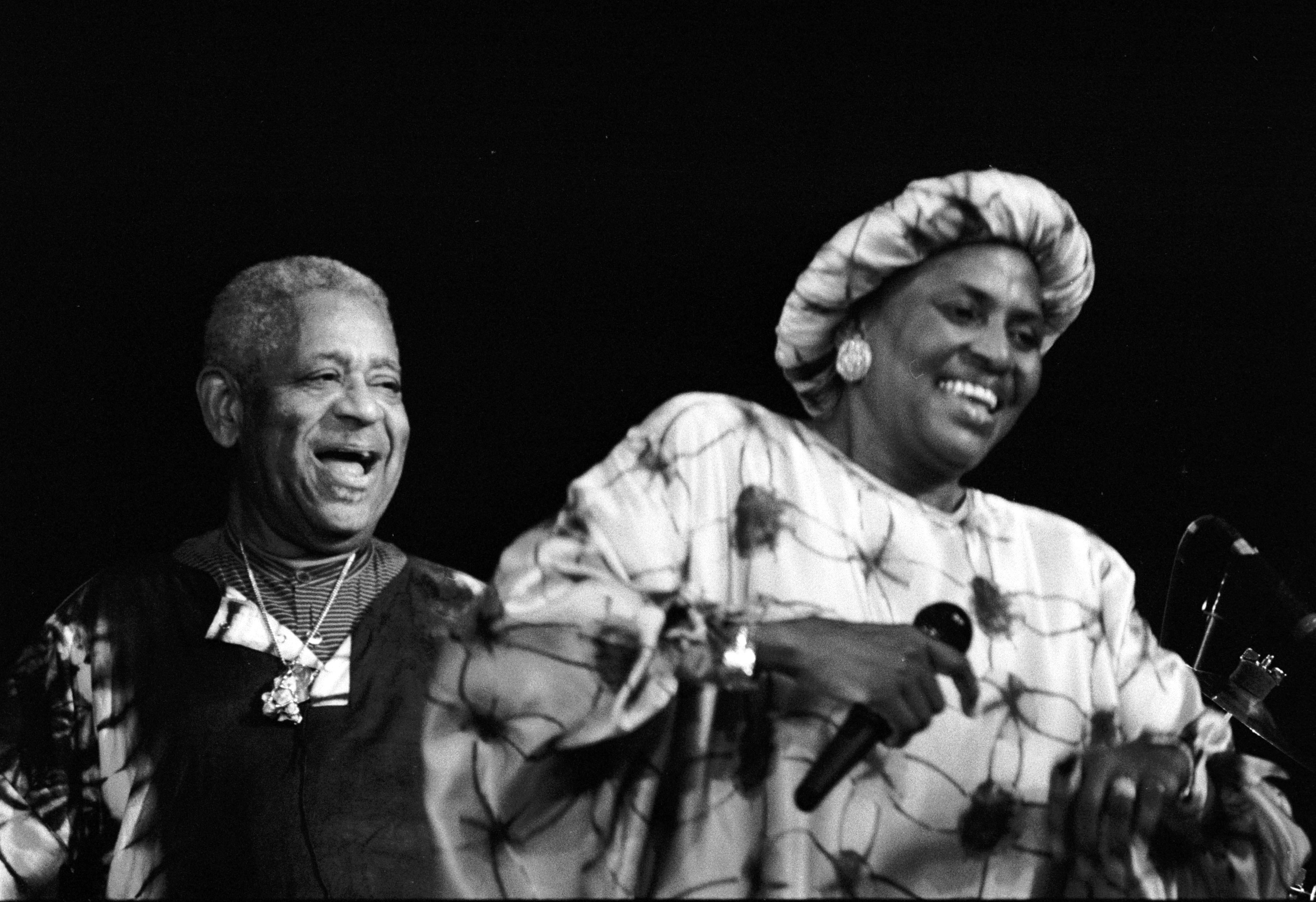
Miriam Makeba: ihr Leben, ihre Stimme, ihr Kampf und die Songs, die ein Land getragen haben
Südafrika • Musik • Widerstand Miriam Makeba: ihr Leben, ihre Stimme, ihr Kampf — und die Songs, die ein Land getragen haben Sie war nicht…
Artikel lesen
What is a good gift for a South African sports fan? 10 ideas for this Christmas
Hero image credit: Matti Blume, CC BY-SA 4.0, via Wikimedia Commons South Africa • Sport • Christmas gifts What is a good gift for a…
Artikel lesen
Der Cape Doctor: Warum ist Kapstadt so windig?
Foto mit freundlicher Genehmigung von: KodachromeFan, CC BY-SA 3.0 , über Wikimedia Commons. Kapstadt • Wetter • Wind & Jahreszeiten Der Cape Doctor & die…
Artikel lesen
Kulturelle Sensibilität als ausländische Person in Kapstadt, Südafrika
Kapstadt • Kultur & Kontext Kulturelle Sensibilität und der Umgang mit Rassismus als ausländische Person in Kapstadt Kapstadt ist atemberaubend – und kompliziert. Die Stadt…
Artikel lesen