Cape Town Airport Fire: What Happened on 24 February 2026
February 25, 2026
The Fire at Cape Town International Airport: What We Know So Far
On 24 February 2026 — the day before South Africa's budget speech — an electrical cable fire plunged Cape Town International Airport into darkness. Flights were suspended, thousands of passengers were stranded with no information, and staff appeared just as lost as the people they were supposed to guide. Here's a full breakdown of what happened, what went wrong, and what it tells us about the state of South Africa's critical infrastructure.
What happened: the timeline
Tuesday, 24 February 2026. A normal weekday morning at Cape Town International Airport — South Africa's second-busiest aviation hub and the primary gateway for Western Cape tourism and trade. The airport processed over 11 million passengers in 2025. The next day, Finance Minister Enoch Godongwana was scheduled to deliver the national budget speech in Cape Town, meaning the city was already busy with an influx of politicians, business leaders, and media.
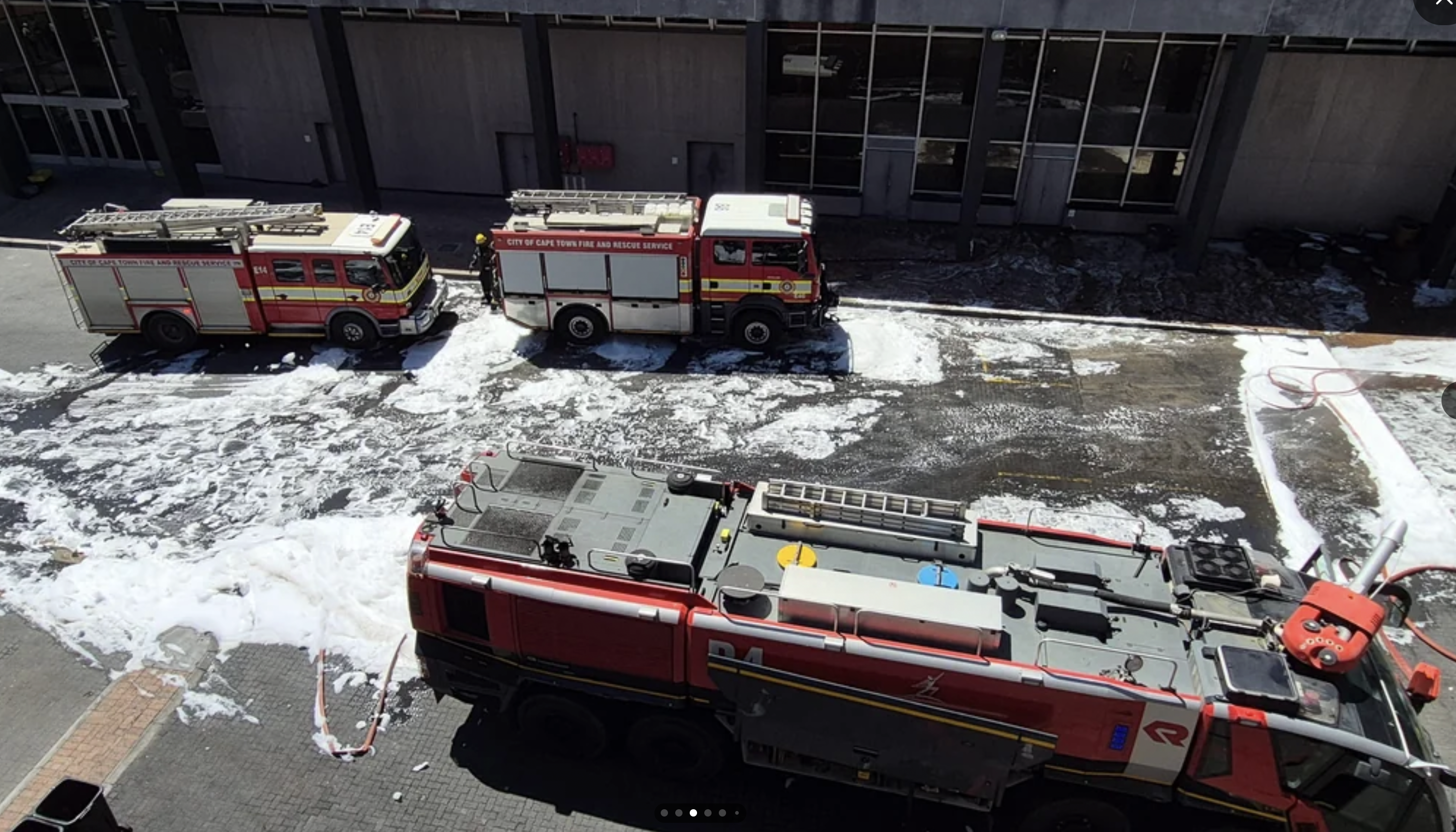
Then, at approximately 11:15 on Tuesday morning, a fire broke out in the Northern Service Yard on the landside of the airport. Within minutes, the consequences cascaded far beyond the flames themselves.
The suspected cause: an electrical cable fire
The official investigation is still under way, but the evidence available within the first day points clearly in one direction: an electrical infrastructure failure.
Visual evidence posted on social media showed thick bundles of heavy cabling engulfed in flames inside an exterior structural column, with fire and smoke venting from the top of the conduit. The Daily Maverick described the scene as a suspected IT cable fire, with images pointing to a major electrical blaze within the airport's infrastructure.
An airport employee present during the initial moments told News24 they suspected an electrical fire based on the smoke and its location. ACSA confirmed that the fire was on the "landside" of the airport and that it had knocked out network and IT services, including Wi-Fi and essential operational systems. A later update pinpointed the location as the Northern Service Yard.
Preliminary assessment
Preliminary reports suggest an electrical fault may have been behind the incident. The fire appears to have occurred within a cable conduit housing both power and data infrastructure — explaining why a single fire could simultaneously knock out lighting, network connectivity, check-in systems, baggage handling, and payment terminals in one stroke.
What makes this particularly concerning is the apparent single point of failure. Modern airports rely on layered redundancy — backup generators, distributed network infrastructure, and failover systems designed to keep critical operations running even when one component fails. At Cape Town International, a single cable fire appears to have brought almost everything down at once.
The cascade: what the fire took down
The fire itself was contained relatively quickly. But the systems failure it triggered was far more damaging than the flames. Here's what went offline:
■ Lighting & power Down
■ Display boards Down
■ Check-in systems Down
■ Baggage handling Down
■ Wi-Fi & network Down
■ Payment systems Down
This was, in the words of the eTurboNews analysis, less a fire event and more a technology failure event. The flames were contained quickly. The systems failure lasted for hours.
The communication vacuum
If the fire exposed an infrastructure vulnerability, the response exposed something arguably worse: a total failure of crisis communication.
Across multiple news sources and passenger accounts, a consistent picture emerges: for the first two or more hours of the crisis, passengers received essentially no official information from the airport itself.
“No one was giving us clear direction. The staff themselves looked lost.”
BusinessDay reported that an eyewitness observed hundreds of passengers filling the airport floor as systems went offline, with no official communication transmitted to the stranded travellers. The electronic display boards were down — but there were also no PA announcements, no printed notices, and no staff visibly deployed with information.
News24 journalists who visited the airport during the crisis found confused passengers stopping anyone they thought might work at the airport, desperately seeking answers. There were no functioning notice boards and no visible announcements informing people that flights had been suspended.
The core failure
When digital systems go down, airports need analogue fallback plans: PA systems on backup power, staff with printed information, visible signage at entry points warning arriving passengers. At Cape Town International on 24 February, none of these appeared to be in place at scale. An affected traveller told Daily Investor that passengers in parts of the airport unaffected by smoke received no communication at all during the fire and evacuation — and were simply left unattended when staff members left.
FlySafair was the first airline to communicate directly with passengers via SMS, confirming delays and the baggage system outage — but this came at approximately 13:50, nearly three hours after the fire started. ACSA's formal media statement was competent and clear, but it was directed at journalists and social media, not at the thousands of people standing in a darkened terminal with no idea what was happening.
A passenger arriving at the airport saw none of this
One of the most concerning aspects: people continued arriving at the airport throughout the afternoon, completely unaware that flights had been suspended. As one traveller told News24, people were still streaming in hours after the fire, with no public notice outside the terminal explaining the situation. The question of how to manage incoming pedestrian traffic when the airport itself is non-functional was raised by multiple passengers — and apparently went unanswered.
Evacuation: partial, confusing, inconsistent
ACSA's official statement urged passengers to "follow security instructions and proceed to designated places of safety as directed by airport personnel." The reality on the ground appeared considerably less organised.
The evacuation was partial. Sections of the International Terminal affected by smoke were cleared, and patrons at a Spur restaurant inside the airport complex were evacuated due to an emergency. Passengers in the baggage reclaim area were redirected to the emergency escape route at immigration.
But in other parts of the terminal, the situation was different. EWN reporter Nokukhanya Mntambo, who landed at the airport during the height of the crisis, reported that passengers were kept on their aircraft for nearly an hour while fire trucks worked to contain the blaze outside.
◆ Near the fire Evacuated
◆ Rest of terminal No clear protocol
The inconsistency is what made the experience so disorienting for passengers. In one part of the building, emergency protocols were activated. In another, people were queueing for flights that wouldn't depart. In another still, staff were simply absent.
The human cost: passenger accounts
No one was physically injured. But the disruption had real consequences for real people — and the stories that emerged paint a picture of frustration, helplessness, and in some cases genuine distress.
Mandy Govender — via News24
Chris van Rensburg — via News24
Linda Sobek — via TimesLive
Anonymous passenger — via IOL Weekend Argus
What stands out in every account is not anger at the fire itself — fires happen — but anger at being left in the dark, both literally and figuratively.
Not the first time: a pattern of power failures
The 24 February fire would have been alarming enough as an isolated incident. But it is not isolated. Cape Town International Airport has experienced multiple significant power failures in recent years, raising serious questions about the state of its electrical infrastructure.
Three incidents in 14 months
Between January 2025 and February 2026, Cape Town International Airport experienced at least three major electrical or power-related failures. Two occurred within the same month (February 2026). Each time, the core problem was the same: a single infrastructure failure cascading into widespread systems collapse. Each time, passengers bore the consequences. The question is no longer whether Cape Town's airport has an infrastructure problem. The question is why it hasn't been fixed.
The questions that need answers
ACSA has confirmed that a full investigation is under way. Based on the available reporting, here are the questions that investigation should address:
1. Why did one fire take down everything?
2. What was the state of the cabling?
3. Why was there no communication plan?
4. Why were passengers not evacuated consistently?
5. What happened to arriving passengers?
6. What has changed since 2024?
The timing: one day before the budget speech
The fire occurred the day before Finance Minister Enoch Godongwana's 2026 national budget speech in Cape Town — an event that annually draws hundreds of business leaders, politicians, and journalists to the city. The Mail & Guardian noted that the airport serves as an essential connector for both domestic and international travel, and that interruptions can cascade across airlines, logistics networks, and the tourism sector.
Whether the timing affected the political response remains to be seen. But the optics are stark: South Africa's second-busiest airport failed catastrophically on the eve of the country's most important economic policy announcement of the year.
If you're travelling: what to do
Practical advice
- Check the ACSA app for real-time updates before heading to the airport
- Contact your airline directly to confirm flight status — don't rely on airport systems alone
- Carry cash as a backup in case card payment systems go down
- Travel with carry-on if possible during periods of disruption — baggage handling is often the last system to come back online
- Check in online before arriving at the airport
- Keep your phone charged — you may need to use it as a torch and your only source of information
- Have a backup plan for accommodation in case you're stranded — not everyone can rebook a hotel at short notice
- If you're being picked up: monitor news and social media before driving to the airport — in the February incident, arriving passengers created additional congestion with no system to manage them
Power has been restored and operations have resumed, but ACSA has warned that delays may persist as IT systems stabilise. If you are travelling through Cape Town International in the coming days, build in extra time and stay in contact with your airline.
Bottom line
Nobody was hurt. The fire was put out within about 30 minutes. In that narrow sense, the emergency response worked. But the broader response — the communication, the passenger management, the infrastructure resilience — failed comprehensively.
Thousands of people were left in a darkened terminal with no information, no updates, and no visible plan. Staff appeared overwhelmed. Airlines were slow to communicate. New passengers kept arriving with no one to turn them around. People missed memorial services, connecting flights, and business engagements. And all of this happened not for the first time, but for at least the third time in 14 months at the same airport.
As eTurboNews put it, this incident may ultimately be remembered less as a fire and more as a technology failure event — one that exposed how fragile the digital systems underpinning a major international airport really are, and how poorly prepared the airport was to cope when those systems failed.
Cape Town International Airport is a critical piece of South Africa's economic and tourism infrastructure. It deserves backup systems that actually work, communication plans that don't depend on electricity, and a management culture that treats passengers as people who need information — not obstacles to be managed with silence.
The investigation will determine what caused the cables to catch fire. But the harder questions are about what happens next. Will the infrastructure be upgraded? Will communication protocols be rewritten? Will there be accountability? Or will we be writing this article again in six months?
Sources & references
This article draws on reporting from:
- News24: Power restored, operations resuming after Cape Town airport fire (24 Feb 2026)
- Daily Maverick: Suspected IT cable fire at Cape Town International halts international flights (24 Feb 2026)
- Bloomberg: Fire, Power Outage Disrupt Cape Town International Airport Operations (24 Feb 2026)
- BusinessDay: Fire halts Cape Town airport operations (24 Feb 2026)
- IOL / Weekend Argus: Fire at Cape Town International Airport leaves passengers confused and evacuated (24 Feb 2026)
- TimesLive: Fire disrupts travel at Cape Town International Airport (24 Feb 2026)
- EWN: Blaze at Cape Town International Terminal sparks chaos and flight delays (24 Feb 2026)
- EWN: International operations resume after fire-induced power failure (24 Feb 2026)
- Daily Investor: Major disruptions at key South African international airport (24 Feb 2026)
- Mail & Guardian: Fire at Cape Town International Airport halts flights (24 Feb 2026)
- eTurboNews: Cape Town Airport Fire Disrupts Flights — Safety Questions and Travel Chaos Explained (24 Feb 2026)
- SABC News: Fire at Cape Town International Airport contained (24 Feb 2026)
- Cape Times: Power restored at Cape Town International Airport following fire (24 Feb 2026)
- Daily Voice: Chaos and panic as fire strikes Cape Town International Airport (24 Feb 2026)
- Hypertext: What happened after the power cut at Cape Town Airport (Jan 2025, prior incident)
- News24: Travellers slam Cape Town airport over 'chaos' during blackout (4 Feb 2026, prior incident)
- Reddit r/capetown: Fire at CTIA in Terminal A under control, check in… (24 Feb 2026, eyewitness photo and discussion)
Disclaimer
Information compiled as of 25 February 2026. The official investigation into the fire is ongoing. Conclusions about the cause are preliminary and based on available reporting. This article will be updated as verified findings are published. Always check ACSA and airline channels for the latest operational status.
You May Also Like

Cape Town Tourism in 2026: Record Numbers, New Hotels, and the Risks Ahead
Photo courtesy of Dietmar Rabich, Wikimedia Commons, licensed under CC BY-SA 4.0 Cape Town Tourism in 2026: Record Numbers, New Hotels, and the Risks Ahead…
Read Article
MyCiTi Phase 2A: Can a Bus Route Fix Apartheid's Spatial Legacy?
Photo courtesy of Dietmar Rabich, Wikimedia Commons, licensed under CC BY-SA 4.0 MyCiTi Phase 2A: Can a Bus Route Fix Apartheid's Spatial Legacy? | Cape…
Read Article
What is going on politically in Cape Town and South Africa in 2026
Photo: Cape Town CBD skyline at dusk. Via Wikimedia Commons , CC BY-SA 4.0. Cape Town Data · Political Analysis Where Things Stand: South Africa's…
Read Article
What's up in Cape Town ? The Weekly | 23-29 March 2026
Edition #10 · 23-29 March 2026 The Cape Town Weekly Your guide to the Mother City Africa's Grandest Gathering returns to the CTICC on Friday…
Read Article
What is the City of Cape Town doing about the N2 safety issues?
Photo courtesy of Diego Delso, Wikimedia Commons, licensed under CC BY-SA 4.0 Where Does Cape Town's R84 Billion Go? | 2025/26 City Budget Analysis Municipal…
Read Article