Are White People Oppressed in South Africa ?
May 14, 2025

South Africa • Politics & Society
“White Genocide” in South Africa? Why is Trump targeting South Africa?
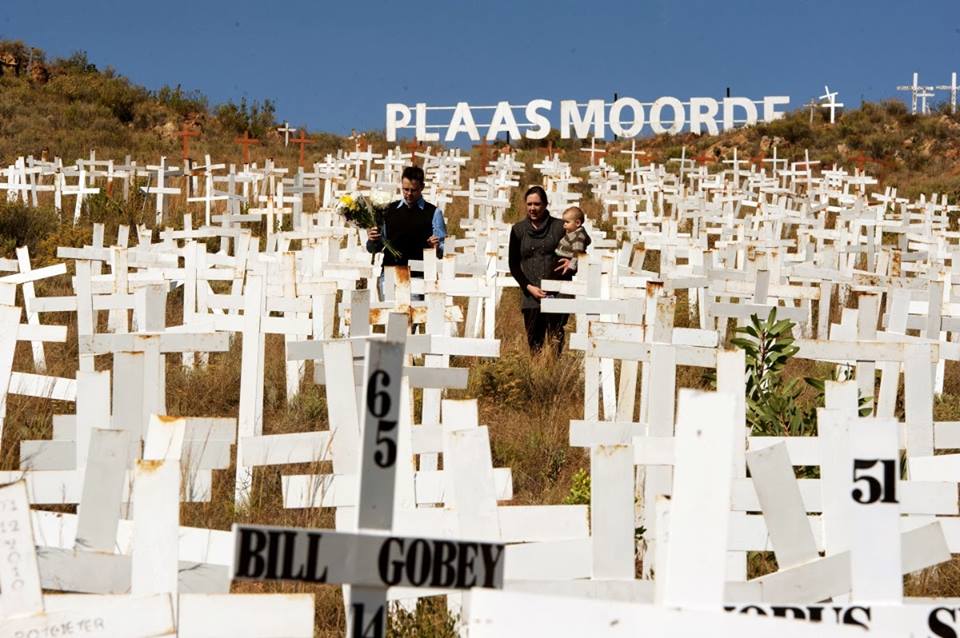
In May 2025, 59 white Afrikaner farmers landed in Washington — greeted by Donald Trump as “refugees from racial persecution.” The images spread across the world. For Trump, it was a welcome stage: he cast himself as the protector of “persecuted Christians,” spoke of an impending “white genocide” in South Africa, and struck precisely the emotional chord of his core electorate.
Trump’s Stage: Hyperbole as Headline
Trump inflated a complex social reality into a moral drama: “innocent white farmers” versus “brutal black attackers.” The story taps into fears of reversed power structures — a projection long cultivated in far-right online circles. His rhetoric relies on hyperbole (a rhetorical device of exaggeration used to argue more aggressively), victim imagery, and selective fact-picking to transform pity into political approval.
The calculation is transparent: whoever talks about “persecuted whites” avoids talking about structural racism, police violence, or social inequality. The myth functions as a mirror in which Trump’s voters see themselves validated — not as a reflection of South Africa’s reality.
1 · Reality Check: Who Owns the Land?
White South Africans make up around 8% of the population but still own roughly 75% of private farmland. Black South Africans — roughly 80% of the population — own very little agricultural land. The claim that whites are being systematically dispossessed does not withstand scrutiny.
Programs like land reform or “Black Economic Empowerment” are not designed for punishment but for balance: they aim to correct a deep economic imbalance that has persisted for centuries.
2 · Crime Facts — Not Myths
Yes, South Africa is violent. But in 2023, the police recorded 49 farm murders — out of more than 27,000 murders in total. That’s about 0.2%. There is no targeted, racially motivated campaign.
Data overview: Farm murders are relatively rare, declining, and affect people of all races. Motives are usually robbery or property crimes — not ethnic “cleansing.”
| Year | Farm murders | Source |
|---|---|---|
| 2018 | 47 | AgriSA |
| 2019 | 45 | AfriForum |
| 2020 | 63 | AfriForum |
| 2021 | 55 | AfriForum |
| 2022 | 50 | ISS/SAPS |
| 2023 | ≈ 50 | ISS/Estimate |
| 2024 (Q3) | 1 case | SAPS Report |
3 · Who Is Really Suffering?
While unemployment among whites remains stable in the single digits, over 30% of Black South Africans are jobless. In the executive suites of South African companies, whites still dominate — holding two-thirds of all leadership positions. This disparity is no coincidence but the enduring legacy of an economic system that, for decades, categorized people by race.
The real divide in South Africa does not run along ethnic lines but social ones: between those who could inherit and those who were denied ownership for generations. The supposed “reversal of apartheid” — a favorite trope among right-wing commentators abroad — simply does not exist. Those who truly suffer today are not wealthy farmers but millions of Black South Africans who, despite democratic freedom, continue to live in the shadow of structural poverty.
And that reality is hard to emotionalize. It lacks the simple good-versus-evil narrative that Trump needs for his story. The figure of the “persecuted white” in South Africa fits perfectly into his worldview and political agenda: a symbol of an allegedly endangered Western identity that seamlessly merges into the rhetoric of the “forgotten white man” in the United States. For Trump, this is not about South Africa — it is a mirror of America.
Conclusion — Political Theater, Not Humanitarian Concern
Trump’s tale of “white genocide” is not a humanitarian plea but political theater — staged, exaggerated, calculated. It transforms a complex social fabric into a simple moral tale: innocent victims here, barbaric perpetrators there. The narrative follows the oldest rule of populist communication — stoke fear, promise identity, harvest outrage.
For Trump, South African farmers are not figures of fate but props on his political stage — interchangeable symbols in a drama that serves only his own campaign. Their stories are shortened, their suffering instrumentalized, their existence turned into a parable about supposedly “persecuted whites.” What emerges is not solidarity but a caricature of reality, designed for one purpose: Trump’s return to the spotlight as both victim and savior.
The “white genocide” myth thus works like a distorted mirror: it reflects not South Africa, but the fears and projections of a politics built on polarization. And that is where its danger lies — not in what it describes, but in what it conceals.
Farm murders < 0.2% of all homicides White population ≈ 8% Trump exploits hyperbole & fear imagery
Sources
- Al Jazeera — “Trump administration welcomes 59 white South Africans” (12 May 2025)
- Reuters — Land ownership analysis (2024)
- SAPS — Statistical report on farm murders (2024)
- Associated Press — U.S. churches criticize preferential resettlement (2025)
- Statistics South Africa — QLFS Q1 2025
Official police data and research reports confirm: farm murders are rare, socially driven, and no proof of a “persecution of whites” — but they do reveal South Africa’s broader crisis of violence and inequality.
More in Culture & Identity
- Navigating Cultural and Racial Sensitivity as a Foreigner in Cape Town, South Africa
- PART II: The South African Miracle: Lessons in Forgiveness, Unity, and Nation-Building
- PART I: The South African Miracle: Lessons in Forgiveness, Unity, and Nation-Building
- Who are Afrikaners and what is Afrikaans culture in South Africa
- Racism Part 3: A Guide for Foreigners Navigating South Africa’s Racial Dynamics
- Racism Part 2: Recent Incidents and Current Racial Tensions
You May Also Like

Abdullah Ibrahim in 2026: A Living Legend Returns to Cape Town International Jazz Festival CTIJF
Editorial feature · capetowndata.com · March 2026 Photo courtesy of Patrick Scales, Wikimedia Commons, licensed under CC BY 3.0 CTIJF 2026 · Cape Jazz ·…
Read Article
Miriam Makeba: the life, the voice, the fight and the songs that carried a country
Photo courtesy of: Roland Godefroy (CC BY 3.0), via Wikimedia Commons South Africa • Music • Resistance Miriam Makeba: the life, the voice, the fight…
Read Article
What is a good gift for a South African sports fan? 10 ideas for this Christmas
Hero image credit: Matti Blume, CC BY-SA 4.0, via Wikimedia Commons South Africa • Sport • Christmas gifts What is a good gift for a…
Read Article
The Cape Doctor: Why is Cape Town so windy?
Photo courtesy of: KodachromeFan, CC BY-SA 3.0 , via Wikimedia Commons. Cape Town • Weather • Wind & Seasons The Cape Doctor & Cape Town…
Read Article
Get Your Shoes Ready for the 2026 Two Oceans Marathon
Photo courtesy of Bernard303 , CC BY-SA 4.0 , via Wikimedia Commons Photo: „Clean water for a village in West Lombok“ , author Josh Estey/AusAID…
Read Article